
Chapter 4 - A Question of Trust (Ncert Solutions) for Class 10 English
Ultimate NCERT Solutions for Chapter 4 – A Question of Trust
Updated Solution 2024-2025 Updated Solution 2024-2025
NCERT Solutions for Class 10 English, Chapter 4 A Question of Trust
(Question/Answers, summary)
Chapter 4 A Question of Trust
(Summary of Chapter 4: A Question of Trust)
The story A Question of Trust by Victor Canning revolves around a clever thief, Horace Danby, who considers himself a gentleman burglar. He steals only once a year, carefully planning his heists to maintain a comfortable life. His latest target is a wealthy woman’s house, where he intends to steal valuable jewels.
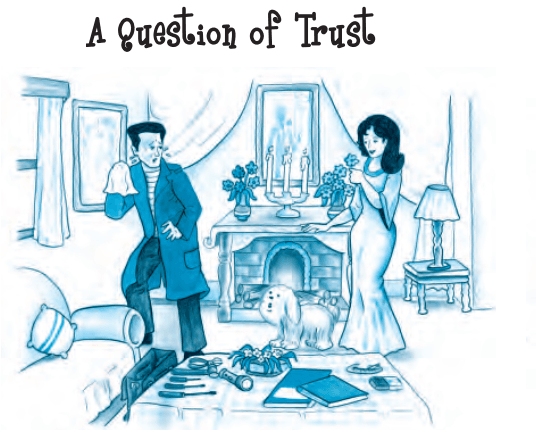
As Horace breaks into the house and begins his work, a charming and confident woman catches him red-handed. She claims to be the owner and cleverly manipulates him, pretending to need his help in opening the safe because she has forgotten the combination. Trusting her, Horace opens the safe, only to realize later that he has been deceived—the woman is actually another thief.
In the end, Horace gets caught by the police because his fingerprints are found at the crime scene, while the mysterious woman escapes with the jewels. This ironic twist highlights the theme of deception and misplaced trust.
READ AND FIND OUT
Q 1. What does Horace Danby like to collect?
Ans 1: He had a passion for collecting unique and valuable books.
Q 2. Why does he steal every year?
Ans 2: He committed theft to acquire rare and costly books that he cherished for reading and collecting. By breaking into a single safe, he was able to steal enough money to support himself for a whole year.
READ AND FIND OUT
Q 1. Who is speaking to Horace Danby?
Ans 1: A different woman, pretending to be the lady of the house, is engaged in conversation with him.
Q 2. Who is the real culprit in the story?
Ans 2: In the story, the true mastermind was the young woman who masqueraded as the lady of the house. She successfully made off with the stolen goods, while Horace Danby, who left his fingerprints on the safe when he opened it without gloves, ultimately revealed himself as the real culprit.
THINK ABOUT IT
Q 1. Did you begin to suspect before the end of the story, that the lady was not the person Horace Danby took her to be? If so, at what point did you realise this, and how?
Ans 1: When the lady entered the scene after Horace sneezed, her initial reaction raised some doubts in my mind. A genuine mistress of the house would likely feel either anger or fear upon encountering a burglar, rather than remaining so composed.
Additionally, her comment about always being attracted to the wrong kind of person further fueled my suspicions. She mentioned, “Before we left for London, I promised my husband I would take my jewels to the bank, but I left them on the shelf. I need them for a party tonight, so I came down to retrieve them.” This explanation seems rather unconvincing. How could she forget the combination to the safe if her sole purpose for coming down was to access it? Her willingness to let Horace break into the safe raises more questions. Why is she so eager to wear those jewels?
All these points reinforce my suspicion that she is not the true mistress of the house, but rather an imposter.
Q 2. What are the subtle ways in which the lady manages to deceive Horace Danby into thinking she is the lady of the house? Why doesn’t Horace suspect that something is wrong?
Answer 2: The woman in red cleverly employed subtle tactics to convince Horace that she was the true mistress of the house. One of her strategies involved forming a bond with the household dog, Sherry. For instance, she casually remarked, “Don’t worry, Sherry; no one would think I’ve been gone for a month,” which showcased her familiarity with the pet. Her confident stride towards the fireplace, where she adjusted the ornaments, further reinforced her authoritative presence. These small yet significant actions, combined with her commanding voice, led Horace to be entirely convinced of her role as the lady of the house.
Additionally, she intimidated Horace by threatening to report him to the police. When people are frightened, they often lose their ability to think clearly and rationally. In his vulnerable state, Horace was easily swayed by the woman, leaving him unable to suspect that something was amiss.
Q 3. “Horace Danby was good and respectable—but not completely honest.” Why do you think this description is apt for Horace? Why can’t he be categorised as a typical thief?
Ans 3: Horace Danby was not a typical criminal; he was a skilled locksmith who ran a successful business with the help of two assistants. Although he was generally a good and respectable person, he had a few dishonest tendencies. Each year, he planned a carefully thought-out heist to steal from a safe, which provided him with the funds to purchase rare and valuable books. Unlike many thieves, Horace didn’t steal indiscriminately; his annual theft was a calculated endeavor rather than a full-time profession.
Q 4. Horace Danby was a meticulous planner but still he faltered. Where did he go wrong and why?
Answer 4: Horace Danby was known for his meticulous planning when it came to committing robberies. He would carefully observe the houses he targeted, studying the layout, the wiring systems, and even the schedules of the household staff. Always equipped with the right tools and wearing gloves to avoid leaving fingerprints, he had successfully eluded capture up to that point.
On this particular occasion at Shot over Grange, Danby had once again conducted thorough reconnaissance and was well-prepared. However, he encountered an unexpected challenge. Suffering from hay fever, he sneezed, which drew the attention of the lady of the house. She threatened to call the police, striking fear into Danby’s heart. In an attempt to appease her, he removed his gloves to light her cigarette, which was a critical mistake. He then opened the safe without his gloves on, leaving his fingerprints everywhere, including on the safe itself. This slip ultimately led to his arrest.
Chapter 4 A Question of Trust
Updated Solution 2024-2025
TALK ABOUT IT
Q 1. Do you think Horace Danby was unfairly punished, or that he deserved what he got?
Ans 1: I don’t believe Horace Danby was unjustly punished for his actions. He entered Shot over Grange with the intention of robbing the safe, but his plan was thwarted by a woman in a red dress who pretended to be the mistress of the house. She cleverly deceived him, escaping with the stolen goods while he left empty-handed. Had she not intervened, he would have successfully committed the crime.
In my view, a crime should be met with appropriate consequences, and Horace received the punishment he warranted. However, it’s important to note that the lady’s actions were equally questionable. She lacked honor among thieves; instead of sharing the spoils or advising him to wear gloves to avoid detection, she simply deceived him and fled with the loot. Therefore, she too should not escape accountability, as she was guilty of deceit and theft.
Q 2. Do intentions justify actions? Would you, like Horace Danby, do something wrong if you thought your ends justified the means? Do you think that there are situations in which it is excusable to act less than honestly?
Ans 2: I firmly believe that a person’s intentions do not automatically justify their actions. Both the means and the ends should be ethical, fair, and just. While an individual may perceive their intentions as good, others might see them differently. A historical example is Adolf Hitler, who, driven by a misguided belief in racial superiority, inflicted immense suffering on countless Jews. Similarly, many religious extremists, like Aurangzeb, have committed violence against others to promote their own beliefs. Their intentions may have seemed justified to them, but the means they employed were far from acceptable.
I align with the philosophy of Mahatma Gandhi and other wise figures who advocate that both the means and the ends must be virtuous.
I would not have acted like Horace Danby. Although his intention to buy and read books stemmed from a personal desire for pleasure, it did not contribute positively to society or his community.
However, I do acknowledge that there are certain situations where acting with less than complete honesty might be excusable. For instance, if a butcher were pursuing a cow with the intent to kill it and asked me where the cow had gone, I would choose to lie and misdirect him to save the cow’s life. In this scenario, I believe that my dishonesty serves a greater good, and I do not consider it a crime or a sin.
Chapter 4 A Question of Trust – Updated Solution 2024-2025
This complete solution is prepared as per the latest syllabus of 2024-25. If you have any further queries, feel free to ask! 😊