
Chapter 8 - Bholi (Ncert Solutions) for Class 10 English
Ultimate NCERT Solutions for Chapter 8 – Bholi
Updated Solution 2024-2025 Updated Solution 2024-2025
NCERT Solutions for Class 10 English, Chapter 8 – Bholi
(Question/Answers, summary)
Chapter 8 – Bholi
Summary of Chapter 8: Bholi (Eng)
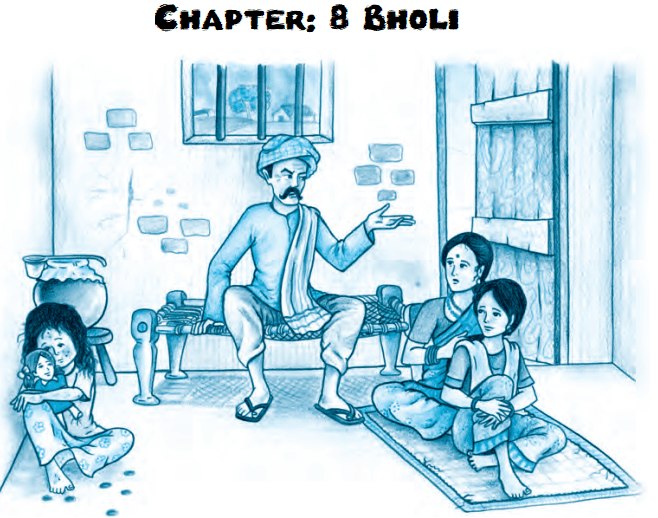
“Bholi” is a touching story written by K.A. Abbas, highlighting the importance of education and self-respect. The story revolves around Bholi, a young girl named Sulekha, who was considered simple and dull due to childhood injuries and a speech defect. She was neglected by her family and treated as a burden.
One day, she was sent to school reluctantly, but there she found encouragement and kindness from her teacher. With time, education transformed her into a confident and intelligent young woman.
Later, when her parents arranged her marriage with an aged and greedy man, Bholi boldly refused to marry him, asserting her dignity and self-respect. She chose to stay back and take care of her parents, proving that education can empower even the weakest.
The story delivers a strong message about women’s empowerment, self-respect, and the role of education in transforming lives.
Summary of Chapter 8: Bholi (In Hindi)
“भोली” एक मार्मिक कहानी है, जिसे के. ए. अब्बास ने लिखा है। यह शिक्षा और आत्म-सम्मान के महत्व को उजागर करती है। कहानी भोली नामक एक लड़की, जिसका असली नाम सुलेखा था, के इर्द-गिर्द घूमती है। बचपन में लगी चोटों और बोलने की समस्या के कारण उसे सीधा-सादा और मंदबुद्धि समझा जाता था। उसका परिवार उसे नजरअंदाज करता था और एक बोझ मानता था।
एक दिन, अनिच्छा से उसे स्कूल भेजा गया, जहाँ उसकी शिक्षिका ने उसे प्रोत्साहन और स्नेह दिया। समय के साथ, शिक्षा ने उसे एक आत्मविश्वासी और बुद्धिमान युवती में बदल दिया।
बाद में, जब उसके माता-पिता ने उसका विवाह एक उम्रदराज़ और लालची व्यक्ति से तय कर दिया, तो भोली ने साहसपूर्वक इस शादी से इनकार कर दिया और अपने आत्म-सम्मान की रक्षा की। उसने अपने माता-पिता के साथ रहकर उनकी देखभाल करने का निर्णय लिया, यह साबित करते हुए कि शिक्षा सबसे कमजोर व्यक्ति को भी सशक्त बना सकती है।
यह कहानी नारी सशक्तिकरण, आत्म-सम्मान और शिक्षा के जीवन-परिवर्तनकारी प्रभाव का एक शक्तिशाली संदेश देती है।
Chapter 8: Bholi Question Answers
READ AND FIND OUT
Q 1. Why is Bholi’s father worried about her?
Answer 1: Ramlal’s other children were all healthy and attractive, making it easy for them to find suitable matches. However, Bholi was not as fortunate; she was neither particularly beautiful nor intellectually gifted, which caused her father to worry about her future.
Q 2. For what unusual reasons is Bholi sent to school?
Answer 2: Bholi’s father, Ramlal, served as a revenue officer in the village. When a primary school for girls was established, the Tehsildar came to inaugurate it and urged Ramlal to send his daughters to school to inspire others in the community. Although Ramlal felt pressured to comply with the Tehsildar’s request, his wife was initially resistant. She believed that sending their daughters to school would harm their prospects for good marriages, a common concern at the time. Eventually, she reluctantly agreed to allow Bholi to attend school, reasoning that Bholi, with her pockmarked face and perceived lack of intelligence, had slim chances of finding a suitable husband anyway.
READ AND FIND OUT
Q 1. Does Bholi enjoy her first day at school?
Answer 1: In her first experience at school, Bholi was completely unfamiliar with what to expect. As she entered the classroom and saw many girls her age, she felt a wave of happiness wash over her. She hoped to make new friends. The colorful pictures of animals decorating the walls caught her attention, and she couldn’t help but compare them to the animals she had seen in her surroundings.
However, her joy was momentarily overshadowed when the teacher asked for her name. Bholi stammered, and the laughter of her classmates made her feel disheartened. In that moment of vulnerability, tears welled up in her eyes. But then, she heard the gentle, reassuring voice of her teacher. The teacher’s kind and encouraging demeanor gave Bholi a sense of comfort and a glimmer of hope. She realized that with time, she could overcome her stammer, gain an education, and earn the respect of others.
By the end of the day, Bholi felt a renewed sense of excitement and happiness about her new journey at school.
Q 2. Does she find her teacher different from the people at home?
Answer 2: The teacher’s gentle and sweet voice, along with her supportive and encouraging demeanor, set her apart from the people at home. Unlike anyone in her family, the teacher spoke to her with kindness and consideration, making her feel truly valued.
Chapter 8 – Bholi
Updated Solution 2024-2025
READ AND FIND OUT
Q 1. Why do Bholi’s parents accept Bishamber’s marriage proposal?
Answer 1: Ramlal agreed to Bishamber’s proposal. Bishamber was a prosperous shopkeeper, owning a large store and a house. Notably, he did not request any dowry. However, his age and a slight limp were considered drawbacks. He was the same age as Ramlal.
Ramlal’s wife also supported the match. She remarked that Bholi was fortunate to have a suitor from another village who was unaware of her shortcomings, such as her lack of understanding and her pockmarks. She noted that if they turned down the proposal, Bholi might remain unmarried for the rest of her life.
Q 2. Why does the marriage not take place?
Answer 2: In the moment when Bishamber placed the garland around Bholi’s neck, he spotted her pockmarks. He then demanded a dowry of Rs. 5,000 as a condition for the marriage. Ramlal, Bholi’s father, accepted this request. However, Bholi was determined not to marry a greedy and selfish man like Bishamber, especially one who was much older and lame. As a result, the wedding did not take place.
THINK ABOUT IT
Q 1. Bholi had many apprehensions about going to school. What made her feel that she was going to a better place than her home?
Answer 1: Bholi had no idea of a school. She had many apprehensions and that like their cow Lakshmi, she was also being turned out of the house. She was reluctant to go to school. But when she was given a both, decent clothes to wear, her hair were oiled and combed she thought she was being taken to a place better than their home.
Q 2. How did Bholi’s teacher play an important role in changing the course of her life?
Answer 2: When everyone else overlooked Bholi and treated her poorly, her teacher showed her kindness and understanding. From her very first day at school, Bholi’s teacher used a gentle and encouraging voice to inspire hope for a brighter future.
She reassured Bholi that there was nothing to fear, which would help her overcome her stammering. The teacher emphasized the importance of education, explaining that it would earn her respect and help her find her voice. With an education, Bholi would become more confident and independent.
The teacher was instrumental in transforming Bholi’s life. She nurtured her into a confident, courageous, and self-respecting individual. No longer the timid girl she once was, Bholi grew into a strong woman who had the bravery to reject a marriage proposal from a greedy, old man.
Q 3. Why did Bholi at first agree to an unequal match? Why did she later reject the marriage? What does this tell us about her?
Answer 3: Initially, Bholi agreed to marry a lame, elderly widower with grown children, believing that her refusal would only add to her parents’ worries. However, during the ceremony, when Bishamber noticed the pockmarks on Bholi’s face, he demanded a hefty compensation of Rs. 5,000 before he would place the garland around her neck. Bholi’s father, humiliated, pleaded with him to reconsider, but Bishamber stood firm in his demand.
This situation ignited a sense of self-respect within Bholi. She courageously rejected the marriage, refusing to accept the proposal from such a greedy and inconsiderate man. Her actions demonstrated that she was no longer the timid girl she once was; she had transformed into a bold, confident young woman who could make her own choices. Not only did she have the confidence to support herself as a teacher, but she was also determined to care for her parents in their old age.
Q 4. Bholi’s real name is Sulekha. We are told this right at the beginning. But only in the last but one paragraph of the story is Bholi called Sulekha again. Why do you think she is called Sulekha at that point in the story?
Answer 4: Sulekha, often referred to as ‘Bholi,’ which translates to a simpleton or foolish girl, embodies innocence throughout most of the story. Up until the conclusion, there are no events that suggest she has evolved beyond this characterization. However, in the end, when Bholi courageously refuses to marry a mean, disabled, and greedy old man, it becomes clear that she has gained significant wisdom. This pivotal moment reveals that she is no longer the naive girl she once was. As a result, the narrator finds it appropriate to drop the name ‘Bholi’ in favor of her true name, Sulekha.
TALK ABOUT IT
Q 1. Bholi’s teacher helped her overcome social barriers by encouraging and motivating her. How do you think you can contribute towards changing’ the social attitudes illustrated in this story
Answer 1: In my neighborhood, many families hire part-time maids to assist with household chores. Last year, when our longtime maid returned to her village, we hired a new one who brought her eight-year-old daughter with her. One day, I asked her why she didn’t send her daughter to school.
The maid replied, “Her two older brothers are already in school, and I can’t afford any more expenses for education. Besides, what will she do after school? She will just be doing household chores like me. It’s not like she can become a professional or work in an office like your mother does.”
I responded, “Why not? She can achieve those things if she gets an education. Also, in government schools, there are no fees, especially for girls.”
She countered, “But what about the cost of books, notebooks, and a uniform? I can’t manage that.”
I reassured her, “Don’t worry about those expenses. I’ll cover them with my pocket money each year.”
After some hesitation, she agreed. I began tutoring Pooja, her daughter, for an hour each day. By April, after just three months of learning, Pooja was admitted to the third grade. She is quite bright and consistently ranks first in her class on every test.
Both the maid and her daughter are thrilled about this opportunity. I feel proud to have helped change the maid’s perspective on education. My mother has joined me in this effort and has promised to support Pooja’s education even through her higher studies after she finishes twelfth grade.
Q 2. Should girls be aware of their rights, and assert them? Should girls and boys have the same rights, duties and privileges? What are some of ways society treats them differently? When we speak of human rights’, do we differentiate between girls’ rights and boys’ rights?
Answer 2: It is essential for girls to not only understand their rights but also to actively assert them. Unfortunately, many young women remain unaware of their entitlements, which can lead to exploitation and prevent them from receiving what they deserve. Both boys and girls are entitled to equal rights and privileges, and the law supports this by ensuring equality in property rights and other important matters. Today, women are increasingly taking on roles traditionally dominated by men, including positions as pilots, engineers, administrative officials, police officers, and even bus and taxi drivers, though the latter remains uncommon. Despite their achievements, women are still underrepresented in many fields.
The outdated notion that women should be confined to household duties persists, particularly in rural areas where awareness is limited. Often, societal norms restrict women’s freedom, preventing them from moving about alone or at night due to concerns about their safety and perceived physical vulnerabilities.
In many rural communities, where education and awareness are lacking, boys often receive preferential treatment in various aspects, including access to food and nutrition. There exists a deeply ingrained myth that a family’s honor is tied to having sons, who are traditionally seen as the ones to perform last rites for their parents. This belief perpetuates the idea that a father’s lineage ends without a son, leading to tragic consequences, including the killing of female infants and even the termination of pregnancies upon discovering the sex of the fetus. While the government is making efforts to combat these issues by criminalizing sex-selective practices, it will take time to dismantle these long-held beliefs and societal norms.
Q 3. Do you think the characters in the story were speaking to each other in English? If not, in which language were they speaking? (You can get clues from the names of the persons and the non-English words used in the story.)
Answer 3: I believe the characters in the story are not conversing in English. Their names, such as Bholi, Bishamber, and Ramlal, are distinctly Hindi. Additionally, the presence of specific Hindi terms like “Izaat” and “Pitaji” indicates that they likely communicate with one another in Hindi.
Chapter 8 – Bholi – Updated Solution 2024-2025
This complete solution is prepared as per the latest syllabus of 2024-25. If you have any further queries, feel free to ask! 😊