
Chapter 9 - The Book That Saved the Earth (Ncert Solutions) for Class 10 English
Ultimate NCERT Solutions for
Chapter 9 – The Book That Saved the Earth
Updated Solution 2024-2025 Updated Solution 2024-2025
NCERT Solutions for Class 10 English, Chapter 9 The Book That Saved the Earth
(Question/Answers, summary)
Chapter 9 The Book That Saved the Earth
“SUMMARY”
Summary of Chapter 9: “The Book That Saved the Earth” (Eng)
“The Book That Saved the Earth” is a humorous science-fiction play written by Claire Boiko. The story is set in the 25th century and revolves around an unusual event that took place in the 20th century when Martians attempted to invade Earth.
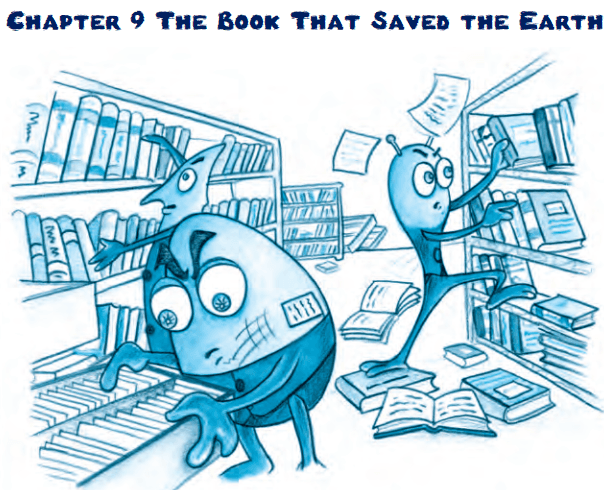
The play is narrated by a Historian, who explains how a single book changed the course of history. The Martians, led by their ruler, the Mighty Think-Tank, planned to conquer Earth, believing humans to be an inferior species. Think-Tank, along with his fellow Martians—Captain Omega, Lieutenant Iota, and Sergeant Oop—monitored Earth’s activities through a space probe. They misinterpreted human books as a source of nourishment and assumed that Earthlings ate them.
One of the books they analyzed was Mother Goose, a collection of nursery rhymes. The Martians misinterpreted the rhymes as Earth’s military strategies. For example, the rhyme about “the cow jumping over the moon” made them think that humans had advanced space technology. This terrified Think-Tank, and fearing Earth’s supposed power, he abandoned the invasion plan and fled to another planet.
The play highlights the theme of irony and humor, showcasing how a simple book of nursery rhymes saved Earth from an alien invasion. It also emphasizes the power of literature and knowledge in influencing events.
Summary of Chapter 9: “The Book That Saved the Earth”
(In Hindi)
“द बुक दैट सेव्ड द अर्थ” एक हास्यपूर्ण विज्ञान-कथा नाटक है, जिसे क्लेयर बोइको ने लिखा है। यह कहानी 25वीं शताब्दी में सेट की गई है और 20वीं शताब्दी में हुई एक असाधारण घटना के इर्द-गिर्द घूमती है, जब मंगल ग्रह के प्राणियों (मार्टियनों) ने पृथ्वी पर आक्रमण करने का प्रयास किया।
इस नाटक का वर्णन एक इतिहासकार द्वारा किया गया है, जो यह बताता है कि कैसे एक अकेली किताब ने इतिहास की दिशा बदल दी। मार्टियनों के नेता माइटी थिंक-टैंक ने पृथ्वी को जीतने की योजना बनाई, क्योंकि उन्हें लगा कि मनुष्य एक हीन प्रजाति हैं। थिंक-टैंक और उसके सहयोगी—कैप्टन ओमेगा, लेफ्टिनेंट आयोटा और सार्जेंट ऊप—एक अंतरिक्ष जांच के माध्यम से पृथ्वी की गतिविधियों पर नजर रख रहे थे। उन्होंने गलती से पृथ्वी की किताबों को भोजन का स्रोत समझ लिया और यह मान लिया कि पृथ्वीवासी इन्हें खाते हैं।
मार्टियनों ने जिन पुस्तकों का विश्लेषण किया, उनमें से एक थी “मदर गूज़”, जो बच्चों की कविताओं का संग्रह थी। उन्होंने इन कविताओं को पृथ्वी की सैन्य रणनीतियाँ समझ लिया। उदाहरण के लिए, “गाय चाँद के ऊपर कूद गई” वाली कविता को उन्होंने पृथ्वी के उन्नत अंतरिक्ष विज्ञान का प्रमाण मान लिया। इससे थिंक-टैंक भयभीत हो गया और उसने धरती पर आक्रमण करने की योजना छोड़ दी। घबराकर, वह अपने साथियों सहित किसी अन्य ग्रह पर भाग गया।
यह नाटक व्यंग्य और हास्य के माध्यम से यह दर्शाता है कि कैसे बच्चों की सरल कविताओं की एक किताब ने पृथ्वी को एलियनों के आक्रमण से बचा लिया। यह कहानी साहित्य और ज्ञान की शक्ति को भी दर्शाती है, जो इतिहास को बदलने की क्षमता रखते हैं।
Question Answers
READ AND FIND OUT
Q 1. Why was the twentieth century calling the ‘Era of the Book’?
Answer 1: This period was often referred to as the “Era of the Book” due to the abundance of literature available. You could discover books covering a wide range of topics, from anteaters to Zulus. These books served multiple purposes: they not only provided instructions and guidance but also educated readers about various subjects. Additionally, they often featured beautiful illustrations and were sometimes used as decorative pieces.
Q 2. Who tried to invade the earth in the twenty-first century?
Answer 2: The Martians launched an invasion of Earth, led by their Commander-in-Chief, Think-Tank. His goal was to expand his dominion by bringing Earth under Martian control.
READ AND FIND OUT
Q 1. What guesses are made by Think-Tank about the books found on earth?
Answer 1: Initially, Think-Tank speculated that since Earthlings enjoy eating, they must consider books as a type of sandwich, which he imagined to be a staple of their diet. He described the two covers as the bread, with the pages serving as the filling in between. To confirm this theory, he instructed his crew aboard Probe One to taste the sandwich-like book. However, when Sergeant Oops attempted to take a bite, he choked and found it unappetizing.
At that moment, Noodle, the apprentice, politely pointed out that in the films they had viewed about these “sandwiches,” Earthlings didn’t actually eat them; instead, they appeared to use them as a means of communication.
Proud of his insight, Think-Tank acknowledged Noodle’s observation and directed the crew to listen to the books, but they heard no sound. Once again, Noodle offered a helpful suggestion, explaining that Earthlings typically open books to read and view the content inside.
Think-Tank refined Noodle’s idea for the crew and instructed them to open the books and look at the pages. However, the crew struggled to understand the text, which seemed to be in a coded language. Prompted by Noodle, Think-Tank then ordered the crew to take intelligence-enhancing vitamins provided by their chemical department. After taking the vitamins, the crew successfully decoded the language in the books.
Chapter 9 The Book That Saved the Earth
Updated Solution 2024-2025
THINK ABOUT IT
Q 1. Noodle avoids offending Think-Tank but at the same time he corrects his mistakes. How does he manage to do that?
Answer 1: Think-Tank is the proud and self-important king of Mars, who believes he is the most intelligent and knowledgeable being in his realm. However, in reality, he is quite ignorant and lacks true understanding. His assistant, Noodle, is not only more knowledgeable but also more intelligent. Understanding that a direct correction would hurt his master’s pride, Noodle chooses a more subtle approach.
For instance, Think-Tank confidently asserts that books are like sandwiches, suggesting that they should be “eaten” to appreciate them. When oops, one of the crew members, tries this and finds the books unappetizing, Noodle tactfully points out that in Earth films about books, people don’t eat them; they use them as tools for communication. Think-Tank, eager to prove his point, claims that this was his intention all along and instructs his crew to “listen” to the books.
When the books remain silent, Noodle gently reminds Think-Tank that Earthlings actually open and read the books rather than listening to them. Embracing the idea of visual communication, Think-Tank orders his crew to observe the books. Yet, when they struggle to decipher the text, Noodle politely suggests that they might benefit from the vitamins provided by their chemical department to enhance their intelligence.
Through these exchanges, we see how Noodle skillfully navigates Think-Tank’s arrogance by offering corrections in an indirect and respectful manner, using flattery to ensure that he does not offend his proud master.
Q 2. If you were in Noodle’s place, how would you handle Think-Tank’s mistakes?
Answer 2: Think-Tank was a proud and arrogant individual, holding himself in high regard. He believed he was the most powerful, intelligent, and knowledgeable person, convinced that he could never be wrong.
People like Think-Tank are often overly sensitive and can become easily upset or irritated when someone points out their mistakes. Even if they know deep down that the criticism is valid, they may refuse to listen and react defensively. Therefore, it’s essential to approach them with care, just as Noodle did. Noodle corrected Think-Tank in a subtle and indirect way, using suggestive language that encouraged Think-Tank to listen rather than react negatively.
If I were in Noodle’s shoes, I would adopt a similar approach. I would avoid directly confronting Think-Tank about his mistakes, as I wouldn’t want to appear more knowledgeable or undermine his confidence. Instead, I would strive to communicate in a way that respects his feelings while still conveying the necessary corrections.
Q 3. Do you think books are being replaced by the electronic media? Can we do away with books?
Answer 3: To date, electronic media has not fully replaced traditional books. While we have seen some progress with the availability of e-books, I believe that physical books will continue to hold their value.
Books are our cherished companions and a wonderful way to spend time. They can be taken anywhere, even to the most remote locations. You can unwind and enjoy reading a book on a sunny beach or in a peaceful forest, sitting under a tree and immersing yourself in your favorite story. In contrast, e-books typically require you to sit in front of a computer screen, which doesn’t offer the same experience. Books are precious possessions, and I truly believe they will remain an essential part of our lives.
Q 4. Why are books referred to as a man’s best companion? Which is your favourite book and why? Write a paragraph about that book.
Answer 4: The Power of Books as Our Closest Friends
There’s no doubt that books are our most loyal companions. They don’t demand anything from us but instead offer endless pleasure and knowledge. In times of solitude, they provide us with company. Whether we’re feeling sad, anxious, or joyful, books are there to resonate with our emotions. They inspire and uplift us when we feel down, and no matter where we are—even in the most remote locations—they are always ready to accompany us.
As Richard De Bury famously said, “If you approach them, they are not asleep; if you seek them, they do not hide; if you blunder, they scold; if you are ignorant, they do not laugh at you.” This perfectly captures the essence of books as invaluable friends.
Personally, I have a deep love for reading and have curated a wonderful collection of books. One that stands out as my favorite is Children Who Made It Big, authored by Thangamani and published by the National Book Trust. This book holds a special place in my heart, as I received it as the first prize in an Essay Writing Competition at the Zonal Science Fair.
Inside, it features twelve inspiring stories about remarkable individuals who started as ordinary young people, just like many of us. They had dreams, faced challenges, and experienced moments of joy and sorrow. Each of them encountered a pivotal moment that guided them toward their careers and shaped their identities. Through their experiences, they transformed into influential figures in various fields—be it science, industry, the arts, cinema, or social work—during the post-independence era.
This book is not just a collection of stories for me; it is a source of inspiration and motivation that continuously encourages me to pursue my own dreams.
TALK ABOUT IT
Q 1. In what ways does Think-Tank misinterpret innocent nursery rhymes as threats to the Martians? Can you think of any incident where you misinterpreted a word or an action? How did you resolve the misunderstanding?
Answer 1: In “The Martian Chronicles” by Ray Bradbury, the Think-Tank misinterprets innocent nursery rhymes as threats to Martians due to their unfamiliarity with human culture and language. The Martians perceive phrases like “Rock-a-bye Baby” and “Humpty Dumpty” as potential warnings or indications of aggression, largely because they lack the contextual understanding that humans attribute to these nursery rhymes. This misunderstanding illustrates how language and culture can lead to misinterpretations, especially when one group lacks knowledge of the other’s symbols and expressions.
As for personal experiences, many people encounter moments of misunderstanding in communication. For example, if someone hears the word “sick” and interprets it as merely feeling ill, they might miss the slang meaning of something being “cool” or impressive in a different context.
To resolve such misunderstandings, one could ask clarifying questions or seek context to better understand the intent behind the words or actions. This promotes clearer communication and reduces the likelihood of further misinterpretations.
Q 2. The aliens in the play speak English. Do you think this is their language? What could be the language of the aliens?
Answer 2: I believe that English is not the language of aliens. If it were, they would have been able to read and comprehend nursery rhymes instead of relying on vitamin pills to decode them. This misunderstanding led the Think-Tank to mistakenly view them as a threat from Mars. In a way, it’s fortunate that they didn’t understand English; otherwise, Earth might have faced an invasion by Martians.
In my view, aliens likely didn’t use any traditional language. Given their advanced brains, they might have communicated through sensory waves instead.
Chapter 9 The Book That Saved the Earth – Updated Solution 2024-2025
This complete solution is prepared as per the latest syllabus of 2024-25. If you have any further queries, feel free to ask! 😊