
Chapter 8 - The Sermon at Benares (Ncert Solutions) for Class 10 English
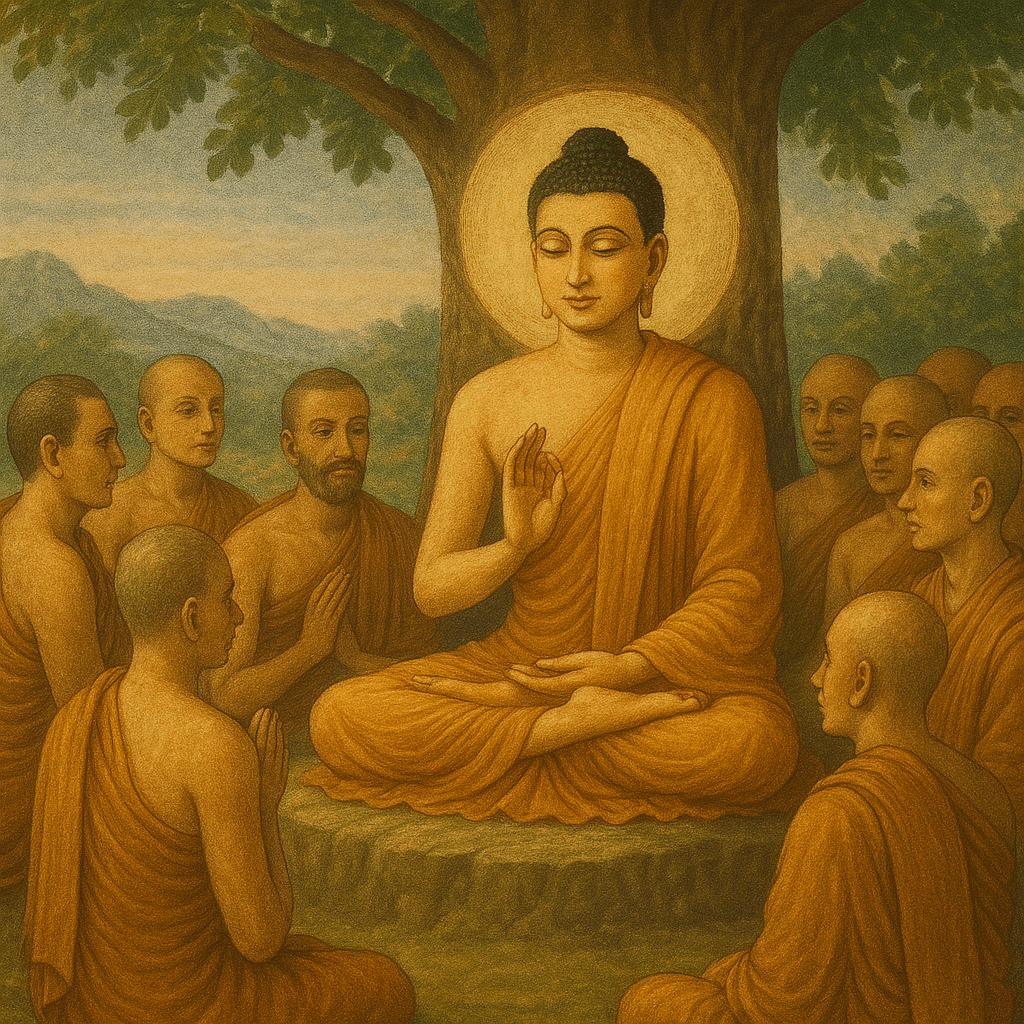
Ultimate NCERT Solutions for Chapter – 8 The Sermon at Benares
Updated Solution 2024-2025 Updated Solution 2024-2025
NCERT Solutions for Class 10 English, Chapter – 8 The Sermon at Benares
(Question/Answers, summary)
Chapter – 8 The Sermon at Benares
Summary of Chapter 8 – The Sermon at Benares (English)
The chapter The Sermon at Benares presents an account of Lord Buddha’s journey from being Prince Siddhartha to attaining enlightenment and preaching his first sermon at Benares.
Born as a prince, Siddhartha Gautama led a life of luxury but was deeply disturbed upon witnessing the sufferings of old age, sickness, and death. Determined to find the cause of human suffering, he renounced his princely life and wandered in search of truth. After years of meditation, he attained enlightenment under the Bodhi tree and became the Buddha, meaning “the Enlightened One.”
Buddha’s first sermon at Benares aimed to help people overcome grief and suffering. He taught that suffering is an inevitable part of life, caused by attachment and desires. To illustrate this, he narrated the story of Kisa Gotami, a grieving mother who had lost her only son. Desperate to bring him back to life, she approached Buddha, who asked her to bring mustard seeds from a house where no one had lost a loved one. As she searched, she realized that death is a universal truth. This experience helped her accept the reality of life.
Buddha emphasized that suffering can end by overcoming desires and following the Middle Path—a balanced life free from extreme indulgence or hardship. He taught that wisdom, virtue, and mental discipline lead to peace and enlightenment. The sermon highlights the inevitability of death and the importance of detachment to attain true peace and happiness.
Summary of Chapter 8 – The Sermon at Benares (In Hindi)
अध्याय “बनारस में उपदेश” भगवान बुद्ध के जीवन और उनके प्रथम उपदेश की कहानी प्रस्तुत करता है।
सिद्धार्थ गौतम एक राजकुमार के रूप में जन्मे थे और एक सुखी जीवन व्यतीत कर रहे थे। लेकिन जब उन्होंने वृद्धावस्था, बीमारी और मृत्यु को देखा, तो वे जीवन के दुखों से व्यथित हो गए। सत्य की खोज में, उन्होंने अपना राजमहल त्याग दिया और वर्षों तक तपस्या और ध्यान किया। अंततः उन्होंने बोधि वृक्ष के नीचे ज्ञान प्राप्त किया और बुद्ध (प्रबुद्ध व्यक्ति) बन गए।
बुद्ध ने बनारस में अपना पहला उपदेश दिया, जिसमें उन्होंने दुखों से मुक्त होने का मार्ग बताया। उन्होंने सिखाया कि दुख जीवन का अविभाज्य हिस्सा है और यह हमारी इच्छाओं और मोह के कारण उत्पन्न होता है। इसे समझाने के लिए उन्होंने किसा गौतमी की कहानी सुनाई। किसा गौतमी अपने इकलौते पुत्र की मृत्यु से अत्यंत दुखी थी और उसे पुनर्जीवित करने का उपाय खोज रही थी।
बुद्ध ने उससे कहा कि यदि वह ऐसे घर से सरसों के बीज ला सके, जहां कभी किसी की मृत्यु न हुई हो, तो वे उसके पुत्र को जीवित कर देंगे। जब किसा गौतमी ऐसे घर की तलाश में गई, तो उसे एहसास हुआ कि मृत्यु एक सार्वभौमिक सत्य है। इस सत्य को स्वीकार कर उसने अपने पुत्र के मोह का त्याग कर दिया और शांति प्राप्त की।
बुद्ध ने यह उपदेश दिया कि इच्छाओं और मोह से मुक्त होकर, संतुलित जीवन जीने से दुखों से छुटकारा पाया जा सकता है। उन्होंने मध्यम मार्ग अपनाने की शिक्षा दी, जिसमें न अधिक भोग-विलास हो और न ही कठोर तपस्या। उन्होंने यह भी बताया कि ज्ञान, सदाचार और मानसिक अनुशासन से ही वास्तविक शांति और मोक्ष प्राप्त किया जा सकता है। यह उपदेश हमें सिखाता है कि मृत्यु और दुख से घबराने के बजाय, हमें जीवन के सत्य को समझकर आत्मिक शांति प्राप्त करनी चाहिए।
Activity
Use a dictionary or ask for your teacher’s help as you discuss the following questions in groups.
Q 1. What is a sermon? Is it different from a lecture or a talk? Can this word also be used in a negative way or as a joke (as in “my mother’s sermon about getting my work done on time…”)?
Ans 1: A sermon is a religious or moral speech delivered to guide and inspire people. It is different from a lecture or a talk because a lecture is more educational, and a talk is usually informal. A sermon is often spiritual and given by a religious leader.
Yes, the word “sermon” can be used in a negative or humorous way. For example, when someone receives unwanted advice or a long moral lesson, they might say, “My mother’s sermon about getting my work done on time…” to express mild annoyance.
Q 2. Find out the meanings of the words and phrases given in the box.
afflicted with be composed desolation lamentation procure be subject to |
Ans 2:
- Afflicted with – Suffering from pain, distress, or disease. (Example: He was afflicted with a high fever.)
- Be composed – To remain calm and in control. (Example: She tried to be composed during the exam.)
- Desolation – A state of loneliness, sadness, or emptiness. (Example: The town was in desolation after the storm.)
- Lamentation – Expressing deep sorrow or grief. (Example: The lamentation of the villagers was heard after the flood.)
- Procure – To obtain something with effort. (Example: He managed to procure a rare book from the old library.)
- Be subject to – To be likely to experience something, especially something unpleasant. (Example: The flight is subject to weather conditions.)
Q 3. Have you heard of the Sermon on the Mount? Who delivered it? Who do you think delivered a sermon at Benares?
Ans 3: Yes, the Sermon on the Mount is a famous sermon delivered by Jesus Christ. It includes teachings about love, humility, and kindness.
The Sermon at Benares was delivered by Gautama Buddha after he attained enlightenment. In this sermon, he explained the reality of suffering and how to overcome it through wisdom and detachment.
Thinking about the text
Q 1. When her son dies, Kisa Gotami goes from house to house. What does she ask for? Does she get it? Why not?
Ans 1: Kisa Gotami, devastated by the death of her only son, wandered from house to house seeking medicine to revive him. In her grief, she desperately hoped someone could offer a cure. However, no one could fulfill her request because death is irreversible, and no medicine can bring back the dead.
Q 2. Kisa Gotami again goes from house to house after she speaks with the Buddha. What does she ask for, the second time around? Does she get it? Why not?
Ans 2: After meeting the Buddha, Kisa Gotami was instructed to collect a handful of mustard seeds from a household that had never experienced the loss of a loved one. She visited many homes, but she could not find a single family untouched by death. Eventually, she realized that death is a universal truth, and no one is exempt from its reach.
Q 3. What does Kisa Gotami understand the second time that she failed to understand the first time? Was this what the Buddha wanted her to understand?
Ans 3: The second time, Kisa Gotami understood that suffering and loss are shared experiences, and death is an unavoidable part of life. She grasped the reality that just as lamps eventually extinguish, life also comes to an end. This realization helped her overcome her grief.
Yes, this is precisely what the Buddha wanted her to learn—that mortality is an inherent part of existence and clinging to sorrow is futile.
Q 4. Why do you think Kisa Gotami understood this only the second time? In what way did the Buddha change her understanding?
Ans 4: Initially, Kisa Gotami was blinded by her personal grief and could only focus on reviving her child. However, when she sought mustard seeds from families untouched by death, she came to understand that loss is a universal experience.
The Buddha used this task to shift her perspective—from seeing death as her individual tragedy to recognizing it as an unavoidable reality for all. Through this realization, she accepted the impermanence of life.
Q 5. How do you usually understand the idea of ‘selfishness’? Do you agree with Kisa Gotami that she was being ‘selfish in her grief’?
Ans 5: Selfishness is generally seen as focusing only on one’s own needs and emotions, often ignoring the experiences of others. In her grief, Kisa Gotami was initially consumed by her pain and unable to see that loss is a part of life for everyone.
Yes, in a way, she was being ‘selfish in her grief’ because she believed she alone was suffering. However, through the Buddha’s lesson, she realized that death affects all, and understanding this helped her overcome her sorrow.
Chapter – 8 The Sermon at Benares Question Answer
Updated Solution 2024-2025
Thinking about Language
Q I: This text is written in an old-fashioned style, for it reports an incident more than two millennia old. Look for the following words and phrases in the text, and try to rephrase them in more current language, based on how you understand them.
- give thee medicine for thy child
- Pray tell me
- Kisa repaired to the Buddha
- there was no house but someone had died in it
- kinsmen
- Mark!
Ans I: Here are the phrases rewritten in a more modern style:
- “Give thee medicine for thy child” → “Give you medicine for your child”
- “Pray tell me” → “Please tell me”
- “Kisa repaired to the Buddha” → “Kisa went to the Buddha”
- “There was no house but someone had died in it” → “Every house had experienced a death”
- “Kinsmen” → “Relatives” or “Family members”
- “Mark!” → “Pay attention!” or “Listen carefully!”
Q II: You know that we can combine sentences using words like and, or, but, yet and then. But sometimes, no such word seems appropriate. In such a case, we can use a semicolon (;) or a dash (—) to combine two clauses.
She has no interest in music; I doubt she will become a singer like her mother.
The second clause here gives the speaker’s opinion on the first clause. Here is a sentence from the text that uses semicolons to combine clauses. Break up the sentence into three simple sentences. Can you then say which has a better rhythm when you read it, the single sentence using semicolons, or the three simple sentences?
For there is not any means by which those who have been born can avoid dying; after reaching old age there is death; of such a nature are living beings.
Ans II: Here is the sentence broken into three simple sentences:
- There is no way for those who are born to avoid dying.
- After reaching old age, death follows.
- This is the nature of all living beings.
Now, comparing the two versions:
- The original sentence with semicolons has a smoother flow and a more rhythmic, philosophical tone.
- The three separate sentences sound clearer and more direct, but they lose the natural progression of thought present in the original.
The single sentence using semicolons has a better cadence and rhythm. This implies that the three parts of the sentence are connected to each other in their meanings. The second clause gives detailed information about the first clause. The third clause is, therefore, directly related to both the first and the second clauses. Their meanings are conveyed in a better way when they are joined by semicolons.
Writing
Q 1: Write a page (about three paragraphs) on one of the following topics. You can think about the ideas in the text that are relevant to these topics and add your own ideas and experiences to them.
- Teaching someone to understand a new or difficult idea
- Helping each other to get over difficult times
- Thinking about oneself as unique, or as one among billions of others
Ans 1: Helping Each Other to Get Over Difficult Times
Life is full of challenges, and at some point, everyone faces difficult times. Whether it is the loss of a loved one, a financial crisis, or emotional struggles, hardships can feel overwhelming. However, having supportive people around can make a significant difference. When we help each other, we remind ourselves that we are not alone. A simple act of kindness, a few comforting words, or just being there for someone can provide strength and hope.
One of the most powerful ways to help others is through empathy. Understanding someone’s pain and offering them emotional support can make them feel heard and valued. In the story of Kisa Gotami, she realized that everyone experiences loss and grief. This realization helped her overcome her sorrow. Similarly, when we listen to others and acknowledge their struggles, we create a sense of connection and shared experience. Offering practical help, such as assisting with daily tasks or just keeping someone company, also plays an important role in supporting people through difficult times.
Difficult situations often teach us important life lessons. They make us stronger, more compassionate, and more appreciative of the people around us. Just as Kisa Gotami learned from the Buddha that death is a universal truth, we, too, learn that no one is truly alone in their struggles. When we support one another, we build stronger relationships and a more caring society. Helping others not only lifts them up but also gives us a sense of fulfillment and purpose. In the end, kindness and understanding are what truly help people move forward.
“Chapter 8 Poem – For Anne Gregory”
Summary of Chapter 8 Poem – For Anne Gregory (English)
The poem For Anne Gregory by William Butler Yeats explores the theme of love and beauty, questioning whether people love others for their inner qualities or merely for their physical appearance. The poem is structured as a conversation between a speaker and Anne Gregory, where the speaker tells her that young men love her for her external beauty, particularly her golden hair, rather than for who she truly is inside.
Anne Gregory responds by saying that if physical beauty is the only reason for love, she can change her appearance by dyeing her hair a different color to see if someone would love her for her inner self. The speaker then shares a deeper perspective, saying that only God is capable of loving someone purely for their true nature, beyond physical attraction.
Through this poem, Yeats highlights how human love is often superficial, based on outward beauty rather than inner character. The poem gently conveys the idea that true love should go beyond appearances and focus on a person’s real essence.
Summary of Chapter 8 Poem – For Anne Gregory (In Hindi)
विलियम बटलर यीट्स की कविता फॉर ऐनी ग्रेगरी प्रेम और सुंदरता के विषय की पड़ताल करती है और यह सवाल उठाती है कि क्या लोग किसी को उसके आंतरिक गुणों के लिए प्यार करते हैं या केवल बाहरी रूप-रंग के कारण। यह कविता एक वार्तालाप के रूप में लिखी गई है, जिसमें वक्ता ऐनी ग्रेगरी से कहता है कि युवा पुरुष उसे उसकी सुनहरी बालों की सुंदरता के कारण पसंद करते हैं, न कि उसकी वास्तविक आत्मा के लिए।
इस पर ऐनी ग्रेगरी जवाब देती है कि अगर शारीरिक सुंदरता ही प्रेम का आधार है, तो वह अपने बालों का रंग बदल सकती है ताकि यह देखा जा सके कि क्या कोई उसे उसकी आंतरिक विशेषताओं के लिए प्यार करेगा। तब वक्ता एक गहरी बात कहता है कि केवल ईश्वर ही किसी को पूरी तरह से उसके सच्चे स्वभाव के लिए प्यार कर सकते हैं, न कि केवल बाहरी आकर्षण के लिए।
इस कविता के माध्यम से यीट्स यह संदेश देते हैं कि मानवीय प्रेम अक्सर सतही होता है और बाहरी रूप-रंग पर आधारित होता है, जबकि सच्चा प्रेम व्यक्ति के आंतरिक गुणों को पहचानना चाहिए। यह कविता एक कोमल तरीके से यह समझाने की कोशिश करती है कि प्रेम को केवल बाहरी सुंदरता तक सीमित नहीं रहना चाहिए, बल्कि व्यक्ति के असली व्यक्तित्व पर आधारित होना चाहिए।
Thinking about the poem
Q 1. What does the young man mean by “great honey-coloured /Ramparts at your ear?” Why does he say that young men are “thrown into despair” by them?
Ans 1: The young man in the poem refers to the “great honey-coloured /Ramparts at your ear” to describe Anne’s beautiful golden hair, which gracefully cascades down and frames her face like a protective barrier. This imagery highlights her beauty, making her irresistible to those who see her. Young men are “thrown into despair” because they are mesmerized by her charm but feel hopeless, as she is admired by many, yet unattainable to all.
Q 2. What colour is the young woman’s hair? What does she say she can change it to? Why would she want to do so?
Ans 2: Anne’s hair is a rich, honey-like yellow. She mentions that she can change its color to black, brown, or even carrot, indicating that external appearances are easily altered. By saying this, she emphasizes that physical beauty is superficial and temporary. She wants young men to look beyond her outer beauty and appreciate her true self—her personality, intellect, and emotions—rather than just her appearance.
Q 3. Objects have qualities which make them desirable to others. Can you think of some objects (a car, a phone, a dress…) and say what qualities make one object more desirable than another? Imagine you were trying to sell an object: what qualities would you emphasise?
Ans 3: Certain qualities make objects more desirable than others. Below is a table showing different objects and the attributes that enhance their appeal:
| Object | Desirable Qualities |
| Car | Color, speed, fuel efficiency, brand |
| Dress | Pattern, fabric, color, fit |
| Phone | Brand, technology, user-friendliness, memory, price |
| Bag | Design, durability, brand, price |
When selling an object, it is important to highlight its best features and explain how it stands out from competitors. Effective marketing focuses on functionality, quality, and value for money to attract potential buyers.
Q 4. What about people? Do we love others because we like their qualities, whether physical or mental? Or is it possible to love someone “for themselves alone”? Are some people ‘more lovable’ than others? Discuss this question in pairs or in groups, considering points like the following.
(i) a parent or caregiver’s love for a newborn baby, for a mentally or physically challenged child, for a clever child or a prodigy
(ii) the public’s love for a film star, a sportsperson, a politician, or a social worker
(iii) your love for a friend, or brother or sister
(iv) your love for a pet, and the pet’s love for you.
Ans 4: Love is a complex emotion influenced by both personal qualities and deep connections. While some admire others for their abilities or physical beauty, genuine love often transcends superficial attributes.
- A parent’s love for a child—whether newborn, gifted, or challenged—is unconditional, based on care and responsibility rather than appearance or achievements.
- The public’s admiration for celebrities, athletes, politicians, or social workers stems from their talents, accomplishments, or influence.
- Love for a friend or sibling is built on shared experiences, trust, and emotional support, rather than external qualities.
- A pet’s love is pure and unconditional, teaching us that true affection is not dependent on appearance or status.
While some people may seem “more lovable” based on their charisma or kindness, deep relationships are formed by emotional bonds rather than superficial traits.
Q 5. You have perhaps concluded that people are not objects to be valued for their qualities or riches rather than for themselves. But elsewhere Yeats asks the question: How can we separate the dancer from the dance? Is it possible to separate ‘the person himself or herself’ from how the person looks, sounds, walks, and so on? Think of how you or a friend or member of your family has changed over the years. Has your relationship also changed? In what way?
Ans 5: People are not just defined by their looks or talents but by their essence as individuals. Yeats’ question—whether we can separate a person from their actions—raises an important point: our perception of people often includes how they present themselves.
Over time, individuals evolve in appearance, personality, and behavior. Relationships also change accordingly. A childhood friend may become distant, or a sibling may grow closer as life progresses. The way we connect with people depends not just on their external traits but on shared memories, mutual respect, and understanding.
It is important to appreciate people for who they truly are rather than just their outward appearance. True relationships are built on deeper emotional and intellectual connections.
Chapter – 8 The Sermon at Benares – Updated Solution 2024-2025
This complete solution is prepared as per the latest syllabus of 2024-25. If you have any further queries, feel free to ask! 😊