
Unit 7 - Madam Rides the Bus Question Answer for Class 10 English
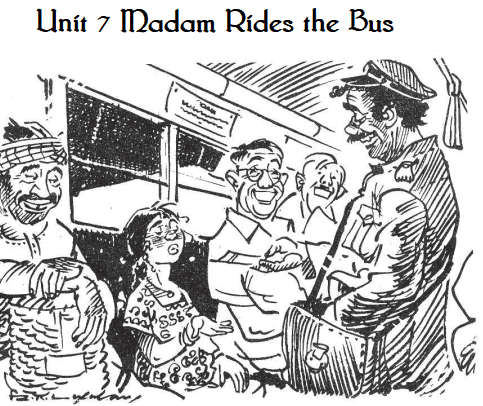
Unit 7 Madam Rides the Bus Question Answer
Updated Solution 2024-2025 Updated Solution 2024-2025
NCERT Solutions for Class 10 English, Unit 7 Madam Rides the Bus
Question Answer, Grammar & Comprehension
Unit 7 Madam Rides the Bus
Let’s Begin
Q 1. In the story ‘Madam Rides the Bus’, Valli took a bus ride on the bus that she wanted to for last several months. She knew that she had to buy tickets for this. So, she saved money suppressing all temptation to buy things like peppermints, toys, balloons, etc., and paid for the ticket.
- What all exciting things did she see from the bus?
- Was the excitement the same on her return journey?
Discuss with your classmate and write a paragraph based on your discussion on the above-mentioned questions.
Ans 1:
“Valli was thrilled to finally ride the bus she had been dreaming about for months. As she sat by the window, she saw many exciting things that fascinated her. She enjoyed watching the green fields, distant mountains, palm trees, and people working in the fields. She also saw a young cow running in front of the bus, which made her laugh joyfully. However, the excitement she felt during the return journey was different. On the way back, she saw the same young cow lying dead on the roadside. This sight made her feel sad and thoughtful, and she realized that life also has a serious and painful side. Her return journey was quieter, as she became more mature and reflective after what she had seen.” |
Q 2: Have you undertaken any journey by bicycle, boat, bus, train, or on an elephant back? Share your experience with your friends in the class.
Ans 2: Yes, I once went on a journey by train when I visited my grandparents during the summer holidays. It was an overnight journey, and I was very excited because I love looking out of the train window. I saw wide fields, rivers, and many small stations where the train would stop for a few minutes. I also enjoyed the snacks that vendors sold at the stations. At night, I lay on the sleeper berth and listened to the rhythmic sound of the train moving on the tracks. It was a fun and memorable journey, and I still remember the excitement I felt while traveling.
Reading Comprehension
TEXT I
Read the passage given below and answer the questions that follow.
Vishav Driman (65-year-old) and her husband Kamal Jeet (69-year-old) set out to discover the hidden treasure of Uttarakhand by bicycle. Vishav shares their post-retirement adventure.
Pedalling through the Golden Years
At a time when our peers were slowing down, relaxing and watching sunsets from their front porch, we found a new passion—cycling. We started out with short daily rides, but found ourselves looking forward to them more and more, so much that we decided to venture further and cover more ground. There were obvious health concerns—the risk of performing a physically strenuous activity at a high altitude, the most obvious of them. But it helped that we had lived in Uttarakhand’s capital, Dehradun, our entire lives, and were therefore acclimatised to the cold winds and narrow winding roads that characterise this beautiful state.
We were also familiar with almost all the scenic mountain trails it had to offer. Short rides extended to longer ones as we started falling deeper in love with not just the sport, but the very idea of discovering a world we had always been a part of, but never had the time to explore. Soon, a simple hobby turned into a project of sorts, and we started participating in cyclotrons and other cycling events being held in the city.
Admiration and encouragement poured in from family members, friends and neighbours along the way, sparking a new thought—was it possible to travel across the state on our bicycles? It seemed daunting at first, but we knew we had to try. Our gear in place, our bikes serviced, and our minds set, we set off on an adventure we would remember for the rest of our lives.
In my opinion, there are very few ways to enjoy and appreciate the beauty of Uttarakhand and cycling is the most thrilling of them all. Sunlight filtering through the trees and a cool breeze gently caressing your faces as you ride, coupled with breathtaking views of sal forests spread like a green cover on the mountains and surrounding valleys, the experience of Pedalling across the state is truly inexplicable. Of the many trails we navigated, there is one that occupies a special place in our hearts. It began from Ghanta Ghar, a popular tourist attraction in Dehradun, it took us through
some of the most picturesque locations of the state such as Kimadi, Hathi Paon, Mussoorie and Chaar Dukaan, right up to George Everest point. This 100km ride (approximately) is also one of the few routes in Uttarakhand that encapsulates all the element that one expects while cycling here—steep slopes, sharp curves, endless hills, lush forests, and off-road experiences.
(Source: by Vishav Driman, India Travel360)
Q.1. What is the meaning of the expression “when our peers were slowing down, relaxing and watching sunsets from their front porch” and in what context has the author used this? _____________________________________________________ _____________________________________________________
Ans 1: The expression “when our peers were slowing down, relaxing and watching sunsets from their front porch” means that most people their age (after retirement) prefer a slow, relaxed life, enjoying peaceful moments at home. The author uses this to contrast their own choice—instead of resting, they took up an adventurous cycling journey to explore Uttarakhand.
Q.2. What made Vishav and her husband confident to venture into Uttarakhand on their bicycles? _____________________________________________________ _____________________________________________________
Ans 2: Vishav and her husband were confident because they had lived in Dehradun (Uttarakhand’s capital) their entire lives, so they were used to the cold winds, high altitudes, and narrow winding roads. Their familiarity with the terrain and acclimatization to the weather made them feel prepared for the challenge.
Q.3. What was the strong passion that prompted the retired couple to take up this adventurous journey?
_____________________________________________________ _____________________________________________________
Ans 3: The strong passion that prompted the retired couple was their growing love for cycling and the desire to discover the beauty of Uttarakhand, which they had been a part of but never fully explored due to lack of time before retirement.
Q.4. What, according to the author, is the most thrilling way to enjoy and appreciate Uttarakhand? Why does she say so?
_____________________________________________________ _____________________________________________________
Ans 4: According to the author, cycling is the most thrilling way to enjoy Uttarakhand. She says so because it allows one to experience sunlight filtering through trees, cool breezes, and breathtaking views of forests and valleys up close, making the journey truly unforgettable.
Q.5. Which trail occupies a special place in the couple’s heart?
_____________________________________________________ _____________________________________________________
Ans 5: The trail that occupies a special place in their hearts starts from Ghanta Ghar in Dehradun and passes through Kimadi, Hathi Paon, Mussoorie, and Chaar Dukaan, ending at George Everest Point. This 100 km ride is scenic and adventurous.
Q.6. What are the expectations of a cyclist from such an adventurous trip through the mountains? Did Vishav and Kamal Jeet get these experiences from the 100 km ride? _____________________________________________________ _____________________________________________________
Ans 6: A cyclist expects steep slopes, sharp curves, endless hills, lush forests, and off-road experiences on such a trip. Yes, Vishav and Kamal Jeet got all these experiences during their 100 km ride, as the trail had all these elements.
TEXT II
Read the poem given below and answer the questions that follow.
Going Down Hill on a Bicycle, A Boy’s Song
With lifted feet, hands still,
I am poised, and down the hill
Dart, with heedful mind;
The air goes by in a wind.
Swifter and yet more swift,
Till the heart with a mighty lift
Makes the lungs laugh, the throat cry: —
“O bird, see; see, bird, I fly.
“Is this, is this your joy?
O bird, then I, though a boy,
For a golden moment share
Your feathery life in air!”
Say, heart, is there aught like this
In a world that is full of bliss?
‘Tis more than skating, bound
Steel-shod to the level ground.
Speed slackens now, I float
Awhile in my airy boat;
Till, when the wheels scarce crawl,
My feet to the treadles fall.
Alas, that the longest hill
Must end in a vale; but still,
Who climbs with toil, wheresoever,
Shall find wings waiting there.
-Henry Charles Beeching–
Q.1. The poem describes the Excitement of going downhill on a bicycle.
(a) enjoyment
(b) happiness
(c) excitement
(d) satisfaction
Ans 1: The poem describes the (c) excitement of going downhill on a bicycle.
Q.2. Which line(s) depict the freedom like that of a bird that the poet enjoys? _____________________________________________________ _____________________________________________________
Ans 2: The lines that depict the freedom like that of a bird are:
“O bird, see; see, bird, I fly.”
“For a golden moment share / Your feathery life in air!”
Q.3. Which is the experience the boy is sharing with the bird? What is the golden moment he is referring to?
_____________________________________________________ _____________________________________________________
Ans 3: The boy is sharing the experience of flying freely, just like a bird, while speeding downhill on his bicycle. The “golden moment” refers to the brief but thrilling feeling of weightlessness and freedom, as if he were truly flying.
Q.4. What is the meaning of ‘full of bliss’ here? Can the boy find this kind of bliss in the world where he lives?
_____________________________________________________ _____________________________________________________
Ans 4: “Full of bliss” here means a world full of happiness and joy. The boy wonders if there is anything in the world as joyful as the exhilarating feeling of cycling downhill. He suggests that this experience is one of the purest forms of happiness.
Q.5. There is a comparison in the third stanza. What is it? _____________________________________________________ _____________________________________________________
Ans 5: The comparison in the third stanza is between cycling downhill and skating. The boy says that the thrill of speeding downhill on a bicycle is “more than skating, bound / Steel-shod to the level ground,” meaning it is even more exciting than skating on flat land.
Q.6. What is the meaning of the last two lines of the poem? Does “toil” mean dedication, determination, and will power to climb the hill? What is the reward here? _____________________________________________________ _____________________________________________________
Ans 6: The last two lines mean that even though climbing a hill is hard work (“toil”), the reward is the exhilarating ride downhill—the “wings waiting there.” Here, “toil” does suggest dedication and effort, and the reward is the freedom and joy of the descent, just like a bird soaring after a struggle.
Vocabulary
Q 1: Find out the words from the text ‘Madam rides the Bus’ that match with the given meanings.
(a) inquisitive __________________________________________
(b) intricate __________________________________________
(c) mesmerizing __________________________________________
(d) immense __________________________________________
(e) hardly __________________________________________
Ans 1: These words reflect the tone and vocabulary used in the story and are related to Valli’s thoughts, feelings, and experiences during her bus ride adventure.
(a) Inquisitive – curious
(b) Intricate – complicated
(c) Mesmerizing – fascinating
(d) Immense – enormous
(e) Hardly – barely
Grammar
Q 1. Read the two sentences given below. The groups of words in italics are phrasal verbs.
This way she picked up various small details.
Valli said, “I am the one to get on.”
The verbs picked and get are combined with up and on respectively. Together they make phrasal verbs.
Now, complete each sentence using a verb from box A and a word from box B (by making a phrasal verb). Use the correct form of the verb wherever necessary.
A break, drive, get, fill, wake, turn | B out, down, off, on, in, up |
(a) It was evening. She __________________________the light.
(b) Do not ______________________Ramesh. He was studying late at night yesterday.
(c) The school bus ______________________and had to be towed to the garage for repair.
(d) They got in the car and_________________________.
(e) She hurt herself as she was ________________________of the car.
(f) You have to __________________________the form yourself.
Ans 1:
(a) It was evening. She turned on the light.
(b) Do not wake up Ramesh. He was studying late at night yesterday.
(c) The school bus broke down and had to be towed to the garage for repair.
(d) They got in the car and drove off.
(e) She hurt herself as she was getting out of the car.
(f) You have to fill in the form yourself.
Editing
Q 1. Use capital letters and full stops wherever necessary and correct the spelling errors as well, in the following paragraph.
An exciting boat journey gliding crosswise the river from Godkhali jetty will take to a place of incredible mystic beauty of Nature. The sundarbans a unesco World Heritage Site is located at the South eastern tip of the 24 Paraganas district about 110 km from Kolkata it got its name from one of the mangrov plants known as Sundari (Heritiera Minor) Sundrbans are a part of the world’s largest delta, formed by the mighty rivers ganga, brahmaputra and meghna it is one of the most attractive and alluring places remaining on earth, a truly undiscovered paradise the Sundarbans is the largest singl block of tidal, halophytic mangrove forests in the world.
It is the largest tiger reserv and National Park apart from being a unique largest mangrove eco-system of the world, the sundarbns has the world’s largest deltaic mangroove forests and is also home to one of India’s most iconic wildlife species – the royal bengal Ttger. The Sundarbans also serves as a crusial protective barrier for the inhabitents in and around Kolkata against the floods that result from the cyclones which are a regular occurrence. The Sundarbans have also been enlisted amongst the finalists in the New 7 Wonders of Nature.
Ans 1: Here’s the corrected version of the paragraph with proper capitalization, punctuation, and spelling corrections:
An exciting boat journey gliding crosswise the river from Godkhali Jetty will take you to a place of incredible, mystic beauty of nature. The Sundarbans, a UNESCO World Heritage Site, is located at the south-eastern tip of the 24 Paraganas district, about 110 km from Kolkata. It got its name from one of the mangrove plants known as Sundari (Heritiera minor).
The Sundarbans are a part of the world’s largest delta, formed by the mighty rivers Ganga, Brahmaputra, and Meghna. It is one of the most attractive and alluring places remaining on Earth — a truly undiscovered paradise. The Sundarbans is the largest single block of tidal, halophytic mangrove forests in the world.
It is the largest tiger reserve and National Park. Apart from being a unique and vast mangrove ecosystem, the Sundarbans has the world’s largest deltaic mangrove forests and is also home to one of India’s most iconic wildlife species — the Royal Bengal Tiger. The Sundarbans also serves as a crucial protective barrier for the inhabitants in and around Kolkata against the floods that result from the cyclones, which are a regular occurrence. The Sundarbans have also been enlisted amongst the finalists in the New 7 Wonders of Nature.
Listening
Q 1. Following is a passage on Mizoram and its people. When one visits this place, one is enchanted by its natural beauty and the vibrant culture of the state. Listen to the passage carefully and answer the questions that follow. You can listen to the recorded story or ask your teacher, sibling or friend to read the story aloud.
“Mizoram”
Once a tourist remarked, “I visited the Eastern States this time—where the people talk in songs and they always dance.”
The eastern region of India is no doubt charmingly novel in many of its features. Mizoram, literally the land of Mizos is an expanse of blue-green hills. Mizoram is broken up lenghwise into five major mountain ranges gradually descending from the south to the north. The hills are rugged and their heights uneven. The name of the state Mizoram is made of two words. ‘Mi’ means human beings, ‘Zo’ means a hill. So, a ‘Mizo’ is a human dweller of a hill; Mizoram means the land of the hilldwellers. Aizawl is the capital town of the State built in tiers along the hill.
The Mizos have three main festivals—Mim Kut, Chapchar Kut and Pawl Kut. These festivals are associated with their agricultural activities during which they enjoy life by singing and dancing. The Mizos, blessed as they are with a beautiful environment and rich culture, are a vibrant and social people. They love to dance as much as they love to sing. They boast a number of folk and community dances handed down from one generation to the other through the ages. The dances are expressions of the gay, carefree spirit of the Mizos. It should be noted here that these dances are not intended for stage performance, rather they have been evolved for community involvement and participation.
English with a Purpose
A Textbook for Class XII (Core Course)
NCERT, 2003
Q 1. The land of Mizo is a large open area of_________________. The hills are _____and______.
Ans 1: The land of Mizo is a large open area of blue-green hills. The hills are rugged and uneven.
Q 2. The state referred here is made of two names—
(a) ‘Mi’ means human beings
(b) ‘Zo’ means a hill
(c) and Mizoram means the land of the hill-dwellers
Q 3. Which activities are associated with Mizo festivals? How do Mizos enjoy these festivals?
____________________________________________________ ____________________________________________________
Ans 3: The Mizo festivals are associated with agricultural activities. Mizos enjoy these festivals by singing and dancing, celebrating life with joy and enthusiasm.
Q 4. What are the special features of a Mizo dance?
____________________________________________________ ____________________________________________________
Ans 4: Mizo dances are folk and community dances handed down through generations. These dances are expressions of a gay, carefree spirit and are meant for community involvement and participation, not for stage performances.
Q 5. The following statements characterize Mizo people. Tick the one which is not true.
(a) Mizos have a beautiful culture. ()
(b) They live in a beautiful natural environment. ()
(c) They are a protective people. ()
(d) They are a vibrant people. ()
(e) They love to dance and not so much to sing. ()
(f) They have a number of community and folk dances. ()
(g) The community involvement and participation is always there. ()
Ans 5: Incorrect statements: (c) and (e)
Speaking
Q 1. Read Part II of the story ‘Madam Rides the Bus’. There are many conversations between Valli, the conductor, and some elderly people in the bus. Convert the conversations into dialogues between the characters. Many words like commandingly, haughtily, loudly (shouted), smilingly, irritably, curtly etc. have been used in this part. These are the different ways in which the characters have spoken. These show the mood, emotion, and intention of the characters.
Now, write the dialogues and then in groups of three, enact it as a skit in the class.
It was a fine spring afternoon. The bus was just on the verge of leaving the village. Valli, a small eight-year-old girl, wanted to go on a bus ride.
Valli (loudly): Stop the bus! Stop the bus!
Conductor (without looking up): Who is it? Hurry then!
Valli (loudly): It’s me, I am the one who has to get on the bus.
Conductor (smilingly): Oh. really! _______________________
Valli (commandingly): I have to_________________________
Here is________________________________________________.
(Conductor stretched out his hand to help her up.)
Valli (smartly): I can_____________________________________
Conductor (jokingly): Oh, please__________________________
(The bus started to move forward with a roar. Valli stood up on the seat to see the outside world clearly.)
A voice (anxiously): Listen, child_________________________
Valli (haughtily): There is nobody________________________
Conductor (smilingly): Oh, sir____________________________
Valli (angrily): I am ______________________________________
Conductor (mimicking her): ______________________________
Valli (steadfastly): Because I______________________________
A voice (with concern): If you_____________________________
Valli (irritably): I’m not___________________________________
Ans 1: “Skit: Madam Rides the Bus – Dialogue Version”
(Scene: A fine spring afternoon at the village bus stop. The bus is just about to leave.)
Valli (loudly): Stop the bus! Stop the bus!
Conductor (without looking up): Who is it? Hurry then!
Valli (loudly): It’s me, I am the one who has to get on the bus.
Conductor (smilingly): Oh, really! And where do you think you’re going, madam?
Valli (commandingly): I have to go to the town and come back on this very bus.
Valli (handing coins): Here is the money – thirty paise for the fare.
(Conductor stretches out his hand to help her up.)
Valli (smartly): I can get on by myself. I’m not a child, thank you.
Conductor (jokingly): Oh, please make way! Let the young madam pass.
(Bus starts moving with a roar. Valli climbs onto a seat and stands up to look outside.)
A voice (anxiously, from an elderly passenger): Listen, child, you shouldn’t stand like that while the bus is moving. You’ll get hurt!
Valli (haughtily): There is nobody here who’s a child. I’ve paid my fare like everyone else.
Conductor (smilingly): Oh sir, she’s madam now! Paid her fare and all.
Valli (angrily): I am not a child. I tell you I’m eight years old!
Conductor (mimicking her): Oh, my! Eight years old! What a grown-up madam we have here!
Valli (steadfastly): Because I can take care of myself. I don’t need anyone’s help.
A voice (with concern): If you sit down, dear, you’ll enjoy the view better and be safe too.
Valli (irritably): I’m not asking for your advice, thank you.
Q 2. Two communicative tasks are given below. Practice with your partner.
Communicative Task I
(Offering, accepting and refusing help)
Role Play
Chaman: Hello Prem. You look tired. Is there anything I can do to help you?
Prem: Thank you very much. I think I can manage. I am preparing a chart on Children’s Rights.
Chaman: It’s a lot of work. Let me help you.
Prem: Thank you. But I’ve already collected all the necessary information.
Chaman: I can help you in illustrating some of the rights.
Prem: Oh, can you? That sounds wonderful.
Chaman: Could you tell me the themes to be illustrated?
Prem: Here you are. I’m really thankful to you.
Chaman: What about children’s duties?
Prem: Oh, yes. It’s a good suggestion. I’ll list their duties also.
Chaman: Thank you.
Pair or Group Work
Write conversations like the one above imagining you are in the classroom. Use the clues given below.
- Excuse me…
- Yes?
- I wonder if you could lend me our dictionary. I’m doing my class work.
- I’m sorry. I’m using it right now. May be later.
- That’s okay. Thanks anyway.
Write similar conversations imagining you are in the following situations: in the kitchen; at the railway station; asking somebody to open the door; in a hospital; in the playground.
Ans 2: Here are short role-play conversations for each of the given situations. Each one includes polite expressions for offering, accepting, and refusing help, similar to the classroom example.
📚 In the Classroom
Amit: Excuse me…
Riya: Yes?
Amit: I wonder if you could lend me your dictionary. I’m doing my classwork.
Riya: I’m sorry. I’m using it right now. Maybe later?
Amit: That’s okay. Thanks anyway.
🍳 In the Kitchen
Mother: You look busy. Can I help you with something?
Ravi: Yes, please. Could you chop the vegetables?
Mother: Sure! What dish are you making?
Ravi: Mixed vegetable curry.
Mother: Sounds tasty! I’ll help with the onions too.
Ravi: That would be great. Thanks a lot!
🚉 At the Railway Station
Passenger 1: Excuse me, do you need help with your luggage?
Passenger 2 (elderly): Oh, thank you, young man. That would be very kind.
Passenger 1: Let me carry this bag for you. Which coach are you in?
Passenger 2: Coach B2.
Passenger 1: No problem. I’ll walk you there.
🚪 Asking Someone to Open the Door
Neha: Hello! Could you please open the door? My hands are full.
Tina: Of course! Just a second.
Neha: Thank you so much.
Tina: No problem! Need help with those books too?
Neha: That would be lovely, yes. Thanks again!
🏥 In a hospital
Nurse: You look uncomfortable. May I help you sit up?
Patient: Yes, please. My back is hurting a little.
Nurse: I’ll adjust the pillows and raise the bed.
Patient: That feels much better. Thank you.
Nurse: Anytime. Let me know if you need anything else.
🏏 In the Playground
Ali: Hey! Do you want me to throw you some practice balls?
Rohit: That would be awesome. I need to warm up before the match.
Ali: Alright! Get ready. I’ll bowl underarm first.
Rohit: Perfect. Let’s go!
Unit 7 Madam Rides the Bus Question Answer, Grammar & Comprehension
Updated Solution 2024-2025
Communicative Task II
Q 2: (Asking for information, indirect questions and question tags)
Role Play
Vineet: Could you get me some warm clothes from the cupboard, please?
Ashima: Are you feeling cold?
Vineet: It’s cold today, isn’t it?
Ashima: Yes, it is. I shall have to light the fire soon.
Vineet: Oh, you have coal-fires, do you?
Ashima: Yes. We don’t have a room heater. You have room heaters, don’t you?
Vineet: Yes. We do. But coal-fires are nice. They are more comforting than a radiator, aren’t they?
Ashima: Yes, but there is a lot more work than just switching on a heater. We keep talking about getting room heaters.
Vineet: I suppose coal-fires aren’t very convenient, are they?
Ashima: They certainly aren’t.
Pair or Group work
Using the above piece as a model, ask for information, make requests and give your opinion regarding — the floods in Chennai, ‘Cyberabad’ (Hyderabad), a celebration in your school, a landslide during the Amarnath yatra, etc.
Ans 2: Here are four short role-play conversations based on your topic options. Each uses requests, indirect questions, question tags, and opinions, following the style of Vineet and Ashima’s dialogue.
- The Floods in Chennai
Ravi: Could you tell me more about the floods in Chennai, please?
Anjali: Yes, it was terrible this time, wasn’t it?
Ravi: Yes, it caused a lot of damage, didn’t it?
Anjali: It did. Many areas were completely submerged.
Ravi: Oh, people had to be rescued, didn’t they?
Anjali: Yes, and they were moved to relief camps. You’ve seen the news, haven’t you?
Ravi: I have. The rescue teams did a good job, didn’t they?
Anjali: They really did. But the government should improve the drainage system, shouldn’t it?
- Cyberabad (Hyderabad’s Tech Hub)
Aarav: Could you tell me what ‘Cyberabad’ means?
Mira: It’s the name given to Hyderabad’s tech hub, isn’t it?
Aarav: Oh, I didn’t know that. It has many IT companies, doesn’t it?
Mira: Yes, it’s like the Silicon Valley of India. You’re interested in computers, aren’t you?
Aarav: I am! Maybe I’ll work there someday.
Mira: That would be amazing. You know it’s growing very fast, don’t you?
Aarav: Yes. It’s exciting to think about.
- A Celebration in Your School
Neha: Could you tell me more about the annual day celebration in your school?
Kabir: It was grand this year, wasn’t it?
Neha: I heard there was a dance competition too, wasn’t there?
Kabir: Yes, and a skit based on the environment. You like plays, don’t you?
Neha: I do. Who was the chief guest?
Kabir: The District Collector! Everyone was thrilled.
Neha: That’s impressive. You must’ve enjoyed the event a lot, didn’t you?
Kabir: We certainly did!
- Landslide During the Amarnath Yatra
Simran: Could you tell me what happened during the Amarnath Yatra last year?
Raj: There was a terrible landslide, wasn’t there?
Simran: Yes, and some pilgrims were trapped, weren’t they?
Raj: Sadly, yes. But the army reached them quickly.
Simran: They used helicopters, didn’t they?
Raj: Yes. It’s always risky in those mountain areas, isn’t it?
Simran: Definitely. Pilgrims should be more cautious, shouldn’t they?
Raj: True. Safety comes first.
Writing
Q 1. In the text, seeing Valli travelling alone in the bus, some of the characters showed concerns.
An elderly woman asked, “Are you alone, dear?”
The Conductor questioned, “Won’t your mother be looking for you?”
The old woman continued asking, “Is it proper for such a young person to travel alone? Do you exactly know where you’re going in town? What’s the street? What’s the house number?”
Do you think that the concerns of the elderly lady and the conductor are apt and genuine? Will you say that it is applicable to young boys as well? Discuss in groups, make note and then arrange a debate competition. You can consider the following points for discussion or debate. Then write a paragraph considering these issues and give your opinion as well.
- Girls and boys of Valli’s age can travel alone in a bus or auto rickshaw, etc.
- Freedom should be given to them to move around.
- Safety of the young children is of utmost concern.
- What type of education should be given to them?
- This is a vulnerable age and children are innocent.
Ans 1: Should Young Children Travel Alone? – A Balanced View
The concerns shown by the elderly woman and the conductor in Madam Rides the Bus were certainly genuine. At the age of eight, like Valli, children are still quite young and often unaware of the dangers of the outside world. It’s natural for adults to worry about their safety. However, it is also true that boys and girls of Valli’s age begin to show curiosity and independence. If guided properly, they can start learning how to be responsible. That being said, complete freedom to travel alone may not be advisable at such a young age.
Both boys and girls are equally vulnerable—age, not gender, determines their level of maturity. Proper education about personal safety, how to seek help in emergencies, and awareness of surroundings is essential. While small freedoms help build confidence, the safety of children must remain the top priority. Therefore, children should be allowed some independence in familiar and safe environments, but with adult supervision or knowledge.
Q 2. You have read that on her return journey, Valli saw the young cow lying dead by the roadside. This young cow was running very fast in front of the bus and had given Valli unbound happiness when she was travelling to the town.
Now, write a paragraph on ‘Should the domestic animals be let loose to walk on the roads freely’ where the vehicles are plying? Who is responsible for the death of the young cow?
Ans 2: Should Domestic Animals Be Let Loose on Roads?
Domestic animals, such as cows, goats, and dogs, should not be allowed to roam freely on roads where vehicles are continuously moving. It is not only dangerous for the animals but also for the people travelling on the roads. In the story Madam Rides the Bus, Valli finds great joy in seeing a young cow running in front of the bus. However, on her way back, she is heartbroken to see the same cow lying dead by the roadside. This sad incident shows the harsh reality of what can happen when animals are not properly cared for.
The responsibility lies with the animal’s owner, who should not have allowed the cow to roam unattended, and also with the authorities, who must ensure that stray and domestic animals are kept away from busy roads. There should be strict rules, awareness campaigns, and penalties for allowing animals on highways or city roads. After all, safety on roads is not just for humans but for animals too.
Project
Q 1. Read the quick tips for travelling by a bike given below.
When you travel by a bike, Vishav says that the frame and tyres of the bike should be according to the rider’s height. One should carry a hand pump, extra tubes, and a puncture kit for emergency situations. Right accessories such as sweat-resistant gloves, helmets, knee and elbow pads, and a pair of shoes is of utmost importance. It is also necessary to carry essentials like dry food, water, and Oral Rehydration Salts (ORS). A first-aid kit with pain killers, muscle relaxing balms, and band-aids are also advisable.
Now, prepare a list of things that you would like to suggest to people who want to travel by:
(a) a train
(b) a bus
(c) a boat
(d) a motorbike
(e) on foot (for example a trek)
Ans 1: Here’s a clear and organized list of travel suggestions based on the mode of transport. These tips cover comfort, safety, and preparedness for different journeys:
Travel Essentials by Different Modes of Transport
(a) By Train
- Valid ID proof and confirmed ticket
- Snacks and bottled water
- Light blanket or shawl (for night travel)
- Earphones or a book (to pass time)
- Padlock for luggage safety
- Power bank for charging devices
- Small first-aid kit (band-aids, medicines)
- Hand sanitizer and tissues
(b) By Bus
- Small backpack with essentials
- Light snacks and water bottle
- Travel pillow for neck support
- Lightweight blanket or jacket
- Motion sickness medicine (if needed)
- Headphones or entertainment source
- Wet wipes and sanitizer
- Keep change or online payment ready
(c) By Boat
- Life jacket (if not provided)
- Waterproof bag for valuables
- Sunscreen and sunglasses
- Hat or cap for sun protection
- Light snacks and drinking water
- Light, comfortable clothing
- Seasickness tablets (if prone to it)
- Phone pouch or waterproof case
(d) By Motorbike
- Helmet (mandatory)
- Sweat-resistant gloves
- Knee and elbow pads
- Comfortable riding boots or shoes
- Hand pump, puncture kit, extra tubes
- ORS, dry snacks, and water
- First-aid kit with balm and painkillers
- Valid driving license and documents
(e) On Foot (Trekking)
- Sturdy trekking shoes
- Backpack with rain cover
- Reusable water bottle and energy bars
- Cap/hat and sunglasses
- Light jacket and raincoat
- First-aid kit with antiseptic and band-aids
- Map or GPS device
- Walking stick (optional for support)
- Torch/flashlight with extra batteries
Q 2. A. Copies of some tickets are given here. Collect some more train tickets, bus tickets, flight tickets, platform tickets, entry tickets for the zoo, cinema hall, metro rail etc.
Make a collage.
- Study the information given in these tickets.
- Draw a table to enter the information like PNR number, time of departure, time of arrival, confirmed ticket, waitlisted ticket, RAC status in train, seat number, food preferences, price of the ticket, number of passengers, etc.
- How are these tickets different from each other?
- Write a paragraph on ‘Why it is essential to travel with a ticket?
Ans 2: Part A: Ticket Collage and Analysis
Steps to Complete the Activity:
- Collect Tickets: Gather different types of tickets such as train, bus, flight, metro, cinema, zoo, and platform tickets.
- Make a Collage: Arrange these tickets creatively on a chart paper or digital format.
- Study the Information: Observe details like PNR, departure/arrival time, seat number, price, etc.
4. Prepare a Table:
Ticket Type | PNR/Booking No. | Departure Time | Arrival Time | Status (Confirmed/ Waitlisted/RAC) | Seat No. | Food Preference | Price | Passenger Count |
Train | 1234567890 | 10:00 AM | 6:00 PM | Confirmed | B2, 45 | Veg | ₹500 | 2 |
Flight | ABC123 | 8:30 AM | 11:00 AM | Confirmed | 12A | Non-Veg | ₹3000 | 1 |
Bus | XYZ789 | 9:15 PM | 5:00 AM | Confirmed | 22 | – | ₹800 | 1 |
Metro | – | – | – | – | – | – | ₹30 | 1 |
Cinema | CINE456 | 3:00 PM | – | Confirmed | G12, G13 | – | ₹200 | 2 |
Differences Between Tickets:
- Train/Flight/Bus Tickets: Contain PNR, seat number, departure/arrival times, and fare.
- Metro/Platform Tickets: Usually have only fare and validity, no seat allocation.
- Cinema/Zoo Tickets: Include entry time, seat/entry number, and price but no travel details.
- Status Differences: Train tickets may show RAC/Waitlist, while flight/bus tickets show confirmed/cancelled.
Ans B: Paragraph on “Why It Is Essential to Travel with a Ticket?”
Traveling with a valid ticket is crucial for several reasons. First, it ensures compliance with transport rules, avoiding penalties or fines for ticketless travel. Tickets help authorities manage passenger counts, ensuring safety and preventing overcrowding. They also serve as proof of payment and provide essential journey details like seat number, departure time, and destination. In emergencies, tickets help identify passengers and their travel routes. Moreover, booked tickets (train/flight) offer passenger security, as unhooked travel may lead to inconvenience or denial of boarding. Therefore, carrying a ticket is not just a legal requirement but also a necessity for a smooth and hassle-free journey.
Unit 7 Madam Rides the Bus Question Answer, Grammar & Comprehension
This complete solution is prepared as per the latest syllabus of 2024-25.
If you have any further queries, feel free to ask! 