
The Sermon at Benaras Questions Answers for (Class 10 English )
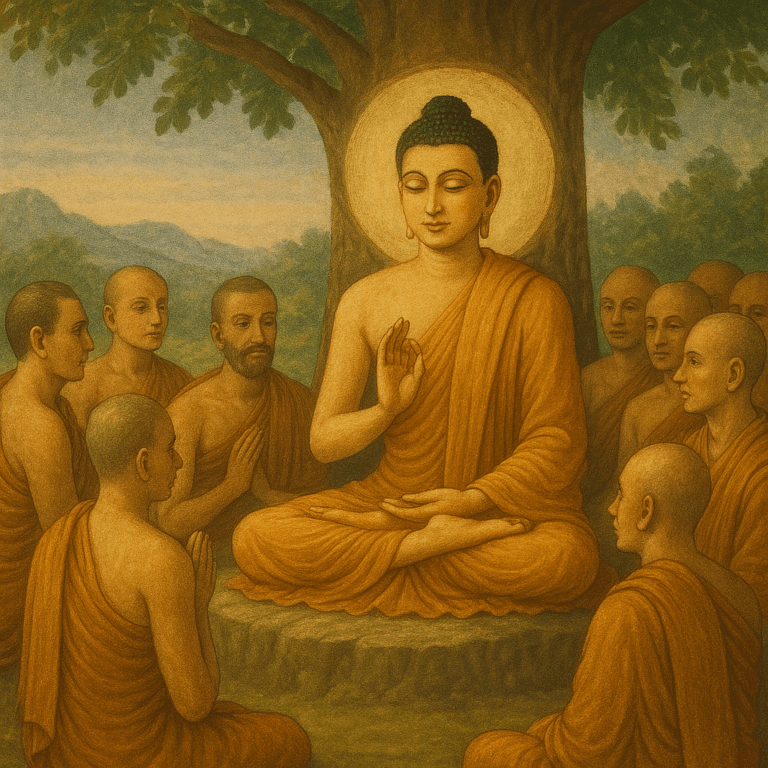
Unit 8 The Sermon at Benaras Questions Answers
Updated Solution 2024-2025 Updated Solution 2024-2025
NCERT Solutions for Class 10 English, Unit 8 The Sermon at Benaras Questions Answers, Grammar & Comprehension
(Unit 8 The Sermon at Benaras Questions Answers)
Let’s Begin
Q 1. In the lesson ‘The Sermon at Benaras’ you were asked to find out the meaning of ‘sermon’. The meanings are given below but these are in different contexts:
- a talk on a religious or moral subject
- a long or monotonous piece of admonition or caution or a warning, a lecture.
(a) Discuss with your classmates the context to which the present text belongs.
Ans a): The word sermon in the lesson ‘The Sermon at Benares’ refers to a talk on a religious or moral subject. It describes the first sermon given by Gautama Buddha after he attained enlightenment. In this context, the sermon is a spiritual and moral teaching meant to help people understand the nature of suffering and how to overcome it.
(b) What could be the examples for the different context according to you?
Ans b):
- Religious or moral subject:
- A priest giving a sermon in a church about kindness and forgiveness.
- Buddha teaching about detachment and suffering.
- Long or monotonous warning or lecture:
- A teacher scolding student for not completing homework and giving a long lecture on discipline.
- A parent lecturing a child about the importance of studying regularly.
(c) When your parents or elders say something, you say, “Oh, not again!” When do you say so and why?
Ans c): I usually say “Oh, not again!” when my parents repeat the same advice or warning many times—like telling me to study, not use my phone too much, or go to bed early. I say it because I’ve already heard it so many times, and it starts to feel like a long lecture rather than helpful advice. Even though I know they mean well, it can feel a bit annoying when repeated too often.
Q 2. Read the poem given below in the context of ‘The Sermon at Benaras’. It was actually delivered as a part of a sermon in 1910 by the author, Canon Henry Scott Holland (1847—1918), a priest at St. Paul’s Cathedral, London. After reading the poem, discuss in groups of four and list the similarities and differences between ‘The Sermon at Benaras’ and ‘Death Is Nothing at All’. For example, the theme, the situation, the philosophy of the two speakers etc.
Death Is Nothing at All
Death is nothing at all.
It does not count.
I have only slipped away into the next room.
Nothing has happened.
Everything remains exactly as it was. I am I, and you are you, and the old life that we lived so fondly together is untouched, unchanged.
Whatever we were to each other, that we are still.
Call me by the old familiar name.
Speak of me in the easy way which you always used.
Put no difference into your tone.
Wear no forced air of solemnity or sorrow.
Laugh as we always laughed at the little jokes that we enjoyed together.
Play, smile, think of me, pray for me.
Let my name be ever the household word that it always was.
Let it be spoken without an effort, without the ghost of a shadow upon it.
Life means all that it ever meant.
It is the same as it ever was.
There is absolute and unbroken continuity.
What is this death but a negligible accident?
Why should I be out of mind because I am out of sight?
I am but waiting for you, for an interval,
somewhere very near, just round the corner
All is well.
Nothing is hurt;
nothing is lost.
One brief moment and all will be as it was before.
How we shall laugh at the trouble of parting when we meet again!
—Canon Henry Scott Holland
Ans 2: Here’s a clear and structured comparison of ‘The Sermon at Benares’ and the poem ‘Death Is Nothing at All’ by Canon Henry Scott Holland. You can use this to guide your group discussion and write your answers.
Similarities between ‘The Sermon at Benares’ and ‘Death Is Nothing at All’:
| Point | ‘The Sermon at Benares’ | ‘Death Is Nothing at All’ |
| Theme | The nature of death and how to overcome sorrow | The nature of death and how to cope with loss |
| Message | Death is inevitable; one must overcome grief through detachment and understanding. | Death should not be feared or grieved; it is just a temporary separation. |
| Tone | Calm, reflective, spiritual | Gentle, comforting, and personal |
| Purpose | To teach people how to attain peace and enlightenment by accepting the reality of death | To provide comfort to the living by assuring them that death changes nothing important |
Differences between the two texts:
| Point | ‘The Sermon at Benares’ | ‘Death Is Nothing at All’ |
| Speaker | Gautama Buddha, an enlightened spiritual leader | A priest, Canon Henry Scott Holland, speaking as if from someone who has died |
| Belief system | Based on Buddhist philosophy — detachment, karma, and spiritual awakening | Based on Christian or Western humanist ideas — emotional continuity and comfort |
| View of death | A natural part of life; unavoidable and not to be grieved | A small, unimportant event; emotional bonds continue despite physical absence |
| Philosophy | One must detach from worldly sorrow to overcome suffering | One should maintain emotional connection and not change how they live due to death |
| Language style | Philosophical, abstract | Personal, intimate, conversational |
Conclusion:
Both texts try to help people deal with the pain of death, but they do it in different ways. Buddha teaches us to accept and detach from the idea of self and loss, while Canon Holland encourages us to stay emotionally connected and not let death change our love or joy. One is spiritual and wise, the other is gentle and comforting.
Reading Comprehension
Text I
Read the passage given below and answer the questions that follow.
In the future, if we want a happier humanity, a happy world, we must tackle the root of the problem. Of course, the economy and political power are also causes. But the ultimate cause lies within the human mind. Every human action, verbal or physical, even minor actions, have some motivation. Proper motivation or proper development is an important factor. Thus, if intelligence is accompanied with human affection and compassion, what I call human feeling, then it is very useful.
If society’s moral values and standards of behaviour become negative, each of us will suffer. Therefore, the intentions of an individual are very much related to the interests of society. There is a definite correlation.
The educational system and family life are two very important areas. In the educational field, one has to take care not only of the brain, but also of one’s spiritual development. I say “spiritual development” not in a religious sense but simply in the sense of having a good and compassionate heart. If one has a compassionate heart, it automatically brings inner strength and allows for less fear and less doubt. Subsequently, one becomes happier and more open-minded, thus making more friends in society.
(Source: The Transformed Mind by His Holiness the Dalai Lama)
Q.1. According to His Holiness the Dalai Lama, what should we do if we want a happier humanity? _____________________________________________________ _____________________________________________________
Ans 1: We must tackle the root of the problem, which lies within the human mind, and focus on developing proper motivation along with human affection and compassion.
Q.2. Where does the ultimate cause of the problem lie?
_____________________________________________________ _____________________________________________________
Ans 2: The ultimate cause of the problem lies within the human mind.
Q.3. “What I call human feeling, then ‘it’ is very useful.” What is ‘it’ referred to here? _____________________________________________________ _____________________________________________________
Ans 3: ‘It’ refers to intelligence accompanied by human affection and compassion.
Q.4. Why does the Dalai Lama say that proper motivation is important? _____________________________________________________
_____________________________________________________
Ans 4: Proper motivation is important because every human action has some motivation behind it, and right motivation leads to more useful and positive actions for individuals and society.
Q.5. Why is there a requirement of correlation between the intention of an individual and the interest of society?
_____________________________________________________ _____________________________________________________
Ans 5: Because if society’s moral values and behaviour become negative, everyone suffers, so an individual’s intentions must align with society’s well-being for mutual benefit.
Q.6. What does His Holiness the Dalai Lama mean by “spiritual development”? _____________________________________________________ _____________________________________________________
Ans 6: By “spiritual development,” he means developing a good and compassionate heart, not in a religious sense but in the sense of being kind, caring, and emotionally strong.
Q.7. A compassionate heart brings—
(a) __________________________________________________
(b) __________________________________________________
(c) __________________________________________________
Ans 7:
(a) Inner strength
(b) Less fear and doubt
(c) Happiness and more friends in society
TEXT II
Read the poem given below and answer the questions that follow. Father Gilligan was overworked and extremely tired as he kept attending to the sick and dying among his parishioners. He was offering them spiritual comfort day and night. One night he fell asleep on a chair. God sent his angel down to help his most beloved servant of the people.
“The Ballad of Father Gilligan”
The old priest Peter Gilligan
Was weary night and day,
For half his flock were in their beds,
Or under green sods lay.
Once while he nodded on a chair,
At the moth-hour of eve,
Another poor man sent for him,
And he began to grieve.
“I have no rest, nor joy, nor peace,
For people die and die;”
And after cried he, “God forgive!
My body Spake, not I!”
And then, half-lying on the chair,
He knelt, prayed, fell asleep;
And the moth-hour went from the fields,
And stars began to peep.
They slowly into millions grew,
And leaves shook in the wind;
And God covered the world with shade,
And whispered to mankind.
Upon the time of sparrow chirp
When the moths came once more,
The old priest Peter Gilligan
Stood upright on the floor.
“Mavrone, Mavrone! The man has died,
While I slept on the chair,”
He roused his horse out of its sleep
And rode with little care.
He rode now as he never rode,
By rocky lane and fen;
The sick man’s wife opened the door:
“Father! You come again!”
“And is the poor man dead?” he cried.
“He died an hour ago.”
The old priest Peter Gilligan
In grief swayed to and FRO.
“When you were gone, he turned and died,
As merry as a bird.”
The old priest Peter Gilligan
He knelt him at that word.
“He who hath made the night of stars
For souls who tire and bleed,
Sent one of His great angles down
To help me in my need.
He who wrapped in purple robes,
With planets in His care,
Had pity on the least of things
Asleep upon a chair.”
-W.B. Yeats–
Q.1. Why did Father Gilligan cry “my body Spake, not I”?
_____________________________________________________ _____________________________________________________
Ans 1: Father Gilligan cried this because he had just complained about not having rest or peace, but he immediately regretted his words. He felt guilty for complaining, as it came from his tired body, not his true, devoted self. So, he asked God to forgive him.
Q.2. “The moth-hour of eve”, “the moth hour went” and “the moths came once more” establish a link. They suggest—
(a) the movement of moths.
(b) the passage of time.
(c) the actions of Father Gilligan.
Ans 2: (b) the passage of time.
Q.3. Why did the poet say that the priest “rode with little care”? Does it mean that the old priest, Peter Gilligan, had no care for the safety of the horse and people on the way? What did he not care about?
_____________________________________________________ _____________________________________________________
Ans 3: The phrase “rode with little care” does not mean he was careless about safety. It means he was so anxious and filled with guilt for possibly failing in his duty that he did not care about his own safety or the rough path. His only concern was reaching the sick man as fast as possible.
Q.4. How did the priest feel when he heard that the sick man was dead? (Choose the correct option.)
(a) He was frustrated and amazed.
(b) He was ashamed and annoyed.
(c) He was full of grief and self-condemnation.
Ans 4: (c) He was full of grief and self-condemnation.
Q.5. Why did Father Gilligan kneel down when he heard the sick man’s wife say “When you were gone…”?
_____________________________________________________ _____________________________________________________
Ans 5: He knelt down in gratitude and awe because he realized that God had sent an angel in his place to perform the last rites, even while he was asleep. He felt humbled and thankful for God’s mercy and support.
Q.6. How did God help when “the least of things” was in need? _____________________________________________________ _____________________________________________________
Ans 6: God helped Father Gilligan, who was exhausted and asleep (the “least of things”), by sending an angel to carry out the priest’s duties. This act of divine kindness showed that even the humble and tired are cared for by God.
Vocabulary
Q 1. Antonyms for the words in the text ‘The Sermon at Benaras’ are given below. Find the words and fill in the blanks.
- Unfit __________
- Joy __________
- Contentment __________
- Found __________
- Cheered __________
- Lively __________
- Calm __________
Ans 1: Antonyms:
a) Unfit Fit
b) Joy Sorrow
c) Contentment Discontent
d) Found Lost
e) Cheered Grieved
f) Lively Lifeless
g) Calm Agitated
Q2. Use a dictionary to find out four words each having the meaning nearest to the ones given below
Example:
| Wander | stroll | dawdle | drift | roam | |
| a. | Vow | ||||
| b. | Preach | ||||
| c. | Preserve | ||||
| d. | Awaken | ||||
| e. | Enlighten | ||||
| f. | reign |
Ans 2:
| Word | Synonym 1 | Synonym 2 | Synonym 3 | Synonym 4 |
| Vow | Pledge | Oath | Promise | Swear |
| Preach | Sermonize | Proclaim | Evangelize | Advocate |
| Preserve | Conserve | Protect | Safeguard | Maintain |
| Awaken | Arouse | Stir | Rouse | Waken |
| Enlighten | Educate | Illuminate | Inform | Edify |
| Reign | Rule | Govern | Dominate | Sovereignty |
Grammar
Reported Speech
Q : We use direct speech when we repeat someone’s words and indirect speech when we use our own words to report what someone else has said. We use an appropriate reporting verb, make pronominal (relating to pronouns) changes and change certain words denoting ‘nearness’ in the direct form to words suggesting ‘remoteness’ (in time and place) in the indirect form
For example:-
(a) Riki said, “I’m hungry.”
(b) Riki said that he was hungry.
(c) Alexa said to Meena, “Have you visited your home town Puducherry?”
(d) Alexa asked Meena if she had visited her home town Puducherry
In the sentences ‘b’ and ‘d’ there are changes of person (I–he, Meena-you-she, your-her). The reporting verb ‘said’ has been changed to ‘asked’.
Some of the reporting verbs are: tell, ask, reply, warn, say, report, answer, explain, exclaim, mention, promise, suggest, order, etc. Example
(a) The doctor said to me, “Drink eight glasses of water to avoid acidity.”
(b) The doctor told me to drink eight glasses of water to avoid acidity.
(c) “Please don’t tell anybody about my illness”, Amita said to me.
(d) Amita asked me not to tell anyone about her illness.
Ans : Here’s a structured breakdown of Reported Speech (Indirect Speech) with rules and examples in a clear format:
Reported Speech Rules & Examples
- Key Changes in Reported Speech
| Element | Direct Speech → Indirect Speech |
| Pronouns | I → he/she ; you → me/her/him etc. |
| Tenses | Present → Past (e.g., am → was) |
| Time/Place Words | today → that day; here → there |
| Reporting Verbs | said → told/asked/explained etc. |
2. Examples of Conversion
| Direct Speech | Indirect Speech |
| Riki said, “I’m hungry.” | Riki said that he was hungry. |
| Alexa asked Meena, “Have you visited Puducherry?” | Alexa asked Meena if she had visited Puducherry. |
| The doctor said, “Drink water.” | The doctor told me to drink water. |
| Amita said, “Don’t tell anyone.” | Amita asked me not to tell anyone. |
3. Common Reporting Verbs
- Say→ said that…
- Ask→ asked if/whether…
- Order→ ordered to…
- Explain→ explained that…
- Promise→ promised to…
Q 1. Read the passage (“Kisa Gotami had an only son, … a child, husband, parent or friend.”) from the text, ‘The Sermon at Benaras’ (page 134). Rewrite the paragraphs changing the direct speech into reported speech in the space given below.
Ans 1: Here’s the rewritten passage from The Sermon at Benaras with direct speech converted to reported speech
Original Passage (Direct Speech):“Kisa Gotami had an only son, and he died. In her grief, she carried the dead child to all her neighbors, asking them for medicine, and the people said, ‘She has lost her senses. The boy is dead.’ At length, Kisa Gotami met a man who replied to her request, ‘I cannot give thee medicine for thy child, but I know a physician who can.’ And the girl said, ‘Pray tell me, sir; who is it?’ And the man replied, ‘Go to Sakyamuni, the Buddha.'” Rewritten (Reported Speech):Kisa Gotami had an only son who died. In her grief, she carried the dead child to all her neighbors, asking them for medicine. The people remarked that she had lost her senses and that the boy was dead. Eventually, Kisa Gotami met a man who responded to her request by saying that he could not give her medicine for her child but knew a physician who could. The girl then begged him to tell her who it was, and the man advised her to go to Sakyamuni, the Buddha. Original Passage (Direct Speech):“The Buddha said, ‘I want a handful of mustard-seed.’ And when the girl in her joy promised to procure it, the Buddha added, ‘The mustard-seed must be taken from a house where no one has lost a child, husband, parent or friend.'” Rewritten (Reported Speech):The Buddha told her that he wanted a handful of mustard-seed. When the girl joyfully promised to procure it, the Buddha added that the mustard-seed must be taken from a house where no one had lost a child, husband, parent, or friend. |
Q 2. Read the story given below. Change the direct speech into reported speech and rewrite the story in the space provided. Use the reporting verbs given above wherever necessary. You can use any other reporting verb you find suitable.
It is said, “It is not how much we have, but how much we enjoy that makes happiness.”
Being happy does not require everything to be good but an eye to see good in everything. One day a crow saw a swan.
“This swan is so white,” he thought, “and I am so black. This swan must be the happiest bird in the world.”
The swan replied, “I was feeling that I was the happiest bird around. But I think the parrot is the happiest bird as it has two colours.” The crow then approached the parrot. The parrot said, “I have only two colours, but the peacock has multiple colours.”
The crow then visited a peacock in the zoo. “Dear peacock,” the crow said, “you are so beautiful. Every day, thousands of people come to see you. You are the happiest bird on the planet.”
The peacock said, “I always thought that I was the most beautiful and happy bird on the planet. But I am entrapped in this zoo. I have realised that the crow is the only bird not kept in a cage, and could happily roam everywhere.”
Ans 2: Here’s the story rewritten in reported speech with appropriate reporting verbs:
The Story in Reported SpeechIt is often said that happiness does not depend on how much we have, but on how much we enjoy. Being happy does not require everything to be perfect, but rather the ability to see the good in everything. One day, a crow saw a swan and thought that the swan was very white, while he himself was black. He concluded that the swan must be the happiest bird in the world. The swan replied that he had once believed he was the happiest bird, but now he thought the parrot was happier because it had two colors. Hearing this, the crow approached the parrot. The parrot admitted that although it had two colors, the peacock had multiple colors and must be happier. The crow then visited a peacock in the zoo. He told the peacock that it was very beautiful and that thousands of people came to see it every day, making it the happiest bird on the planet. The peacock responded that he had always considered himself the most beautiful and happy bird, but being trapped in the zoo had made him realize something. He explained that the crow was truly the happiest because it was the only bird not kept in a cage and could roam freely wherever it wished. |
Unit 8 – The Sermon at Benaras Questions Answers, Grammar & Comprehension –
Updated Solution 2024-2025
Editing
Q 1. There are some omissions in the paragraph given below. Edit the paragraph, use suitable prepositions and words.
The Wild Geese
One day, Prince Siddhartha was going the royal gardens on his way the river. A flock wild geese passed overhead. Devadatta, the Prince’s cousin, shot arrow into their midst one of the geese fell. It was wounded and fell just front of Siddhartha. His heart was filled compassion when he saw poor bird bleeding profusely. He lifted it and he drew the arrow very carefully from its body. He took the bird with him. Devadatta sent a messenger claim the bird. But Siddhartha refused to give it. He said that belonged to him because he had saved its life. It did not belong to Devadutta who had tried to kill.
Ans 1: Here’s the edited paragraph with the correct prepositions and missing words added:
The Wild Geese
One day, Prince Siddhartha was going to the royal gardens on his way to the river. A flock of wild geese passed overhead. Devadatta, the Prince’s cousin, shot an arrow into their midst, and one of the geese fell. It was wounded and fell just in front of Siddhartha.
His heart was filled with compassion when he saw the poor bird bleeding profusely. He lifted it up and he drew the arrow very carefully from its body. He took the bird with him. Devadatta sent a messenger to claim the bird. But Siddhartha refused to give it back. He said that it belonged to him because he had saved its life. It did not belong to Devadatta, who had tried to kill it.
Listening
Q 1. Following is a narrative on Sanchi stupa. Listen to it carefully and answer the questions that follow. You can listen to the recorded narrative or ask your teacher, sibling or friend to read it aloud.
“The fascinating and world famous Sanchi stupa is located on a hilltop in Sanchi town, Madhya Pradesh, India. It is one of the most important Buddhist monuments that portrays Buddhist art and sculpture. Starting from the third century BC through the twelfth century AD, it
attracts the attention of thousands of visitors round the year including national and foreign tourists, archaeologists, and historians among others.
This stupa is the oldest stone structure in India that was built during the Mauryan period. Originally commissioned in the third century BCE by Emperor Ashoka, this huge hemispherical dome consists of a central chamber. In this chamber, the relics of Lord Buddha are placed. The original construction work of this stupa was supervised by Ashoka. His wife, Devi, was the daughter of a merchant of nearby village, Vidisha.
Sanchi was also her birthplace as well as the venue of her and Ashoka’s wedding. Later, four ornamental gateways or toranas facing four directions and a balustrade surrounding the stupa were added in the first century BCE. The Great stupa at Sanchi is one of the oldest stone structures in India and counted among the best conserved ancient stupas of Central India. It has been enlisted as an UNESCO World Heritage Site since 1989.
The sculptures on the ornamental gateways or toranas consist of decorative illustrations of events encompassing the life of Lord Buddha. These events are explained in the Jataka tales. The tree used here symbolises Lord Buddha. The most striking features regarding the stupa is that Lord Buddha has been depicted symbolically by figures like thrones, wheels, and footprints among others.”
(a) Which Buddhist monument is referred to here and what does it portray?
_______________________________________________________ _______________________________________________________
Ans a): The monument referred to is the Sanchi Stupa. It portrays Buddhist art and sculpture, showcasing events from the life of Lord Buddha and symbolic depictions like thrones, wheels, and footprints.
(b) Who are the people who visit this Stupa throughout the year?
_______________________________________________________ _______________________________________________________
Ans b): The stupa attracts national and foreign tourists, archaeologists, and historians throughout the year.
(c) In which period the Stupa was built, and who commissioned it?
_______________________________________________________ _______________________________________________________
Ans c): The stupa was built during the Mauryan period (3rd century BCE) and was commissioned by Emperor Ashoka.
(d) Where is the central chamber in the Stupa? What is kept inside it?
_______________________________________________________ _______________________________________________________
Ans d): The central chamber is located inside the huge hemispherical dome. It contains the relics of Lord Buddha.
(e) What structures were added to the huge hemisphere in first century BCE?
_______________________________________________________ _______________________________________________________
Ans e): In the first century BCE, four ornamental gateways (toranas) facing four directions and a balustrade surrounding the stupa were added.
(f) The toranas are decorated with: (Tick the right answer)
- stone ornaments ()
- events of Lord Buddha’s life ()
- Lord Buddha’s relics ()
- symbolic depiction of Lord Buddha as throne, wheel, footprints, etc. ()
Ans f): The correct answer is: b). events of Lord Buddha’s life
The toranas (gateways) of the Sanchi Stupa are beautifully decorated with carvings that depict important events from the life of Lord Buddha, often in symbolic form.
Speaking
Q: It is important to know that everyone has some problem or other, and they grieve in unique ways. Your grief is different than those around you. You have experienced a loss or an intense sorrow, especially caused by someone’s death. This can also refer to the loss of physical or cognitive abilities or the loss of something that was routine in your life such as friendship, head boy or head girl, playing for school, etc.
Discuss with your friend and note down—
- what could be the possible reasons for someone’s grief or sorrow.
- how can they overcome this.
Share your feelings and suggestions in the class.
Ans: Here’s a sample discussion that you can have with a friend or present in class. It includes possible reasons for grief and ways to overcome it:
Discussion Notes
1. Possible Reasons for Someone’s Grief or Sorrow:
- Loss of a loved one (family member, friend, pet)
- Loss of a friendship (due to misunderstandings, moving away, etc.)
- Failure in exams or not achieving a goal
- Being rejected or left out (by peers or in school activities)
- Not being chosen for a team or leadership role (like head boy/head girl, school captain)
- Health problems (loss of physical abilities, long-term illness)
- Parents’ separation or family problems
- Change in environment (changing school, shifting cities)
2. How Can They Overcome This?
- Talk to someone you trust — a friend, parent, teacher, or counselor
- Express your feelings — through writing, art, or speaking
- Accept your emotions — it’s okay to feel sad or hurt
- Try mindfulness or meditation to calm the mind
- Stay connected with supportive people
- Focus on hobbies or things you love doing
- Set small goals to rebuild confidence
- Remember that time heals — healing takes time, and that’s normal
Feelings & Suggestions (Sample Sharing):
“When I lost my grandfather, I felt a huge emptiness inside. I didn’t talk much at school and didn’t feel like playing with my friends. But slowly, by remembering the good times with him and talking to my mom about how I felt, I started feeling better. I also drew pictures and wrote in a journal to express my feelings.”
Suggestion: “It’s important to support others too. Just listening to someone who’s upset can make a big difference. You don’t have to give advice — just being there is enough.”
Writing
Q 1. Write a paragraph on how you can help others who are in grief. You may consider the following points:
- grief is expressed through a variety of behavior’s— observe these
- reach out to others in their grief, but some people may not want to accept help; some will not share their grief—understand this
- some others will want to talk about their thoughts and feelings—be a support to them, stand by them
- let the grieving person know you care for them—be patient
- focus on what you can do, like holding their hand, etc.—a solace or a consolation.
Ans 1: How I Can Help Others Who Are in Grief
Grief is a deeply personal experience, and people express it in different ways—some may cry, remain silent, withdraw from others, or even become irritable. As a friend or classmate, I believe it is important to observe these signs and reach out with kindness. I understand that not everyone will want to talk or accept help right away, and that’s okay. It’s important to be patient and give them space. For those who do want to share their feelings, I can be a good listener and offer my support without judging them. Sometimes, small actions like sitting beside them, holding their hand, or simply saying “I’m here for you” can bring great comfort. I want to let them know that they are not alone, and that someone genuinely cares. My role is not to fix their pain, but to stand by them and offer quiet strength and consolation during their difficult time. |
Q 2. Two poems are given in the textbook, First Flight, page 138–139, one by Kahlil Gibran, and the other by Rabindra Nath Tagore. Read the poems, discuss in groups of four on what these two poets want to say in their respective poems. Then write the summary of each poem and share it with your classmates.
Ans 2: Here’s a helpful summary and interpretation of the two poems from First Flight (pages 138–139)—one by Kahlil Gibran and the other by Rabindranath Tagore—to guide your group discussion and classroom sharing.
Poem 1: Kahlil Gibran – On Death
Summary:
In this poem, Kahlil Gibran reflects on the nature of death, saying it should not be feared. He believes that death is not the end but a new beginning—a return to the source from where we came. The poem suggests that life and death are connected, like day and night, and one cannot exist without the other. Gibran speaks with calm acceptance, encouraging us to look at death as a natural and beautiful transition rather than something dark or tragic.
Message:
- Death is not the opposite of life, but a part of it.
- We should accept it peacefully, just like we accept the coming of sleep.
- The soul is eternal, and death only frees it from the body.
Poem 2: Rabindranath Tagore – Peace, My Heart
Summary:
In this short but powerful poem, Rabindranath Tagore speaks about inner peace and acceptance when life’s journey comes to an end. He asks his heart to be still and peaceful, like the ending of a beautiful song. There is a tone of gratitude and calmness, showing that we should not fear the end but embrace it with love, just as we accept the ending of something lovely. The poet compares the end of life to a closing flower or a sunset, which are beautiful and not sad.
Message:
- We should let go with peace and grace.
- The end is not something to mourn but to accept with calm.
- Gratitude, beauty, and peace can be part of the final moments of life.
Project
- Work in groups of four.
- Collect Jataka tales (at least six) concerning the previous births of Gautama Buddha in both human and animal form.
- Read these and rewrite the stories in your own words. You can develop a comic strip too.
- Make a collage of the stories.
- Illustrate the stories and display the collage in your class
Ans:- (Project: Jataka Tales – The Previous Births of Gautama Buddha)
Objective:
To explore and present six Jataka tales (stories of Buddha’s past lives) through creative storytelling, illustrations, and a collage.
Jataka Tales Project Guide
Step 1: Collect Six Jataka Tales
Here are six popular Jataka tales about the previous lives of Gautama Buddha, both in human and animal forms:
- The Monkey King
- The Golden Deer
- The Wise Rabbit (Moon Rabbit)
- The Brave Parrot
- The Merchant and the Demon
- The Banyan Deer
Step 2: Rewrite the Stories in Your Own Words
Here’s a short version of each, which you can rewrite and expand into simple language suitable for a comic or collage:
🐒 1. The Monkey King
Buddha was born as a strong and wise monkey king. He protected his troop from a greedy human king who wanted their mangoes. He used his body as a bridge for others to escape. Though injured, he died peacefully, teaching the king about selfless leadership.
🦌 2. The Golden Deer
Buddha was born as a golden deer. One day, a hunter was about to kill a doe. The golden deer saved her and offered his own life. The king, moved by his compassion and courage, spared the deer and banned hunting in the forest.
🐰 3. The Wise Rabbit (Moon Rabbit)
Buddha was born as a kind rabbit. He offered his body as food to a hungry man (who was actually a god in disguise). The god was touched and painted the rabbit’s image on the moon to honor his sacrifice and kindness.
🦜 4. The Brave Parrot
Buddha was once a little parrot. When a forest fire broke out, he tried to put it out by carrying drops of water in his beak. The gods were moved by his bravery and effort, and they helped stop the fire.
👤 5. The Merchant and the Demon
Buddha was born as a wise merchant who outwitted a demon that ate travelers. Using his intelligence and calm, he helped others escape and taught them the importance of awareness and wisdom.
🦌 6. The Banyan Deer
Buddha was the king of a herd of deer. When the king of Benares demanded a deer daily, he offered himself to protect the others. His compassion and willingness to sacrifice changed the king’s heart, and he stopped hunting deer.
Step 3: Create a Comic Strip or Collage
- Comic Strip:
- Use A3 sheets or chart paper.
- Divide each story into 4–6 boxes.
- Use simple dialogues and captions.
- Add speech bubbles, expressions, and sound effects!
- Collage:
- Print/draw pictures or illustrations for each story.
- Paste them neatly with short retellings.
- Use decorative borders, titles, and vibrant colors.
Step 4: Illustrate the Stories
- Use sketches, watercolors, crayons, or printed images.
- You can also make cut-outs of animals/people to represent the stories.
- Add titles like: “The Wise Rabbit” or “The Selfless Monkey King”.
Step 5: Display in Class
- Pin your collage or comic strips on the soft board or wall.
- Arrange them story-wise or in a circle showing Buddha’s journey through different lives.
- You can even label it “The Wisdom of Jataka Tales”.