
Chapter-4-Agriculture (GEOGRAPHY) for Class 10
Ultimate NCERT Solutions for Chapter -4-Agriculture
Updated Solution 2025-2026 Updated Solution 2025-2026
NCERT Solutions for Class 10 Geography,Chapter -4-Agriculture
(Exercises, Question/Answers & Activities)
Chapter -4-Agriculture
ACTIVITY AND IN TEXT QUESTIONS
Q 1. Can you name some industries based on agriculture raw material?
Ans 1. Here’s a brief overview of industries based on agriculture for raw materials:
- Cotton Textile Industry: Utilizes cotton fibers to produce clothing and textiles, contributing significantly to the fashion and textile sectors.
- Rubber Industry: Relies on natural rubber sourced from rubber trees for manufacturing tires, footwear, and various rubber products.
- Food Processing Industry: Transforms raw agricultural products into consumables, enhancing shelf life and adding value to food items.
- Perfume Industry: Extracts essential oils and fragrances from agricultural sources like flowers and plants for use in cosmetics and perfumes.
- Tea Processing Industry: Involves the harvesting and processing of tea leaves into various types of tea, catering to global beverage markets.
- Food Product Industry: Focuses on creating preserved foods such as jams, jellies, and pickles, adding value to fruits and vegetables.
- Coffee Processing Industry: Processes coffee beans from plantations into roasted coffee products, catering to a large consumer market.
Intext Question
Q 2. Can you name the type of farming Rinjha’s family is engaged in?
Ans 2. Primitive subsistence agriculture.
Q 3: Can you enlist some crops which are grown in such farming?
Ans 3: Bajra, rice, vegetables.
Intext Question (Page 35)
Q 4. Can you name some of the states of India where such farming is practised?
Ans 4.
(1) Uttar Pradesh,
(2) Bihar,
(3) Assam,
(4) West Bengal,
(5) Orissa,
(6) Punjab.
Q 5. Can you give some more examples of crops which may be commercial in one region and may provide subsistence in another region?
Ans 5. Wheat serves as a commercial crop in the states of Punjab and Haryana, where it is cultivated on a large scale for sale and profit. In contrast, in states like Madhya Pradesh, Bihar, and Uttar Pradesh, wheat functions more as a subsistence crop, primarily grown to meet the local population’s food needs rather than for commercial purposes.
Q 6: Collect information about agriculture, horticulture, agricultural schemes, etc. from Farmers’ Portal website https://farmer. gov.in/FarmerHome.aspx. Discuss about the benefits of the information available on the portal.
Ans 6: The Farmers’ Portal provides valuable resources for agriculture and horticulture, including detailed information on various agricultural schemes, best practices, and government initiatives aimed at improving farmers’ livelihoods. Key benefits include access to up-to-date information on crop management, pest control, and financial assistance schemes. This helps farmers make informed decisions, enhance productivity, and potentially increase income. The portal also promotes awareness of sustainable practices and supports farmers in accessing essential resources.
Intext Question
Q 7. List the items which are made of rubber and are used by us.
Ans 7: list of items made from rubber
- Tires and inner tubes
- Rubber belts
- Footwear
- Bags
- Toys
- Gloves
- Erasers
- Balls
- Insulating mats
- Exercise equipment
EXERCISES
1. Multiple choice questions:
(i) Which one of the following describes a system of agriculture where a single crop is grown on a large area?
(a) Shifting agriculture
(b) Plantation agriculture
(c) Horticulture
(d) Intensive agriculture
Ans (i) (b) Plantation agriculture. This system involves growing a single crop, often on a large scale, typically for commercial purposes.
(ii) Which one of the following is a rabi crop?
(a) Rice
(c) Millets
(b) Gram
(d) Cotton
Ans (ii) (b) Gram. Gram is a rabi crop, which is typically sown in the winter and harvested in the spring.
(iii) Which one of the following is a leguminous crop?
(a) Pulses
(c) Millets
(b) Jawar
(d) Sesamum
Ans (iii) (a) Pulses
2. Answer the following questions in 30 words:
(i) Name one important beverage crop and specify the geographical conditions required for its growth.
Ans (i): One significant beverage crop is coffee.
Geographical Conditions Required for Coffee Growth:
- Climate: Coffee thrives in tropical and sub-tropical climates, typically between the Tropics of Cancer and Capricorn.
- Altitude: It prefers higher altitudes (600 to 2,000 meters) which contribute to better flavor profiles due to cooler temperatures.
- Soil: Coffee plants require deep, fertile, and well-drained soils, rich in organic matter and nutrients.
- Rainfall: A consistent and ample rainfall (1,200 to 2,500 mm annually) is necessary, with a distinct dry season to facilitate harvesting.
- Temperature: Ideal temperatures range between 15°C and 24°C, avoiding frost and extreme heat.
These conditions create an optimal environment for the growth and quality of coffee beans.
(ii) Name one staple crop of India and the regions where it is produced.
Ans. Staple Crop of India: Rice
- Rice is one of the primary staple crops in India.
- Regions of Production:
- North and North-Eastern Plains: These areas, including states like Punjab, Haryana, and West Bengal, are known for their extensive rice cultivation.
- Coastal Areas and Deltaic Regions: States such as Andhra Pradesh, Tamil Nadu, and Odisha also contribute significantly to rice production, especially in their fertile delta regions.
(iii) Enlist the various institutional reform programmes introduced by the government in the interest of farmers.
Ans (iii): The government has implemented several technological and institutional reforms aimed at supporting farmers, including:
(i) Crop Insurance: A scheme providing coverage for losses due to drought, floods, cyclones, fires, and diseases.
(ii) Credit Accessibility: Farmers now have access to credit through institutional sources, such as commercial banks, regional rural banks, and cooperative societies, offering loans at low interest rates or on favorable terms.
(iii) Weather Forecasts: Special weather forecasts and bulletins have been introduced on radio and television to keep farmers informed.
(iv) Minimum Support Price: The government announces minimum support prices for various crops well in advance, giving farmers confidence in the market value of their produce.
(v) Kissan Credit Card (KCC) and Personal Accident Insurance Scheme (PAIS): These initiatives have been launched to provide additional support and security to farmers in India.
3. Answer the following questions in about 120 words:
(i) Suggest the initiative taken by the government to ensure an increase in agricultural production.
Ans (i). Government Initiatives to Boost Agricultural Production:
- Formation of the Indian Council of Agricultural Research (ICAR): This organization plays a crucial role in coordinating agricultural research and education, aiming to improve productivity and sustainability.
- Development of Agricultural Universities: Establishing specialized universities focuses on agricultural education and research, producing skilled professionals to advance farming practices.
- Veterinary Services: Enhancing veterinary services ensures better health management for livestock, contributing to increased agricultural output.
- Animal Breeding Centers: These centers work on improving the genetic quality of livestock, leading to higher productivity in dairy, meat, and other animal-related sectors.
- Horticulture Development Projects: Initiatives aimed at promoting horticulture enhance the production of fruits, vegetables, and flowers, diversifying income sources for farmers.
- Research and Development in Meteorology: Investing in meteorological research aids in better weather forecasting, allowing farmers to make informed decisions about planting and harvesting.
- Improvement of Rural Infrastructure: Upgrading rural infrastructure, such as roads, irrigation systems, and storage facilities, supports efficient farming and distribution of agricultural products.
(ii) Describe the geographical conditions required for the growth of rice.
Ans (ii). Geographical Conditions for Rice Cultivation
- Seasonality: Rice is primarily a kharif crop, meaning it is sown during the monsoon season.
- Temperature Requirements: The ideal temperature for rice growth is above 25°C, which is crucial for optimal development.
- Humidity and Rainfall: High humidity levels are essential, along with an annual rainfall exceeding 100 cm. In regions with lower rainfall, irrigation methods are employed to ensure adequate water supply.
- Preferred Regions: Rice thrives in the fertile plains of northern and northeastern India, as well as in coastal areas and delta regions, where conditions are conducive to its growth.
- Irrigation Advances: The expansion of a comprehensive irrigation system, including canals and tube wells, has facilitated rice cultivation in drier areas, such as Punjab and Haryana, where natural rainfall is insufficient.
Project Work
1. Group discussion on the necessity of literacy among farmers.
Ans 1. Group Discussion: The Necessity of Literacy Among Farmers
Introduction: Literacy among farmers is crucial for several reasons, influencing agricultural productivity, economic stability, and community development.
Key Points:
- Access to Information:
- Literacy enables farmers to read and understand agricultural research, weather forecasts, and market prices, helping them make informed decisions.
- Adoption of Technology:
- Educated farmers are more likely to adopt modern farming techniques and technologies, leading to increased crop yields and efficiency.
- Financial Management:
- Literacy enhances farmers’ ability to manage finances, understand credit options, and navigate government schemes, reducing dependence on intermediaries.
- Empowerment and Advocacy:
- Literate farmers can better advocate for their rights, engage in community discussions, and participate in cooperative movements, fostering a sense of empowerment.
- Sustainable Practices:
- Education promotes awareness of sustainable agricultural practices, helping farmers to protect the environment and ensure long-term viability of their farms.
Conclusion: Investing in literacy programs for farmers is essential for improving agricultural outcomes, enhancing livelihoods, and promoting sustainable development in rural areas. Encouraging education among farmers not only benefits individual families but also strengthens entire communities and the economy as a whole.
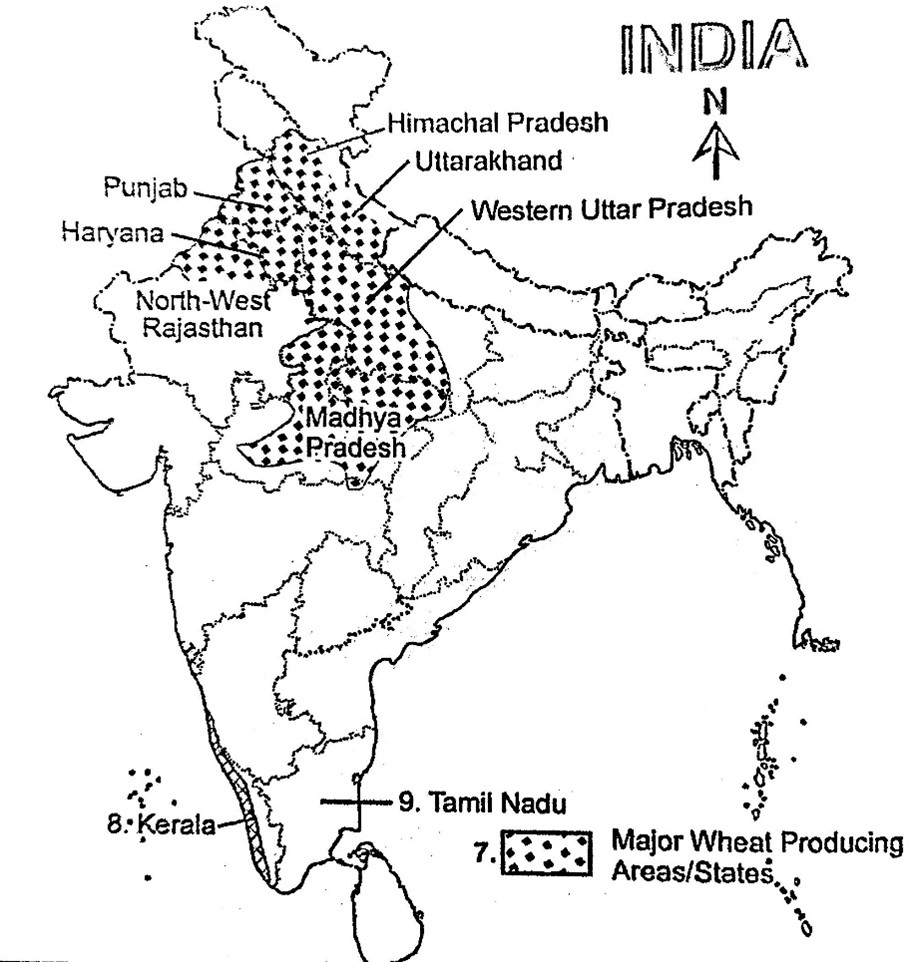
2. On the outline map of India show wheat producing areas.
Ans 2:
Activity
Solve the puzzle by following your search horizontally and vertically to find the hidden answers.

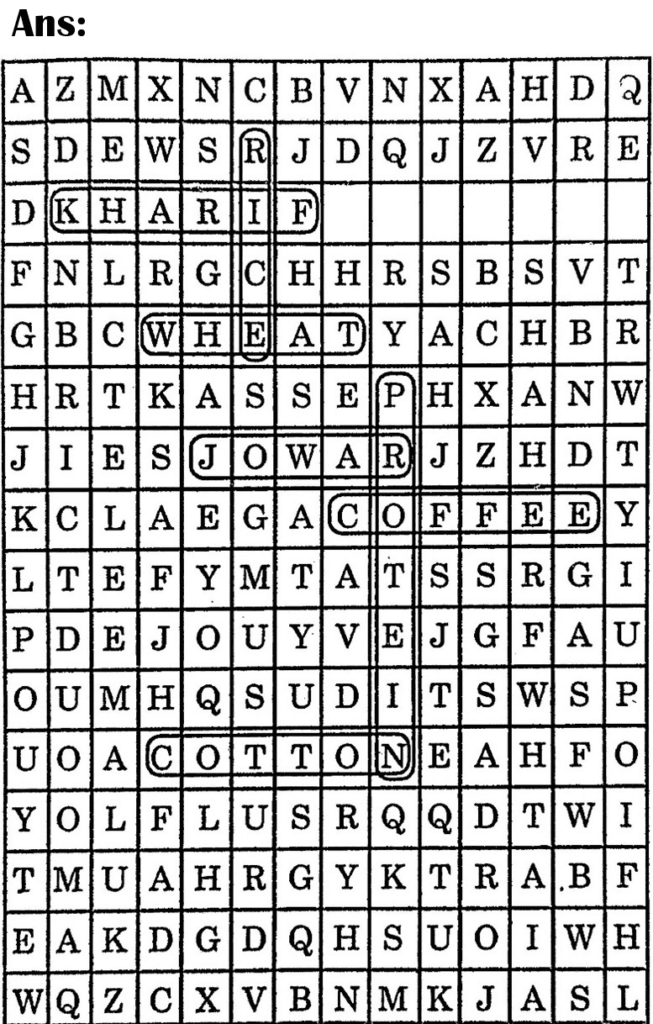
1. The two staple food crops of India.
Ans 1. Wheat, Rice
2. This is the summer cropping season of India.
Ans. Kharif
3. Pulses like arhar, moong, gram, urad contain.
Ans. Protein
4. It is a coarse grain.
Ans. Jowar
5. The two important beverages in India are
Ans. Tea, Coffee
6. One of the major fibers grown on black soils.
Ans. Cotton