
Chapter-6 Manufacturing Industries (GEOGRAPHY) for Class 10

Ultimate NCERT Solutions for Chapter-6 Manufacturing Industries
Updated Solution 2025-2026 Updated Solution 2025-2026
NCERT Solutions for Class 10 Geography, Ch-6 Manufacturing Industries
(Exercises, Question/Answers & Activities)
Chapter – 6 Manufacturing Industries
In Text Questions
Q 1. Do you have some ideas about these industries?
Ans 1: Diya-making is a cottage industry where members from two to three families typically work together. This type of industry focuses on creating handmade products, utilizing locally available raw materials. Common items produced in cottage industries include baskets, flower pots, and similar handcrafted goods.
Q 2. Classify the following into two groups on the basis of bulk and weight of raw material and finished goods.
(i) Oil
(ii) Knitting needles
(iii) Brassware
(iv) Fuse wires
(v) Watches
(vi) Sewing machines
(vii) Ship building
(viii) Electric bulbs
(ix) Paint brushes
(x) Automobiles
Ans 2:
Heavy industries | Light industries |
(i) Oil | (i) Knitting |
(ii) Brassware | (ii) Watches |
(iii) Ship building | (iii) Fuse wires |
(iv) Automobiles | (iv) Electric bulbs |
(v) Sewing machines | (v) Paint brushes |
Q 3. Why did Mahatma Gandhi lay emphasis on spinning yarn and weaving khadi?
Ans 3:
- To increase employment opportunities for a larger number of people.
- To inspire and strengthen a sense of national pride.
- To support and uplift the cottage industries.
- To reduce reliance on foreign-made fabrics and boycott imported cloth as a form of protest.
Q 4. Why is it important for our country to keep the mill sector loomage lower than power loom and handloom?
Ans 4:
- It will promote the growth of cottage industries.
- A larger number of rural residents will gain employment opportunities.
- The migration of rural residents to urban areas in search of jobs will decline.
- The living standards of people in rural areas will improve.
- This initiative will also contribute to earning foreign exchange, ultimately strengthening our country’s economy.
Q 5. Make a list of all such goods made of steel that you can think of.
Ans 5: Here is a list of steel-made goods:
knives, spoons, pots, pressure cookers, Steel chairs, tables, panels are essential in buildings, hammers, Steel pipes, bicycles, dumbbells, frames, lamps, Railway Tracks
Q 6. Where would it be economically viable to set up the cement manufacturing units?
Ans 6: Setting up cement manufacturing units is economically viable in areas with easy access to raw materials like limestone, clay, and gypsum, as well as nearby markets to reduce transportation costs. Regions close to power sources, such as coal or renewable energy, are also favorable, given the high energy requirements of cement production. Areas with established infrastructure for logistics, such as good road and rail connectivity, further support cost-efficiency. Additionally, setting up in regions with favorable government policies, subsidies, or tax incentives can make the operation more economically viable.
Q 7. Find out where the plants are located in other states of India. Find their names.
Ans 7: Plants in other Indian states are located as follows:
- Karnataka: Shahabad, Bhadravati
- Andhra Pradesh: Karimnagar, Vijayawada, Krishna
- Gujarat: Porbandar, Jamnagar
- Jharkhand: Dalmia Nagar, Sindri
EXERCISES
Q 1. Multiple choice questions:
(i) Which one of the following industries uses bauxite as a raw material?
(a) Aluminum Smelting
(b) Cement
(c) Paper
(d) Steel
Ans (i): (a) Aluminum Smelting: Bauxite is primarily used as the raw material for producing aluminum.
(ii) Which one of the following industries manufactures telephones, computer, etc.
(a) Steel
(b) Electronic
(c) Aluminum smelting
(d) Information Technology
Ans (ii). (b) Electronic: The electronics industry manufactures telephones, computers, and other electronic devices.
2. Answer the following briefly in not more than 30 words:
(i) What is manufacturing?
Ans (i): Manufacturing is the process of transforming raw materials into finished products through various methods, including machining, assembling, and fabrication, to meet consumer demand and create economic value.
(ii) What are basic industries? Give an example.
Ans (ii): Basic industries are essential sectors that produce raw materials for other industries. An example is the steel industry, which provides steel for construction, manufacturing, and various engineering applications.
3. Write the answers of the following questions in 120 words:
(i) How do industries pollute the environment?
Ans (i): Industries contribute to environmental pollution in several ways:
- Air Pollution: Emission of harmful gases like sulfur dioxide and nitrogen oxides from factories can lead to smog and respiratory problems.
- Water Pollution: Industrial discharge often contains toxic chemicals that contaminate rivers, lakes, and groundwater, harming aquatic life and affecting drinking water.
- Soil Contamination: Improper disposal of hazardous waste can lead to soil degradation, affecting agriculture and ecosystems.
- Noise Pollution: Manufacturing processes generate excessive noise, disrupting local wildlife and affecting human health.
- Waste Generation: Industries produce large amounts of solid waste, often disposed of improperly, contributing to landfills and environmental degradation.
(ii) Discuss the steps to be taken to minimise environmental degradation by industry?
Ans (ii): To minimize environmental degradation caused by industry, several key steps can be implemented:
- Adopt Sustainable Practices: Industries should embrace eco-friendly technologies and sustainable resource management to reduce waste and energy consumption.
- Implement Waste Management Systems: Establish comprehensive recycling and waste reduction programs to manage industrial waste effectively.
- Use Clean Energy: Transition to renewable energy sources, such as solar, wind, and hydro, to minimize carbon footprints.
- Conduct Environmental Impact Assessments: Regular assessments can help identify potential environmental impacts and inform better decision-making.
- Promote Green Supply Chains: Encourage suppliers to adopt sustainable practices, ensuring a lower environmental impact across the supply chain.
- Engage in Corporate Social Responsibility: Companies should actively participate in community initiatives focused on environmental conservation and sustainability.
Activity
Q 1. Give one word for each of the following with regard to industry. The number of letters in each word are hinted at in brackets.
(i) Used to drive machinery (5) P………………………
(ii) People who work in a factory (6) W……………………..
(iii) Where the product is sold (6) M……………………..
(iv) A person who sells goods (8) R………………………
(v) Thing produced (7) P………………………
(vi) To make or produce (11) M……………………..
(vii) Land, Water and Air degraded (9) P………………………
Ans 1:
(i) Power
(ii) Worker
(iii) Market
(iv) Retailer
(v) Product
(vi) Manufacture
(vii) Pollution
Project work
Q 1. Select one agro-based and one mineral based industry in your area.
(i) What are the raw materials they use?
(ii) What are the other inputs in the process of manufacturing that involve transport cost?
(iii) Are these factories following environmental norms?
Ans 1: Agro-Based Industry: Rice Mill
(i) Raw Materials Used
- Paddy (Rice): The primary raw material, sourced from local farmers.
- Water: Essential for the milling process, particularly for washing the rice.
- Packaging Materials: Used for packing the processed rice, often made of jute or plastic.
(ii) Other Inputs and Transport Costs
- Fuel: Diesel or electricity is required for running machinery, which incurs transport costs when procuring fuel from suppliers.
- Machinery: The transportation of milling machines and spare parts adds to the cost.
- Labor: Workers may need to be transported from surrounding areas, contributing to overall transport costs.
- Packaging Supplies: Transporting packaging materials to the mill adds additional logistical costs.
(iii) Environmental Norms
Most modern rice mills are required to adhere to environmental regulations, which include:
- Waste Management: Proper disposal of husk and other by-products.
- Water Management: Treatment of wastewater to prevent contamination.
- Air Quality Standards: Use of dust collectors to minimize air pollution.
These measures ensure compliance with local and national environmental laws.
ACTIVITY
Q 1. Solve the puzzle by following your search horizontally and vertically to find the hidden answers.
- Textiles, sugar, vegetable oil and plantation industries deriving raw materials from agriculture are called.
- The basic raw material for sugar industry.
- This fibre is also known as the ‘Golden Fibre’.
- Iron-ore, coking coal, and limestone are the chief raw materials of this industry.
- A public sector steel plant located in Chhattisgarh.
Ans 1:
- Agro-based industries
- Sugarcane
- Jute
- Iron-steel industry
- Bhilai
Q 2. Solve the puzzle by following your search horizontally and vertically to find the hidden answers.

- Textiles, sugar, vegetable oil and plantation industries deriving raw materials from agriculture are called…
- The basic raw material for sugar industry.
- This fibre is also known as the ‘Golden Fibre’.
- Iron-ore, coking coal, and limestone are the chief raw materials of this industry.
- A public sector steel plant located in Chhattisgarh.
- Railway diesel engines are manufactured in Uttar Prad
Ans 2:
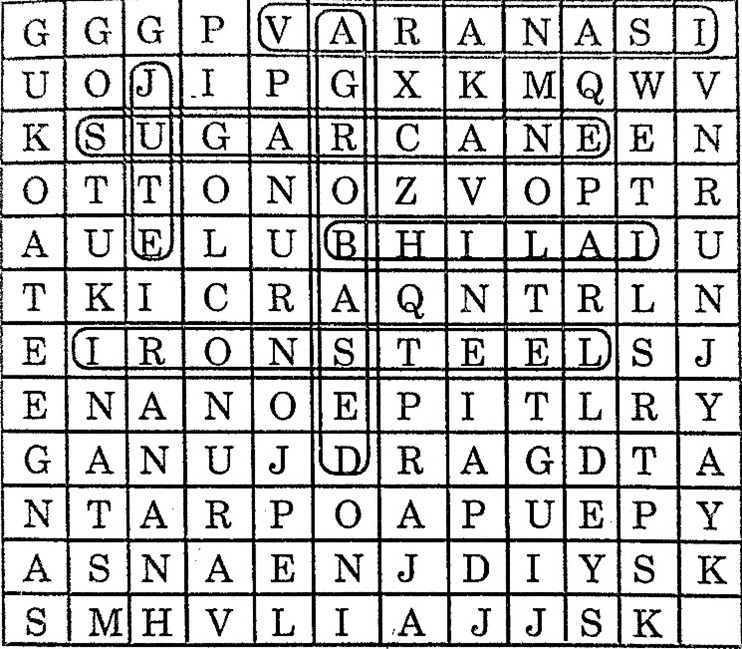
Ans 2:
- Agro-based industries
- Sugarcane
- Jute
- Iron-steel industry
- Bhilai
- Varanasi