
Chapter 3 Gender Religion and Caste (Political Science) for Class 10
Ultimate NCERT Solutions for Ch 3 Gender Religion and Caste
Updated Solution 2025-2026 Updated Solution 2025-2026
NCERT Solutions for Class 10 (Political Science)Ch 3 Gender Religion and Caste
(Exercises, Question/Answers & Activities)
Chapter 3 Gender Religion and Caste
ACTIVITY AND IN-TEXT QUESTIONS
Let Us Read the Image
Q 1. Discuss all these perceptions of an ideal woman that prevail in our society. Do you agree with any of these? If not, what is your image of an ideal woman?
Ans 1: It’s encouraging to see women demonstrating their talents across all areas of life. It wouldn’t be fair to define women by just one perspective or portrayal. In my opinion, an ideal woman is someone who can balance both household responsibilities and a career. Achieving this balance, however, requires equal support from men.
Let Us Do It
Q 1. A ‘time use survey’ was conducted in six states of our country. It shows that an average woman works every day for a little over seven and half bours while an average man works for six and a half hours. Yet the work done by men is more visible because most of their work leads to generation of income. Women also do a lot of direct income generating work, but the bulk of their work is household related. This work remains unpaid and invisible.
Daily time use (hours: minutes)
Activities | Men | Women |
Income generating work | 6:00 | 2:40 |
Household and related work | 0:30 | 5:00 |
Talking, Gossip | 1:25 | 1:20 |
No work/Leisure | 3:40 | 3:50 |
Sleep, self-care, reading, etc. | 12:25 | 11:10 |
Source: Government of India, Time Use Survey, 1998-99.
You can conduct a similar time use survey in your own household. Observe all the adult male and female members of your family for one week. Every day note down the number of hours each of them spends on the following activities: income generating activity (working at the office or shop or factory or field etc.), household related activity (cooking, cleaning, washing, fetching water, looking after children or elders etc.), reading and recreation, talking/gossiping, self-care, taking rest or sleeping. If necessary, make new categories: Add up the time taken on each activity for a week and calculate daily average for each activity for each member. Do women work more in your family as well?
Ans 1: The Time Use Survey conducted in six Indian states reveals that, on average, women work over seven and a half hours daily, while men work around six and a half hours. However, men’s work is often more visible as it mostly generates income, whereas women’s work, largely related to household chores, remains unpaid and invisible. The survey data shows women spend significantly more time on household tasks than men, highlighting the imbalance in unpaid work.
To explore this in your household, observe and record the daily time adult male and female family members spend on different activities for a week, categorizing them into income-generating work, household chores, leisure, self-care, etc. Summing up weekly hours for each activity, calculate the daily averages for each member. This can help you see if the work distribution in your family reflects similar patterns.
In-Text Questions (Page 43)
1. Can you identify your state on this map? What is the child sex ratio in it? How is it different from others with a different colour?
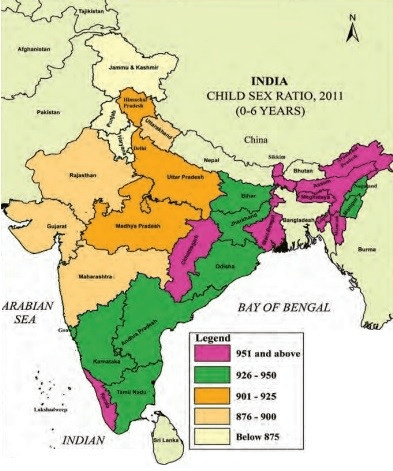
Ans 1: To analyze the map:
1. Identify Your State: Locate your state on the map of India. Each state is color-coded based on its child sex ratio as per the 2011 data for children aged 0-6 years.
2. Child Sex Ratio: Use the color legend provided on the map to determine the child sex ratio in your state:
- Green: 951 and above (high child sex ratio, with a more balanced ratio or female-favorable).
- Yellow: 926 – 950 (moderate child sex ratio).
- Orange: 901 – 925 (slightly lower ratio).
- Pink: 876 – 900 (low child sex ratio).
- Purple: Below 875 (very low child sex ratio, indicating male-dominated population).
3. Comparison with Other States: Compare your state’s color with others on the map.
- If your state is green, it has one of the highest child sex ratios, showing a better gender balance than states in orange, pink, or purple.
- If it’s yellow, orange, pink, or purple, it has a lower ratio than green-colored states, suggesting regional differences possibly due to cultural, economic, or social factors affecting gender ratios.
Q 2. Identify the states which have child sex ratio below 900.
Ans 2: The states with the majority of districts showing a child sex ratio below 900 include Rajasthan, Punjab, Haryana, Delhi, Gujarat, Maharashtra, Uttarakhand, and the Union Territories of Jammu & Kashmir and Ladakh.
Q 3. Compare this map with the poster on the next page. How do the two of them tell us about the same issue?
Ans 3: Both the map and poster are concerned about the decreasing trend of child sex ratio.
In-Text Questions
1. Could you think of some reasons why women’s representation is so low in India? Do you think Americas and Europe have achieved a satisfactory level of women’s representation?
Ans 1:
- Women’s literacy rates remain low, and even among educated women, there is limited political engagement. Many women, along with their male family members, believe that politics is not suitable for women. Additionally, political parties often do not allocate election tickets to female candidates in a way that reflects their population proportion.
- No, neither the Americas nor Europe has reached a satisfactory level of women’s representation in government. In the Americas, women make up only 20.2 percent of national parliament members, and in Europe, this figure is just 19.6 percent. These percentages do not align with the overall female population in these regions.
In-Text Question
Q 1: If casteism and communalism are bad, what makes feminism a good thing? Why don’t we oppose all those who divide the society on any line’s caste, religion or gender?
Ans 1: Feminism is a positive movement that advocates for equal rights and opportunities for all genders. Unlike social divisions such as communalism and casteism, which often perpetuate inequality, feminism emphasizes the importance of equality. Empowering women contributes to a more robust and equitable society.
Let’s Read the Cartoon
Q 1: This cartoon offers an understanding of why the Women’s Reservation Bill has not been passed in the Parliament. Do you agree with this reading.
Ans 1: The cartoon illustrates the male dominance within our legislative system. Each entrance to Parliament is heavily protected by men who seem unwilling to allow women inside. However, they feign intentions of soon enacting a bill to ensure women’s representation in the legislature.
In-Text Question
Q 1: I am not religious. Why should I bother about communalism and secularism?
Ans 1: If you do not adhere to any religious beliefs, it indicates a lack of faith in God. Communalism refers to a social issue stemming from the harmful attitudes exhibited by certain religious groups. Such behaviors can disrupt social harmony and strain relationships among different faith communities. Therefore, it is important to be concerned about communalism to foster peace within society.
Secularism, on the other hand, denotes the absence of a state religion, ensuring that the government treats all religions with equal respect. Regardless of your personal beliefs, it is essential to support secularism to prevent any form of favoritism or discrimination based on religion. This approach contributes to a positive environment within the nation.
In-Text Question
Q 1: I often crack jokes about people from one religion. Does that make me communal?
Ans 1: Religion represents the beliefs held by individuals or groups concerning their approach to worship and their connection with a particular supernatural entity. This belief system is deeply rooted in both personal conviction and community traditions. Therefore, it is important to avoid making jokes about individuals from any religious background, as such actions can lead to social unrest, for which one could be held accountable.
In-Text Questions
Q 1. I don’t care what my caste is. Why are we discussing all this in the textbook? Are we not promoting casteism by talking about caste?
Ans 1: India is a nation characterized by its linguistic diversity, religious plurality, and a complex caste system. It is widely acknowledged that individuals from various castes coexist within Indian society. This reality is undeniable and serves as the basis for discussing caste in this textbook. Simply addressing the issue of caste does not equate to endorsing casteism.
Q 2. Now you don’t like it! Didn’t you tell me that wherever there is domination, we should discuss it in political science? Will caste disappear if we keep mum about it?
Ans 2: (1) Caste plays a significant role in Indian politics today. Consequently, discussions in political science often arise whenever one caste asserts its dominance over others.
(2) Even if society chooses to remain silent about it, caste will persist in Indian politics, as it has become an integral component of both the political and social frameworks.
In-Text Question
Q 1: Do you think that political leaders are right to treat people belonging to a caste as ‘vote banks’?
Ans 1: I believe that it is misguided for political leaders to treat individuals from specific castes as mere vote banks. This approach fosters division within society, as politicians and political parties exploit caste identities for electoral gain. Such tactics can lead to increased tension among various caste groups, potentially resulting in violent clashes during election periods.
EXERCISES
Q 1. Mention different aspects of life in which women are discriminated or disadvantaged in India.
Ans 1:
(1) In the education sector, the literacy rate for women remains at just 54 percent.
(2) Women are significantly underrepresented in high-paying and prestigious jobs, indicating ongoing discrimination in the workforce.
(3) Gender-based discrimination is clearly reflected in the declining sex ratio, which has dropped to between 850 and 800 in certain regions of India.
(4) In politics, the representation of women is disproportionately low compared to their overall population.
Q 2. State different forms of communal politics with one example each.
Ans 2:
- Communal politics often manifests in daily beliefs, including biases against certain religions and stereotypes about religious groups.
- Another aspect of communal politics is the pursuit of political supremacy for one’s own religious community.
- Political mobilization based on communal affiliations is a common occurrence in communal politics.
- In some cases, communalism can devolve into its most horrific manifestations, such as violence, riots, and massacres.
Q 3. State how caste inequalities are still continuing in India.
Ans 3:
- People still prefer to marry within their own caste or community.
- Voters often support candidates from their own community.
- Despite constitutional measures, the practice of untouchability persists to some extent.
- Many traditional aspects of caste still exist today, and the impacts of historical privileges and disadvantages are ongoing.
- Caste remains closely associated with economic status.
- It has also become a significant factor in politics.
Therefore, it can be concluded that caste-based inequalities continue to exist in India.
Q 4. State two reasons to say that caste alone cannot determine election results in India.
Ans 4:
(1) In certain constituencies, voters might find multiple candidates representing their community or caste.
(2) No parliamentary constituency in our nation is dominated by a single caste with a clear majority.
Q 5. What is the status of women’s representation in India’s legislative bodies?
Ans 5:
(1) The proportion of women elected to the Lok Sabha has never exceeded 14.36 percent of its total membership.
(2) In state assemblies, the representation of women is below 5 percent.
Q 6. Mention any two constitutional provisions that make India a secular state.
Ans 6:
- The Constitution grants every person and community the right to embrace, practice, and promote any religion, or to choose not to follow any at all.
- The Constitution forbids discrimination based on religious beliefs.
Q 7. When we speak of gender divisions, we usually refer to:
(a) Biological difference between men and women
(b) Unequal roles assigned by the society to men and women
(c) Unequal child sex ratio
(d) Absence of voting rights for women in democracies
Ans 7: (b) Unequal roles assigned by the society to men and women.
Q 8. In India seats are reserved for women in
(a) Lok Sabha
(b) State legislative assemblies
(c) Cabinets
(d) Panchayati Raj bodies
Ans. (d) Panchayati Raj bodies
Note- [The 73rd Amendment to the Constitution of India, enacted in 1992, provides for the reservation of one-third of the total number of seats for women in Panchayati Raj institutions, which include the three tiers of local self-governance in rural areas: the village, block, and district levels. While there is also a proposal to reserve seats for women in the Lok Sabha and State Legislative Assemblies, this has not been implemented yet.]
Q 9. Consider the following statements on the meaning of communal politics. Communal politics is based on the belief that:
(A) One religion is superior to that of others
(B) People belonging to different religions can live together happily as equal citizens.
(C) Followers of a particular religion constitute one community.
(D) State power cannot be used to establish the domination of one religious group over others.
Which of the statements is/are correct?
(a) A, B, C and D
(b) A, B, and D
(c) A and C
(d) B and D
Ans 9: (c): A and C
Q 10. Which among the following statements about India’s Constitution is wrong? It
(a) prohibits discrimination on grounds of religion
(b) gives official status to one religion
(c) provides to all individuals freedom to profess any religion
(d) ensures equality of citizens within religious communities.
Ans 10: (b) gives official status to one religion.
Q 11. Social divisions based on _______ are peculiar to India.
Ans 11: Gender religion and caste.
Q 12. Match List I with List II and select the correct answer using the codes given below the Lists:
List I | List II |
1. A person who believes in equal rights and opportunities for women and men | A. Communalist |
2. A person who says that religion is the principal basis of community | B. Feminist |
3. A person who thinks that caste is the principal basis of community | C. Secularist |
4. A person who does not discriminate against others on the basis of religious beliefs | D. Castiest |
| 1 | 2 | 3 | 4 |
(a) | B | C | A | D |
(b) | B | A | D | C |
(c) | D | C | A | B |
(d) | C | A | B | D |
Ans 12: (b) 1-B, 2-A, 3-D, 4-C.
- A person who believes in equal rights and opportunities for women and men – This is a B). Feminist.
- A person who says that religion is the principal basis of community – This refers to a A). Communalist.
- A person who thinks that caste is the principal basis of community – This refers to a D. Castiest.
- A person who does not discriminate against others on the basis of religious beliefs – This is a C). Secularist.