
Chapter 1: Development (Economics) for Class 10
Ultimate NCERT Solutions for Class 10 – Chapter 1 Development
Updated Solution 2025-2026 Updated Solution 2025-2026
NCERT Solutions for Class 10 (Economics) Chapter 1 Development
(Exercises, Question/Answers & Activities)
Chapter 1 Development
ACTIVITY AND IN-TEXT QUESTIONS
Let’s Work these
Q 1. Let us try to imagine what development or progress is likely to mean to different persons listed in Table 1.1. What are their aspirations? You will find that some columns are partially filled. Try to complete the Table. You can also add any other category of persons.
Ans 1: Table 1.1 Developmental Goals of Different Categories of Persons
Category of Person | Developmental Goals/Aspirations |
Landless rural laborers | More days of work and better wages; local school is able to provide quality education for their children; there is no social discrimination and they too can become leaders in the village. |
Prosperous farmers from Punjab | Assured a high family income through higher support prices for their crops and through hardworking and cheap laborers, they should be able to settle their children abroad. |
Farmers who depend only on rain for growing crops | Seek enhancements in artificial irrigation systems, access to high-yield variety (HYV) seeds, chemical fertilizers, pesticides, and credit options to maximize their agricultural output. |
A rural woman from a land-owning family
| Desire a higher family income, equality in status and resources within the household, and access to quality education and health services. |
Urban unemployed youth | Aim for expanded job opportunities and increased access to vocational training and education programs. |
A boy from a rich urban family | Wants to receive top-tier education and have opportunities to study abroad; requires funding to launch his business ventures. |
A girl from a rich urban family | She gets as much freedom as her brother and is able to decide what she wants to do in life. She is able to pursue her studies abroad. |
An Adivasi from Narmada valley | Seek rehabilitation, steady employment, improved wages, and better education and health services for their children. |
Q 1. Why do different persons have different notions of development? Which of the following explanations is more important and why?
(a) Because people are different.
(b) Because life situations of persons are different.
Ans: (b) This is due to the varying circumstances individuals face in their lives. People pursue what they consider most essential, which often aligns with their aspirations and desires.
Q 2. Do the following two statements mean the same? Justify your answer:
(a) People have different developmental goals.
(b) People have conflicting developmental goals.
Ans 2. The two statements differ in their meanings, which can be illustrated through a specific example. Consider a boy from a wealthy urban family who aspires to obtain a high-quality education and secure capital for investment. In contrast, an Adivasi individual from the Narmada Valley seeks rehabilitation and stable employment opportunities. While their developmental objectives vary significantly, they do not necessarily conflict with one another.
Q 3. Give some examples where factors other than income are important aspects of our lives.
Ans 3:
- For women in rural areas, achieving gender equality often takes precedence over financial income.
- For individuals from scheduled castes and tribes, aspects like social equality, self-confidence, and self-esteem are often more crucial than monetary earnings.
- In the context of child labor, access to quality education and the ability to experience freedom are considered more important than income.
- For casual laborers, job security is prioritized over the potential for higher wages.
Q 4. Explain some of the important ideas of the above section in your own words?
Ans 4:
- Individuals desire increased earnings through consistent employment, improved wages, and higher prices for their goods.
- In addition to financial gain, people aim for various developmental objectives, including equality in society, personal freedom, safety, access to quality education, housing, healthcare, and a sense of self-worth.
- When it comes to development, individuals look for a combination of different goals.
- When women participate in the workforce, their status and respect within both their households and society tend to rise.
- A secure environment encourages women to pursue a wider range of job opportunities or to start their own businesses.
Let’s Work these out
Discuss the following situations:
1. Look at the picture on the right. What should be the developmental goals for such an area?
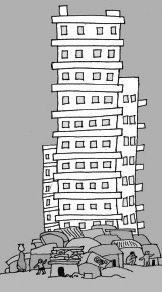
Ans 1:
- Construct Permanent Housing: It is essential to build durable homes for those living in slums.
- Ensure Access to Clean Water and Sanitation: Adequate water supply and proper sanitation facilities must be provided for these communities.
- Enhance Income through Employment: Improving work opportunities and ensuring fair wages can significantly boost their earnings.
- Provide Quality Education: Access to high-quality education is crucial for the children of these families.
- Promote Social Inclusion: It is vital to eliminate any form of social discrimination against these individuals.
Q 2. Read this newspaper report and answer the questions that follow:
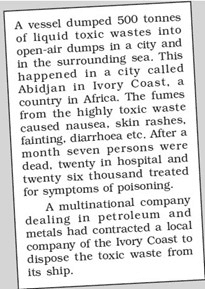
(i) Who are the people who benefited and who did not?
(ii) What should be the developmental goal for this country?
Ans 2.
(i) While the local business owner and the multinational corporation reaped the rewards, many innocent locals experienced significant hardships due to this situation.
(ii) The development objectives for this nation must include effective management of industrial waste and improved healthcare services for the population.
Q 3. What can be some of the developmental goals for your village, town or locality?
Ans 3:
- There is a need to generate job opportunities.
- Local schools must deliver high-quality education for students.
- Durable housing should be constructed for low-income families.
- Establishment of primary healthcare centers and hospitals is essential.
- The caste system and child labor must be eradicated.
- Gender equality should be upheld within families.
Activity 1
Q 1. If even the idea of what constitutes development can be varied and conflicting, then certainly there can be differences about ways of developing. If you know of any such controversy, try to find out arguments advanced by different people. You may do so by talking to different persons or you may find it from the newspapers and television.
Ans 1: The concept of development is indeed diverse and often contentious, leading to various approaches to achieving it. Here are some common controversies and the arguments surrounding them:
- Economic Growth vs. Sustainable Development:
- Proponents of Economic Growth argue that increasing GDP is essential for improving living standards, creating jobs, and funding public services. They believe that a focus on economic expansion leads to innovation and investment.
- Sustainable Development Advocates counter that relentless economic growth can lead to environmental degradation, social inequality, and depletion of natural resources. They argue for a balanced approach that considers ecological sustainability alongside economic advancement.
- Top-Down vs. Bottom-Up Approaches:
- Top-Down Approach Supporters assert that government-led initiatives can efficiently implement large-scale projects, citing examples of successful infrastructure development in rapidly growing economies.
- Critics of Top-Down Strategies highlight the importance of local knowledge and community involvement, advocating for bottom-up approaches. They argue that grassroots participation leads to more relevant and sustainable outcomes because it incorporates the needs and desires of the affected populations.
- Western Development Models vs. Indigenous Practices:
- Western Models often emphasize industrialization and modernization as the path to development. Proponents argue that these methods have historically lifted many countries out of poverty.
- Indigenous Practices Supporters argue that local traditions and practices can provide sustainable solutions tailored to specific contexts. They stress the importance of cultural sensitivity and preserving local identities, which can sometimes be overlooked in the pursuit of modernity.
- Globalization vs. Protectionism:
- Globalization Advocates claim that open markets lead to economic growth, technological advancement, and cultural exchange. They argue that globalization can lift people out of poverty by providing access to international markets.
- Protectionists, however, warn that globalization can harm local industries, lead to job losses, and exacerbate inequality. They argue for protective measures to support local economies and preserve cultural identities.
Q 2. Based on data given in Table 1.2, calculate the average income for both the countries.
(i) Will you be equally happy to live in both these countries?
(ii) Are both equally developed?
Ans 2: Table 1.2 Comparison of Two Countries
country | Monthly incomes of citizens (in rupees) | |||||
I | II | III | IV | V | Average | |
Country A | 9500 | 10500 | 9800 | 10000 | 10200 | 10000 |
Country B | 500 | 500 | 500 | 500 | 48000 | 13600 |
(i) No, because country B lacks a fair distribution of income.
(ii) No, country A maintains an equitable distribution of income among its population, while in country B, four out of five citizens live in poverty.
Let’s Work these
Q 1. Give three examples where an average is used for comparing situations.
Ans 1: (1) To evaluate the performance of cricket players, the average is calculated by dividing the total runs scored by the number of matches played, excluding instances where the player was not out.
(2) Average daily income is computed to assess the earnings of casual laborers, providing a clearer picture of their financial situation.
(3) Averages are also utilized to gauge students’ performance in examinations. This is done by adding up the marks obtained in all subjects, dividing by the total maximum marks available, and then multiplying by 100 to express the result as a percentage.
Q 2. Why do you think average income is an important criterion for development? Explain.
Ans 2: Average income is a crucial measure for assessing development because it provides insight into the economic well-being of individuals within a country. While total income reflects the overall wealth of a nation, it does not account for population size, which can distort the understanding of how much an average person earns. By calculating average income, or per capita income, we can better evaluate the standard of living and the distribution of wealth among the population. This metric helps to identify disparities in income, indicating whether the economic growth is benefiting the general populace or concentrated among a few. Thus, average income serves as a vital indicator of development, highlighting the economic conditions experienced by the average citizen.
Q 3. Besides size of per capita income, what other property of income is important in comparing two or more societies?
Ans 3: While per capita income serves as a valuable metric for comparison between different societies, it falls short in providing insights into the distribution of that income among the population. Therefore, in addition to considering the overall per capita income, it is crucial to assess the fairness of income distribution when comparing multiple societies.
Q 4. Suppose records show that the average income in a country has been increasing over a period of time. From this, can we conclude that all sections of the economy have become better? Illustrate your answer with an example.
Ans 4: The growth of a country’s average income over time does not necessarily indicate improvements across all sectors of the economy. For instance, in India, the average income has steadily risen since independence, with only a few years of decline. However, this growth has not been evenly distributed; the agricultural sector’s contribution to the overall economy has been shrinking. As a result, many farmers in India continue to face significant hardships and challenges, highlighting that rising average income does not equate to better living conditions for every group within the economy.
Q5. From the text, find out the per capita income level of low-income countries as per world Development Reports.
Ans 5: In 2017, the average income per person in low-income countries was approximately $955.
Q 6. Write a paragraph on your nation of what should India do, or achieve, to become a developed country. Ans. To become a developed country.
Ans 6: Here are some key points on what India should do to become a developed country:
- Economic Growth and Diversification: Focus on expanding sectors like manufacturing, technology, and services to create jobs and reduce dependence on agriculture.
- Infrastructure Development: Invest in transportation, energy, and urban infrastructure to improve connectivity and living standards.
- Education and Skill Development: Enhance the quality of education and vocational training to equip the workforce with necessary skills for the global job market.
- Healthcare Improvements: Strengthen healthcare systems to ensure access to quality medical services for all citizens, addressing both preventive and curative aspects.
- Technological Innovation: Foster a culture of research and development, supporting startups and innovation to boost competitiveness in various industries.
- Sustainable Practices: Implement policies for environmental sustainability, focusing on renewable energy, waste management, and conservation of resources.
- Social Equality: Promote gender equality, social inclusion, and poverty alleviation to ensure that development benefits all segments of society.
- Governance and Transparency: Strengthen democratic institutions, improve governance, and reduce corruption to build public trust and accountability.
- International Trade Relations: Expand trade partnerships and participate in global supply chains to enhance economic growth and resilience.
- Cultural Preservation and Promotion: Celebrate and promote India’s rich cultural heritage to strengthen national identity while fostering tourism and cultural exchange.
Let’s Work these out
Q 1. Look at data in Tables 1.3 and 1.4. Is Haryana ahead of Kerala in literacy rate, etc. as it is in terms of per capita income?
TABLE 1.3 PER CAPITA INCOME OF SELECT STATES
State Haryana | Per Capita Income for 2015-16 (in Rs.) |
Haryana Kerala Bihar | 1,80,174 1,63,475 34,409 |
TABLE 1.4 SOME COMPARATIVE DATA ON HARYANA, KERALA AND BIHAR
State
| Infant Mortality Rate per 1,000 live births (2017) | Literacy Rate (%) (2011)
| Net Attendance Ratio (per 100 persons) Secondary stage (age 14 and 15 years) I-V (2013-14) |
Haryana Kerala Bihar | 30 10 35 | 82 94 62 | 61 83 43 |
Ans 1: The per capita income of Haryana is around 10% higher than Kerala’s. However, while Kerala has a literacy rate of 94%, Haryana’s literacy rate is lower, standing at 82%.
Q 2. Think of other examples where collective provision of goods and services is cheaper than individual provision.
Ans 2: There are many instances were providing goods and services collectively is more efficient and affordable than individual arrangements.
- Healthcare: Public or community hospitals are generally more affordable and effective than hiring a private doctor or setting up medical facilities at home. Additionally, not all families can afford the expenses associated with private healthcare services.
- Electricity: Community electricity services, such as those provided by state electricity boards or companies like BSES in Delhi, offer power at a much lower cost compared to running individual home generators.
Q 3. Does availability of good health and educational facilities depend only on amount of money spent by the government on these facilities? What other factors could be relevant?
Ans 3: The availability of quality health and educational services is significantly influenced by government spending on these sectors; however, funding alone isn’t the only determining factor. Other key influences include:
- Government Commitment: The dedication and prioritization the government places on health and education greatly impact service quality.
- Private Sector Involvement: Participation from private organizations can also enhance these sectors by bringing in resources, expertise, and innovation.
- Public Awareness: Awareness among citizens regarding the importance of health and education plays a crucial role, as informed communities often push for better standards and accountability in these areas.
Q 4. In a study, it was found that in Tamil Nadu, 90 per cent of the people living in rural areas used a ration shop, whereas in West Bengal only 35 per cent of rural people did so. Where would people do better off and why?
Ans 4: The residents of Tamil Nadu, particularly in rural areas, benefit greatly from ration shops. Approximately 90% of the rural population relies on these shops to access essential items like food grains, sugar, and kerosene oil at prices significantly lower than market rates. This accessibility helps support their daily needs while easing financial burdens.
Activity 2
Q 1. Study Table 1.5 carefully and fill in the blanks in the following paragraphs. For this, you may need to make calculations based on the table.
Table 1.5 Educational Achievement of Rural Population of Uttar Pradesh
Category | Mal | Female |
| 76% 90% 85% | 54% 87% 82% |
Ans 1:
(a) In rural areas, the literacy rate stands at 76% for males and 54% for females across all age groups, young and old alike. This isn’t merely due to a lack of schooling opportunities in the past; currently, 16.5% of the population in rural regions is still out of school.
(b) The data shows that 18% of rural girls and 15% of rural boys are not attending school. Consequently, the illiteracy rate among children aged 10-14 is significantly high, at 13% for girls and 10% for boys in rural areas.
(c) Such high illiteracy rates within the 10-14 age group, even after over 68 years since independence, are particularly concerning. Many states remain far from achieving the constitutional goal of providing free and compulsory education to all children up to age 14, a target originally set for 1960.
EXERCISES
Q 1. Development of a country can generally be determined by
(i) its per capita income
(ii) its average literacy level
(iii) health status of its people
(iv) all the above
Ans 1: (iv) all the above.
Q 2: Which of the following neighboring countries has better performance in terms of human development than India?
- Bangladesh
- Sri Lanka
- Nepal
- Pakistan
Ans 2: (ii) Sri Lanka
Q 3. Assume there are four families in a country. The average per capita income of these families is Rs 5000. If the income of three families is Rs 4000, Rs 7000 and Rs 3000 respectively, what is the income of the fourth family?
- Rs 7500
- Rs 3000
- Rs 2000
- Rs 6000
Ans 3: (iv) Rs 6000
Q 4: What is the main criterion used by the World Bank in classifying different countries? What are the limitations of this criterion, if any?
Ans 4: World Bank Country Classification: Main Criterion
- Criterion: The World Bank primarily classifies countries based on Gross National Income (GNI) per capita. Countries are categorized as low-income, lower-middle-income, upper-middle-income, or high-income economies.
Limitations of GNI-based Classification:
- Ignores Inequality: GNI per capita does not account for income distribution, potentially overlooking income inequality within countries.
- Non-Monetary Factors: It does not consider social factors like education, health, and quality of life, which are crucial for a complete view of development.
- Currency Fluctuations: GNI is calculated in USD, so it can be impacted by currency fluctuations, which may misrepresent economic stability.
- Economic Complexity: It does not reflect other economic factors such as industrial diversity or technological development.
Q 5: In what respects is the criterion used by the UNDP for measuring development different from the one used by the World Bank?
Ans 5: The UNDP measures development primarily through the Human Development Index (HDI), focusing on health, education, and living standards. In contrast, the World Bank emphasizes economic indicators like GDP and income levels, prioritizing economic growth over broader social well-being.
Q 6: Why do we use averages? Are there any limitations to their use? Illustrate with your own examples related to development.
Ans 6: Why We Use Averages:
Averages provide a simple way to summarize and analyze data, helping to identify central trends and make comparisons. They are useful in various fields, including economics, education, and health.
Limitations of Averages:
- Sensitivity to Outliers: Averages can be skewed by extreme values. For example, in a small village, if one person earns significantly more than others, the average income may not represent the majority.
- Loss of Information: Averages do not convey the distribution of data. For instance, two populations may have the same average test scores but vastly different performance distributions, obscuring issues in one group.
Examples in Development:
- Income Levels: If a country has an average income of $50,000 but 90% of the population earns $20,000, the average gives a misleading impression of wealth distribution.
- Education Outcomes: In a school, if one student scores 100 on a test while others score below 50, the average score may suggest the class performed well, masking the challenges faced by most students.
Q 7: Kerala, with lower per capita income has a better human development ranking than Punjab. Hence, per capita income is not a useful criterion at all and should not be used to compare states. Do you agree? Discuss.
Ans 7: partially agree with the statement that per capita income is not a useful criterion for comparing states like Kerala and Punjab. Here are some points to consider:
- Human Development Index (HDI): Kerala has a higher HDI due to better health, education, and social welfare systems, indicating that income alone does not determine overall development.
- Social Indicators: Kerala excels in literacy rates and healthcare access, demonstrating that investment in social infrastructure can lead to better outcomes than mere income levels.
- Income Distribution: Per capita income can mask inequalities within a state. Punjab may have higher income but could face disparities that affect overall well-being.
- Quality of Life: Factors like environmental quality, life expectancy, and cultural amenities contribute significantly to human development, often more so than income alone.
- Economic Structure: The economic focus of a state (agriculture vs. industry) can influence development differently, making income a less reliable metric.
Q 8: Find out the present sources of energy that are used by the people in India. What could be the other possibilities fifty years from now?
Ans 8: Present Sources of Energy in India
- Coal: The primary source of energy, used mainly for electricity generation and industrial processes.
- Natural Gas: Increasingly used for power generation, cooking, and as a feedstock for fertilizers.
- Hydropower: Significant for electricity production, particularly in hilly regions.
- Renewable Energy: Rapidly growing sector including solar, wind, and biomass.
- Nuclear Energy: Contributes a small but vital share of electricity generation.
- Oil: Primarily used in the transportation sector.
Future Possibilities (50 Years from Now)
- Advanced Renewable Energy: Greater reliance on solar and wind energy, possibly through improved technologies like solar skins and offshore wind farms.
- Energy Storage Solutions: Advanced battery technologies and other storage solutions to manage intermittent renewable sources.
- Hydrogen Fuel: As a clean energy carrier, hydrogen could become a key player, particularly green hydrogen produced from renewable sources.
- Smart Grids: Enhanced energy distribution systems with real-time data to optimize energy usage and integrate diverse energy sources.
- Nuclear Fusion: Potential breakthroughs in fusion technology could provide a near-limitless and clean energy source.
- Waste-to-Energy Technologies: Advanced systems for converting waste into energy could help reduce landfill waste while generating power.
Q 9: Why is the issue of sustainability important for development?
Ans 9: The issue of sustainability is crucial for development because it ensures that resources are managed in a way that meets present needs without compromising the ability of future generations to meet their own. Sustainable development promotes economic growth while protecting the environment and fostering social equity. It addresses challenges like climate change, resource depletion, and social inequalities, ultimately leading to a healthier planet and improved quality of life for all. By integrating sustainability into development strategies, societies can create resilient economies, preserve biodiversity, and enhance the well-being of communities.
Q 10: “The Earth has enough resources to meet the needs of all but not enough to satisfy the greed of even one person”. How is this statement relevant to the discussion of development? Discuss.
Ans 10: The statement highlights the following points relevant to the discussion of development:
- Sustainable Development: It emphasizes the need for sustainable practices that meet present needs without compromising future generations’ ability to meet theirs.
- Resource Allocation: It points to the imbalance in resource distribution, where a few may hoard resources, leading to inequality and underdevelopment for others.
- Environmental Impact: The pursuit of excessive greed often results in environmental degradation, threatening the planet’s ability to provide for all.
- Equity and Justice: It calls for equitable resource distribution and policies that prioritize the needs of the vulnerable over the desires of the affluent.
- Social Responsibility: Encourages a mindset shift from individualism to collective responsibility, fostering community-oriented development strategies.
Q11: List a few examples of environmental degradation that you may have observed around you.
Ans 11: Here are a few examples of environmental degradation:
- Deforestation: Clearing of trees for agriculture or urban development.
- Air Pollution: Increased smoke and emissions from vehicles and industries.
- Water Pollution: Contaminated rivers and lakes due to industrial waste and plastic.
- Soil Erosion: Loss of fertile soil due to over-farming and deforestation.
- Biodiversity Loss: Decline in local wildlife and plant species due to habitat destruction.
- Waste Accumulation: Litter and non-biodegradable waste in public spaces.
Q 12: For each of the items given in Table 1.6, find out which country is at the top and which is at the bottom.
Ans 12: Based on the data provided in Table 1.6 regarding India and its neighbors for 2021, here’s the analysis of which country is at the top and which is at the bottom for each item:
- Gross National Income (GNI) per capita (2017 PPP $)
- Top: Sri Lanka ($12,578)
- Bottom: Pakistan ($4,624)
- Life Expectancy at Birth
- Top: Sri Lanka (76.4 years)
- Bottom: Myanmar (65.7 years)
- Mean Years of Schooling (People aged 25 and above)
- Top: Sri Lanka (10.8 years)
- Bottom: Pakistan (4.5 years)
- Human Development Index (HDI) Rank in the World (2021-22)
- Top: Sri Lanka (73)
- Bottom: Pakistan (161)
Summary:
- Top countries in each category: Sri Lanka
- Bottom countries in each category: Pakistan (for GNI, Mean Years of Schooling, and HDI Rank), Myanmar (for Life Expectancy).
Q 13: The following table shows the proportion of undernourished adults in India. It is based on a survey of various states for the year 2001. Look at the table and answer the following questions.
State | Males % | Females % |
Kerala Karnataka Madhya Pradesh | 8.5 17 28 | 10 21 28 |
All states | 20 | 23 |
(i) Compare the nutritional level of people in Kerala and Madhya Pradesh.
Ans 13 (i): In the 2001 survey data, the nutritional levels of adults in Kerala and Madhya Pradesh show significant differences:
- Kerala has a lower proportion of undernourished adults, with 8.5% of males and 10% of females affected.
- In contrast, Madhya Pradesh has much higher rates of undernourishment, with 28% of males and 28% of females reported.
Overall, Kerala demonstrates a better nutritional status compared to Madhya Pradesh, indicating more effective health and nutrition policies or better socioeconomic conditions in Kerala.
(ii) Can you guess why around 40 per cent of people in the country are undernourished even though it is argued that there is enough food in the country? Describe in your own words.
Ans 13 (ii): Around 40 percent of people in India are undernourished despite sufficient food availability due to issues like poverty, unequal distribution of resources, and lack of access to nutritious food. Socioeconomic factors, food wastage, and inadequate food security programs also contribute to this disparity, leading to many individuals not being able to afford or access the food they need for proper nutrition.