
Ch- 5- Print Culture and The Modern World (History) for Class 10
Ultimate NCERT Solutions for Class 10 –Ch 5: Print Culture and The Modern World
Updated Solution 2025-2026 Updated Solution 2025-2026
NCERT Solutions for Class 10 (History)Chapter 5 – Print Culture and The Modern World
(Exercises, Question/Answers & Activities)
Chapter 5 Print Culture and The Modern World
ACTIVITY AND IN-TEXT QUESTIONS
Activity (Page 108)
Q 1. Imagine that you are Marco Polo. Write a letter from China to describe the world of print which you have seen there.
Ans 1: Letter from Marco Polo
To my esteemed friends,
As I journey through the wondrous lands of China, I have encountered a remarkable invention: printing. The Chinese craft intricate woodblocks to reproduce texts and images, allowing knowledge to spread far and wide. This remarkable method captures the beauty of characters and illustrations with precision. Books are produced in abundance, making them accessible to many. This art of printing is a marvel that promises to transform the way we share stories and wisdom across the world.
Yours in discovery,
Marco Polo
Activity (Page 111)
Q 1. You are a bookseller advertising the availabilities of new cheap printed books. Design a poster for your shop window.
Ans 1:
CHEAPEST BOOK STALLDELHI |
BUY FOR THREEPAY ONLY TWO
|
|
Discuss (Page 113)
Q 1. Write briefly why some people feared that the development of print could lead to the growth of dissenting ideas.
Ans 1: Some people feared that the development of print could lead to the growth of dissenting ideas because it enabled the rapid spread of information and opinions. This democratization of knowledge threatened established authorities, such as the church and the state, as printed materials could promote alternative beliefs, challenge traditional narratives, and encourage critical thinking among the populace.
Activity (Page 116)
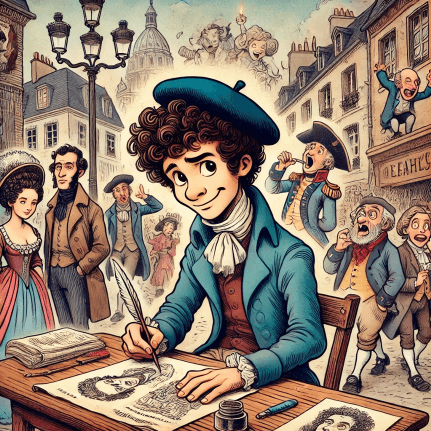
Q 1. Imagine that you are a cartoonist in France before the revolution. Design a cartoon as it would have appeared in a pamphlet.
Ans.
Discuss (Page 116)
Q 1. Why do some historians think that print culture created the basis for the French Revolution?
Ans 1: The following points support the notion that print culture played a significant role in fostering the conditions that led to the French Revolution:
- The printing press helped disseminate the ideas of Enlightenment philosophers like Voltaire and Rousseau.
- Together, their works offered critical insights into tradition, superstition, and authoritarianism, promoting the concept of reason. This encouraged individuals to challenge monarchical rule.
- The advent of printing fostered a new culture of dialogue and debate, juxtaposing traditional religious and political beliefs with emerging political and religious ideologies. This exchange facilitated the dissemination of revolutionary social ideas.
- Cartoons and caricatures produced through print technology ridiculed the monarchy and highlighted the hardships faced by ordinary people, further igniting revolutionary sentiments.
Activity (Page 118)
Q 1. Look at Fig. 13. What impact do such advertisements have on the public mind? Do you think everyone reacts to printed material in the same way?
Ans 1:
- Advertisements have a significant impact on people’s perceptions. They can steer individuals’ thoughts and encourage them to purchase the promoted items.
- Not everyone responds to written content in a uniform manner.
Activity (Page 126)
Q 1. Look at Figs. 19, 20 and 21 carefully.
(i) What comments are the artists making on the social changes taking place in society?
(ii) What changes in society were taking place to provoke this reaction?
(iii) Do you agree with the artist’s view?
Ans 1:
(i) In Figure 19, the man seems controlled by his wife, but at the same time he controls his mother. The artist is showing that traditional family power relationships were changing. Earlier, mothers-in-law had authority over daughters-in-law through their sons, but this old system was beginning to break down.
In Figure 20, the artist shows a complete reversal of traditional roles. The woman is relaxing and smoking a hookah, while the man is playing the veena for her. This suggests that men and women’s roles in society were changing.
Figure 21 suggests that these social changes did not greatly affect English families. According to the artist, their family structure remained mostly the same.
(ii) These reactions were caused by major changes in society, especially the growing influence of Western education and ideas. Women began gaining more freedom and respect, and this shift disturbed traditional customs. Artists responded to these changes by creating satirical and exaggerated images of Indian families.
(iii) In my opinion, the artists’ views are exaggerated and not fully realistic. While social change was happening, it was not as extreme as shown in the illustrations. A more balanced and fair representation would have given a clearer picture of the changes taking place in Indian society.
EXERCISES
Write in Brief
Q1. Give reasons for the following:
(a) Woodblock print only came to Europe after 1295.
(b) Martin Luther was in favour of print and spoke out in praise of it.
(c) The Roman Catholic Church began keeping an Index of prohibited books from the mid-sixteenth century.
(d) Gandhi said the fight for Swaraj is a fight for liberty of speech, liberty of the press and freedom of association.
Ans 1:
(a) In 1295, Marco Polo, the Italian explorer, returned to Europe after an extended stay in China, where he encountered the widespread use of woodblock printing. He introduced this printing method to Europe upon his return.
(b) Martin Luther, through the dissemination of his Protestant beliefs, confronted the traditional practices and rituals of the Roman Catholic Church. His translation of the New Testament led to the sale of 5,000 copies in a remarkably short period, a feat made possible by printing technology. Consequently, he advocated for the use of print and praised its significance.
(c) Starting from the mid-16th century, the Roman Catholic Church faced numerous challenges as various authors produced books that presented personal interpretations of God and creation. In response, the Church prohibited such publications and maintained a record of them, known as the Index of Prohibited Books.
(d) According to Gandhi, the freedom of speech, press, and the right to associate were essential tools for fostering and expressing public opinion. He asserted that the struggle for Swaraj represented a quest for these liberties.
Q 2. Write short notes to show what you know about:
(a) The Gutenberg Press.
(b) Erasmus’s idea of printed book.
(c) The Vernacular Press Act.
Ans 2: (a) The Gutenberg Press
The Gutenberg Press, invented by Johannes Gutenberg in the mid-15th century, revolutionized the production of books and the spread of knowledge in Europe. It was the first movable type printing press, which allowed for the efficient mass production of texts. This innovation dramatically reduced the cost of books, making them more accessible to a wider audience, which contributed to the rise of literacy and the dissemination of ideas during the Renaissance and the Reformation. The Gutenberg Bible, printed around 1455, is one of the most famous products of this press, exemplifying the technological advancements of the time.
(b) Erasmus’s Idea of Printed Book
Desiderius Erasmus, a Dutch humanist and theologian, recognized the transformative power of printed books in the early 16th century. He believed that the availability of printed texts could promote education, facilitate the spread of classical knowledge, and encourage religious reform. Erasmus advocated for the use of the printing press to disseminate scholarly works, including his own writings, which aimed to challenge corrupt practices within the Church. He saw the printed book as a means to empower individuals through learning and to foster critical thinking in society.
(c) The Vernacular Press Act
The Vernacular Press Act was enacted in India in 1878 by the British colonial government to curb the freedom of the press, particularly targeting Indian-language newspapers and publications. The Act aimed to suppress nationalist sentiments and criticism of British rule by imposing restrictions on vernacular publications. It allowed authorities to prohibit any publication deemed seditious or harmful to public peace. The Act faced strong opposition from Indian intellectuals and reformers, leading to debates about freedom of expression and the role of the press in society. Its enforcement contributed to the growth of the Indian nationalist movement, as it galvanized support for greater press freedoms.
Q 3. What did the spread of print culture in 19th century India mean to:
(a) Women
(b) The poor
(c) Reformers.
Ans 3: The spread of print culture in 19th century India had significant implications for various groups:
(a) Women: Print culture facilitated the dissemination of ideas about women’s rights and education, leading to greater awareness and activism. Women’s magazines and literature provided a platform for discussions on social issues, encouraging women’s participation in public life.
(b) The Poor: Access to printed material, including newspapers and pamphlets, educated the poor about social and political issues, fostering a sense of identity and empowerment. It helped spread awareness of rights and mobilized communities for social change.
(c) Reformers: Reformers utilized print to promote social and religious reforms, spreading their ideas widely and rallying support for causes like caste reform, women’s rights, and education. Print culture enabled them to reach a broader audience and challenge traditional norms.
Discuss
Q 1. Why did some people in 18th century Europe think that print culture would bring enlightenment and end despotism?
Ans 1:
(1) In 18th-century Europe, individuals such as Louise-Sebastien Mercier believed that print culture could raise awareness and enhance understanding among the general populace.
(2) They argued that it had the power to encourage rational thought and ultimately shape public opinion.
Q 2. Why did some people fear the effect of easily available printed books? Choose one example from Europe and one from India.
Ans 2: Some people feared the effect of easily available printed books because they believed such access could spread dangerous ideas and challenge traditional authority.
Example from Europe: In the 16th century, the Protestant Reformation was fueled by the printing of Martin Luther’s 95 Theses, which criticized the Catholic Church. This led to widespread religious dissent and the fear of social upheaval among the church and state authorities.
Example from India: During the 19th century, British colonial authorities worried about the potential of printed materials, like pamphlets and newspapers, to incite rebellion and challenge colonial rule. The spread of nationalistic ideas through printed books was seen as a threat to their control over Indian society.
Q 3. What were the effects of the spread of print culture for poor people in nineteenth century India?
Ans 3: The expansion of print culture in India during the 19th century had several impacts on impoverished communities:
- A number of individuals found jobs in printing establishments.
- They gained access to national, international, and local news through affordable printed materials.
- The emergence of the Vernacular press helped instill nationalist sentiments among the poorer population.
- Print culture highlighted caste discrimination, which encouraged the participation of impoverished individuals in the nationalist freedom movement.
- Important messages, such as the need to limit excessive drinking and promote literacy among the poor, were disseminated through print media.
Q 4. Explain how print culture assisted the growth of nationalism in India.
Ans 4: The growth of print culture significantly contributed to the rise of nationalism in India in several ways:
- The vernacular press played a crucial role in exposing the exploitative practices of the colonial government.
- Government mismanagement and attempts to suppress press freedom fueled nationalist sentiments that advocated for press liberties.
- Revolutionary ideas were disseminated discreetly through various print media.
- National newspapers consistently aimed to galvanize public opinion among the Indian populace.
- The emergence of new literary forms, such as novels, poetry, essays, journals, and newspapers, fostered a sense of value and identity among readers.
- Print culture also facilitated education, cultivating receptive minds influenced by the reformist and nationalist ideologies of leaders like Raja Ram Mohan Roy and Mahatma Gandhi.
PROJECT
Q 1. Find out more about the changes in print technology in the last 100 years. Write about the changes, explaining why they have taken place, what their consequences have been.
Ans 1: Here’s a summary of the changes in print technology over the last century, including the reasons behind these changes and their consequences:
Changes in Print Technology
- Introduction of Offset Printing (1930s)
- Reason: Improved efficiency and quality in mass production.
- Consequence: Allowed for high-quality prints at lower costs, making printed materials more accessible.
- Digital Printing Emergence (1980s)
- Reason: Advancements in computer technology and imaging.
- Consequence: Enabled on-demand printing, reducing waste and allowing for customization.
- Desktop Publishing (Late 1980s)
- Reason: Availability of personal computers and software like Adobe PageMaker.
- Consequence: Empowered individuals and small businesses to create professional-looking publications without needing large printing houses.
- Print on Demand (1990s)
- Reason: Digital printing capabilities and e-commerce growth.
- Consequence: Allowed authors to publish books with minimal upfront investment, transforming the publishing industry.
- 3D Printing (2000s)
- Reason: Technological innovation in materials and design.
- Consequence: Expanded the concept of printing from two dimensions to three, enabling rapid prototyping and manufacturing.
- Sustainability Initiatives
- Reason: Growing environmental awareness and regulations.
- Consequence: Shift toward eco-friendly inks, recyclable materials, and energy-efficient printing processes.
- Integration of Augmented Reality (2010s)
- Reason: Rise of smartphones and digital interactivity.
- Consequence: Enhanced printed materials with interactive content, bridging the gap between physical and digital experiences.
- Rise of E-Books and Digital Content (2000s-present)
- Reason: Proliferation of digital devices and consumer preference for digital formats.
- Consequence: Decreased demand for traditional print media, impacting bookstores and print publishers.
Summary
These changes in print technology have been driven by technological advancements, consumer preferences, and environmental considerations. The consequences include increased accessibility to printed materials, changes in publishing dynamics, and a growing emphasis on sustainability and interactivity. As technology continues to evolve, the landscape of print will likely keep transforming, influencing how we consume and interact with printed content.