
Chapter-2- Sectors of The Indian Economy (Economics) for Class 10

Ultimate NCERT Solutions for Class 10 –
Chapter-2- Sectors of The Indian Economy
Updated Solution 2025-2026 Updated Solution 2025-2026
NCERT Solutions for Class 10 (Economic) Ch-2- Sectors of The Indian Economy
(Exercises, Question/Answers & Activities)
Chapter-2- Sectors of The Indian Economy
ACTIVITY AND IN-TEXT QUESTIONS
LET’S WORK THESE OUT
Q 1. Complete the above table to show how sectors are dependent on each other.
Ans 1:
Example | What does this show? |
Imagine what would happen if farmers refuse to sell sugarcane to a particular sugar mill. The mill will have to shut down. | This is an example of the secondary or industrial sector being dependent on the primary. |
Imagine what would happen to cotton cultivation if companies decide not to buy from the Indian market and import all cotton, they need from other countries. Indian cotton cultivation will become less profitable and the farmers may even go bankrupt, if they cannot quickly switch to other crops. Cotton prices will fall. | An example of the primary sector’s dependency on the secondary sector is when agriculture relies on manufacturing for tools, machinery, and processing facilities to produce and package goods.
|
Farmers buy many goods such as tractors, pump sets, electricity, pesticides and fertilisers. Imagine what would happen if the price of fertilisers or pump sets go up. Cost of cultivation of the farmers will rise and their profits will be reduced. | The primary sector relies on the secondary sector for processing and adding value to raw materials.
|
People working in industrial and service sectors need food. Imagine what would happen if there is a strike by transporters and lorries refuse to take vegetables, milk, etc. from rural areas. Food will become scarce in urban areas whereas farmers will be unable to sell their products. | The secondary and tertiary sectors rely on the primary sector, while the primary sector depends on the tertiary. This highlights the strong interdependence among all sectors.
|
Q 2. Explain the difference between primary, secondary and tertiary sectors using examples other than those mentioned in the text.
Ans 2: Primary Sector: Activities directly utilizing natural resources, like growing wheat.
Secondary Sector: Transforming primary goods into different products through manufacturing, such as making paper from bamboo.
Tertiary Sector: Services that support the primary and secondary sectors, like transportation, retail, and legal services.
Q 3. Classify the following list of occupations under primary, secondary and tertiary sectors:
- Tailor
- Basket weaver
- Flower cultivator
- Milk vendor
- Fishermen
- Priest
- Courier
- Workers in match factory
- Moneylender
- Gardener
- Potter
- Bee-keeper
- Astronaut
- Call center employee
Ans 3: This list of occupations can be classified into primary, secondary and tertiary sectors as follows:
Sectors of the economy | Occupations |
Primary sector | Flower cultivator, fishermen, gardener, bee-keeper |
Secondary sector | Basket weaver, workers in match factory, potter |
Tertiary sector | Tailor, milk vendor, priest, courier, moneylender, astronaut, call center employee |
Q 4. Students in a school are often classified into primary and secondary or junior and senior. What is the criterion that is used? Do you think this is a useful classification? Discuss.
Ans 4:
- The classification of students into primary, secondary, junior, or senior is based on their educational level.
- Yes, this classification is useful.
Primary Education: According to our Constitution, the state should ensure free, compulsory education for children under 14 years of age. Primary education provides foundational knowledge for further skill development.
Secondary Education: For students aged 14-18, secondary education prepares them for higher studies and job opportunities.
Let’s Work these out
Q 1. What does the history of developed countries indicate about the shifts that have taken place between sectors?
Ans 1:
- In the early stages of development, developed countries focused heavily on the primary sector, especially agriculture, which provided ample food and employment.
- Over the next century, industrialization introduced manufacturing methods, leading to the expansion of factories. Consequently, the secondary sector became dominant in production and employment.
- In the last century, economies shifted further toward the tertiary sector, with services now playing the most crucial role in production and employment.
This progression of sectoral importance reflects the general development pattern in advanced economies.
Q 2. Correct and arrange the important aspects for calculating GDP from this Jumble.
To count goods and services we add the numbers that are produced. We count all those that was produced in the last five years. Since we shouldn’t leave out anything we add up all these goods and services.
Ans 2: To calculate GDP, we sum the value of all final goods and services produced across different sectors in a specific year. This ensures that we include all contributions to the economy by aggregating output from each sector.
Let’s Work these out (Page 24)
Answer the following questions by looking at the graph.
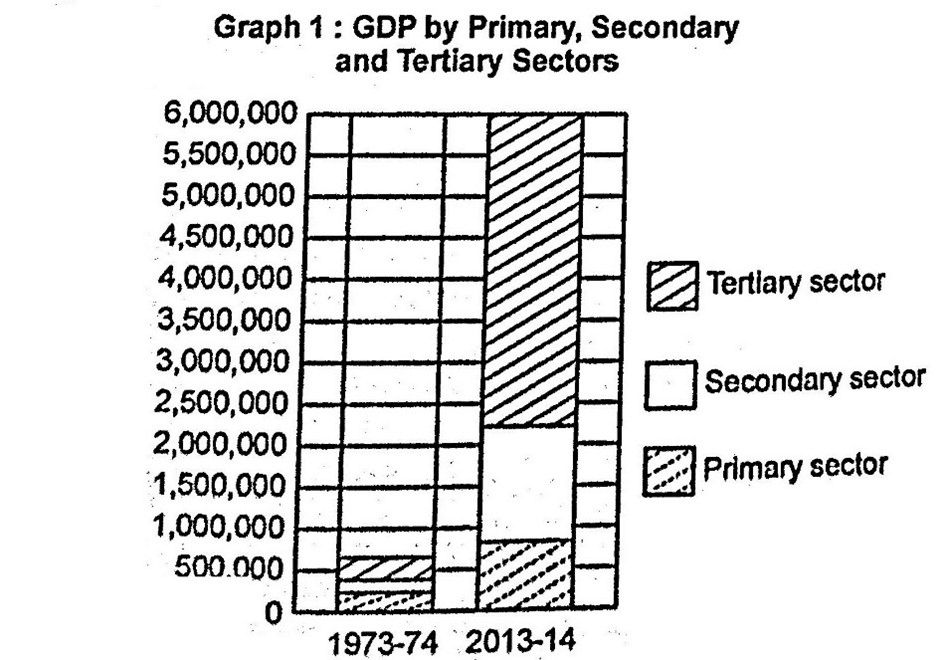
Q 1. Which was the largest producing sector in 1973-747
Ans 1: In 1973, the primary sector led production.
Q 2. Which is the largest producing sector in 2013-14?
Ans 2: In 2013, the tertiary sector became the largest production sector.
Q 3. Can you say which sector has grown the most over forty years?
Ans 3: “Over the past three decades, the tertiary sector has experienced the most significant growth compared to other sectors.”
Q 4. What was the GDP of India in 2013-14?
Ans 4: India’s GDP for the fiscal year 2013-14 was ₹56.25 lakh crores.
Let’s Work these out (Page 27)
Q 1. Complete the table using the data given in Graphs 2 and 3 and answer the question that follows. Ignore if data are not available for some years.
TABLE 2.2 SHARE OF PRIMARY SECTOR IN GDP AND EMPLOYMENT 2013-14 2017-18 | ||||
| 1973-74 | 1977-78 | 2013-14 | 2017-18 |
Share in GDP | ||||
Share in employment | ||||
- What are the changes that you observe in the primary sector over a span of forty years?
Ans 1:
TABLE 2.2 SHARE OF PRIMARY SECTOR IN GDP AND EMPLOYMENT 2013-14 2017-18 | ||||
| 1973-74 | 1977-78 | 2013-14 | 2017-18 |
Share in GDP | 40 % | —— | 19% | ——- |
Share in employment | —– | 71% | ——- | 44% |
In the last three decades, I have noticed several significant transformations in the primary sector:
- The contribution of the primary sector to the Gross Domestic Product (GDP) has declined substantially, dropping from 40% to 13%.
- Unlike the GDP share, the employment percentage in the primary sector has not decreased as markedly, falling from 73% to only 48%.
- Despite more than half of the country’s workforce being employed in the primary sector, this sector generates merely a quarter of the total GDP.
- There is an oversupply of labor in agriculture, indicating that many workers in this sector are underemployed and not fully utilized.
Q 2. Choose the correct answer:
Underemployment occurs when people
(i) do not want to work
(ii) are working in a lazy manner
(iii) are working less than what they are capable of doing
(iv) are not paid for their work
Ans 2: (iii) are working less than what they are capable of doing.
Q 3. Compare and contrast the changes in India with the pattern that was observed for developed countries. What kind of changes between sectors were desired but did not happen in India?
Ans 3: To compare and contrast the changes in India with those observed in developed countries, we can analyze various sectors such as agriculture, industry, and services. Below is a table summarizing these changes, highlighting the desired changes that did not occur in India.
Aspect | Developed Countries | India | Desired Changes in India |
Agriculture | Shift from subsistence to commercial farming. | Still heavily reliant on subsistence farming. | Increased productivity and modernization in agriculture. |
Industrialization | Rapid industrial growth with high technological adoption. | Slower industrial growth, with many small-scale industries. | Transition to large-scale manufacturing and tech integration. |
Services Sector | Dominance of high-value service sectors (e.g., finance, IT). | Growth in IT, but lower value-addition in many services. | Expansion of high-value, export-oriented services. |
Urbanization | High levels of urbanization with developed infrastructure. | Rapid urbanization but inadequate infrastructure. | Improved urban infrastructure and urban planning. |
Labor Market | Skilled labor force with high productivity. | High levels of informal employment, low skill levels. | Skill development and transition to formal employment. |
Economic Growth | Sustained economic growth with stability. | High growth but volatility and inequality issues. | Stable, inclusive growth reducing disparities. |
Conclusion
India has made notable strides in several areas, yet it still trails behind developed nations in achieving higher agricultural productivity, strong industrial growth, advanced services, and better labor market conditions. Ongoing efforts to modernize these sectors and promote inclusive growth are essential for the country’s future development.
Q 4. Why should we be worried about under- employment?
Ans 4: Underemployment occurs when individuals are employed but not utilizing their full potential, often performing jobs that do not match their skills or education. This phenomenon can be described as disguised or hidden unemployment.
Concerns:
- Widespread Issue: Millions in India face underemployment, particularly in the agricultural sector, but it also affects casual workers in urban service industries.
- Economic Inefficiency: Underemployment limits economic productivity and growth, as individuals are not contributing fully to the workforce.
Addressing underemployment is crucial for enhancing overall economic health and improving individuals’ livelihoods. these people work elsewhere, the income earned by them would increase the total family income.
In-Text Question
Q 1: What groups of people do you think are unemployed or underemployed in your area? Can you think of some measures that could be taken up for them?
Ans 1: Groups Affected
In our community, several demographics are facing unemployment or underemployment challenges, including:
- Scheduled Castes
- Scheduled Tribes
- Households of Agricultural Laborers
- Small Farmer Households
- Casual Workers (such as painters, plumbers, repair personnel, and street vendors)
Suggested Measures
To address these issues, the following actions could be considered:
- Implementation of Employment Generation Programs: Quick and effective employment initiatives should be established and executed with dedication and transparency.
- Enhancement of Irrigation Facilities: Improving irrigation systems will support agricultural productivity and create more job opportunities.
- Investment in Infrastructure: The government should focus on developing infrastructure, such as roads and transportation systems, to facilitate farmers in accessing local markets to sell their products.
- Provision of Low-Interest Credit Facilities: Unemployed or underemployed individuals should have access to affordable credit options to help them start small businesses, fostering economic growth within the community.
In-Text Questions
Q 1. Why do you think MGNREGA 2005 is referred to as Right to Work’?
Ans 1: The Mahatma Gandhi National Rural Employment Guarantee Act (MGNREGA) of 2005 is commonly referred to as the ‘Right to Work’ because it guarantees rural households the right to at least 100 days of wage employment each year. This legislation aims to enhance livelihood security in rural areas. If an applicant does not receive a job offer within 15 days of applying, they are entitled to a daily unemployment allowance. Additionally, the act mandates that one-third of the available positions must be reserved for women, promoting gender equality in employment opportunities.
Q 2. Imagine that you are the village head. In that capacity suggest some activities that you think should be taken up under this Act that would also increase the income of people? Discuss.
Ans 2: Suggested Activities to Increase Village Income
Enhancing Irrigation Facilities: Constructing wells, dams, and canals will improve irrigation, boosting agricultural productivity and creating employment opportunities in farming.
- Building Village Roads: Developing roads will facilitate better access for farmers to transport their goods to markets, while also providing seasonal employment for laborers.
- Investing in Public Transportation: Establishing affordable and efficient transportation options will support both agricultural and non-agricultural activities, fostering economic growth.
- Promoting Modern Farming Techniques: Encouraging farmers to adopt advanced farming practices will increase yields and income.
- Providing Low-Interest Loans: Offering loans at reduced interest rates will enable villagers to invest in modern farming and explore various non-farming enterprises.
- Improving Marketing Facilities: Setting up standardized marketing platforms will help villagers sell their products more effectively, ensuring fair prices.
- Training for Small-Scale Enterprises: Organizing training programs will enhance technical skills and knowledge, empowering villagers to establish and sustain small businesses.
By implementing these initiatives, we can significantly enhance the economic prospects of our village.
Q 3. How would income and employment increase if farmers were provided with irrigation and marketing facilities?
Ans 3: The provision of irrigation and marketing facilities for farmers can lead to a significant increase in both income and employment in several ways:
- Irrigation Facilities: Water is crucial for successful agricultural practices. In many regions, reliance on rainfall is insufficient and inconsistent. By introducing irrigation systems, farmers can cultivate multiple crops throughout the year, rather than being limited to one harvest. This diversification allows them to boost their agricultural productivity, leading to higher income and job creation on the same land. Consequently, irrigation serves as a vital resource that enhances agricultural yield, ultimately contributing to increased employment opportunities and revenue for farmers.
- Marketing Facilities: Effective marketing facilities encompass various elements, including storage options for agricultural products, the ability for farmers to hold onto their goods, affordable transportation, and access to market information. With these resources in place, farmers are empowered to grow and sell their crops more effectively. For instance, proper storage for perishable items like potatoes and onions enables farmers to wait for favorable prices before selling, maximizing their profits. Additionally, improved marketing facilities not only benefit farmers but also create jobs in related sectors, such as transportation and trade, thus further contributing to employment growth and income generation in the community.
Q 4. In what ways can employment be increased in urban areas?
Ans 4: There are several strategies to boost employment opportunities in urban areas:
- Adopting Labor-Intensive Production Methods: Encouraging industries to use techniques that require more manpower can create additional jobs.
- Promoting Cottage and Small-Scale Industries: Supporting local artisans and small businesses can lead to job creation while fostering entrepreneurship.
- Addressing Supply Chain Issues: Ensuring consistent power supply, availability of raw materials, and efficient transportation can help industries operate at full capacity, thereby increasing employment.
- Aligning Education with Employment Needs: The education system should focus on skills that meet the demands of the job market, with an emphasis on vocational training to prepare students for available jobs.
- Facilitating Self-Employment: The government can play a pivotal role in promoting self-employment by providing access to credit, training programs, and marketing support for aspiring entrepreneurs.
- Investing in the Service Sector: There is significant potential for job creation in sectors such as tourism and information technology. Proper planning and government support can help maximize this potential.
- Implementing Targeted Employment Programs: It is essential to roll out focused employment generation initiatives with dedication and integrity to ensure their success.
By adopting these strategies, urban areas can enhance their employment landscape and provide more opportunities for their residents.
Q 5. Do you see the differences in the conditions of work between Kanta and Kamal?
Ans 5: Kanta:
Kanta is employed in an office where her work hours are from 9:30 a.m. to 5:30 p.m. She receives her salary at the end of each month, along with a provident fund as mandated by government regulations. Additionally, she benefits from medical and other allowances. Kanta enjoys Sundays off as a paid holiday. Upon her hiring, she received an appointment letter detailing all her employment terms and conditions.
Kamal:
Kamal, who lives next to Kanta, works as a daily wage laborer at a local grocery store. His workday begins at 7:30 a.m. and ends at 8:00 p.m. Unlike Kanta, he does not receive any allowances beyond his daily wages and is not compensated for days he does not work. Consequently, he has no paid leave or holidays. Moreover, he did not receive any formal employment documentation, and his employer can terminate his employment at any time.
Let’s Work these out
Q 1. Look at the following examples. Can you say which of these are unorganised sector activities?
(i) A teacher taking classes in a school
(ii) A headload worker carrying a bag of cement on his back in a market
(iii) A farmer irrigating her field
(iv) A doctor in a hospital treating a patient
(v) A daily wage labourer working under a contractor
(vi) A factory worker going to work in a big factory
(vii) A handloom weaver working in her house
Ans 1: The unorganised sector activities are:
(ii) A headload worker carrying a bag of cement on his back in a market – This worker operates independently and typically lacks formal employment protections.
(iii) A farmer irrigating her field – Most farmers, especially smallholders, operate independently and are often considered part of the unorganised sector.
(v) A daily wage labourer working under a contractor – Daily wage laborers often do not have formal contracts and lack benefits.
(vii) A handloom weaver working in her house – Handloom weavers often work independently without formal arrangements, classifying them in the unorganised sector.
Q 2. Talk to someone who has a regular job in the organised sector and another who works in the unorganised sector. Compare and contrast their working conditions in all aspects.
Ans 2: Comparison of Working Conditions
I spoke with Sam, who works in an IT company representing the organized sector, and Pooja, who is a construction laborer earning daily wages in the unorganized sector. Here is a comparison of their working conditions based on our discussion:
Aspect | Sam (Organized Sector) | Pooja (Unorganized Sector) |
Working Hours | Works a fixed number of hours; overtime pay is provided. | No fixed working hours; no overtime compensation. |
Salary Payment | Receives a regular monthly salary. | Earns daily wages with no guaranteed monthly income. |
Additional Benefits | Receives benefits such as provident fund, medical allowances, paid leave, payment for holidays, gratuity, and pension. | No additional benefits; not compensated for days not worked. |
Job Security | Generally, enjoys job security and stability. | Often faces job insecurity with no guaranteed employment. |
Work Environment | Typically has a structured and regulated work environment. | Often works in informal settings with less regulation. |
Leave and Holidays | Entitled to paid leave and holidays. | No paid leave; must work daily to earn wages. |
Conclusion
The comparison illustrates significant disparities between Sam’s and Pooja’s working conditions. Sam enjoys stability, fixed hours, regular income, and various benefits associated with organized employment. In contrast, Pooja faces uncertainty, irregular income, and a lack of benefits in her unorganized job, highlighting the challenges faced by workers in the unorganized sector.
Q 3. How would you distinguish between organised and unorganised sectors? Explain in your own words.
Ans 3: Distinction Between Organized and Unorganized Sectors
Aspect | Organized Sector | Unorganized Sector |
Definition | Comprises enterprises registered with the government. | Consists of small, scattered units operating largely independently of government regulation. |
Regulation | Must adhere to government laws such as the Factories Act and Minimum Wages Act. | Subject to minimal regulations, which are often not enforced. |
Processes | Follows formal processes and procedures. | Lacks formal processes and procedures. |
Employment Terms | Offers regular employment with assured job security. | Jobs are often temporary or informal, with no guaranteed security. |
Working Hours | Employees typically work set hours; overtime is compensated. | No fixed working hours; employees may work irregular hours without overtime pay. |
Payment Structure | Workers receive regular monthly salaries. | Workers are paid daily wages, often lower than in the organized sector. |
Additional Benefits | Includes benefits such as paid leave, pensions, and gratuity. | Limited to no additional benefits; primarily receive daily wages. |
Facilities | Provides facilities like safe drinking water and a secure working environment. | Generally, lacks basic facilities for employees. |
Q 4. The table below shows the estimated number of workers in India in the organised and unorganised sectors. Read the table carefully. Fill in the missing data and answer the questions that follow.
Table 2.3 Workers in Different Sectors (In Millions)
Sector | Organised | Unorganised | Total |
Primary | 1 | 232 | |
Secondary | 41 | 74 | 115 |
Tertiary | 40 | 88 | 122 |
Total | 82 | ||
Total in percentage | 100% |
(i) What is the percentage of people in the unorganised sector in agriculture?
(ii) Do you agree that agriculture is an unorganised sector activity? Why?
(iii) If we look at the country as a whole, we find that % of the workers in India are in the unorganised sector. Organised sector employment is available to only about % of the workers in India.
Ans 4: Table 2.3
Workers in Different Sectors (In Millions)
Sector | Organised | Unorganised | Total |
Primary | 1 | 231 | 232 |
Secondary | 41 | 74 | 115 |
Tertiary | 40 | 88 | 122 |
Total | 82 | 393 | 476 |
Total in percentage | 17% | 83% | 100% |
(i) In the agricultural sector, approximately 58.78% of individuals are engaged in unorganised work.
(ii) I concur that agriculture functions as an unorganised sector. This is primarily because agricultural operations typically lack government registration. While there are certain regulations in place, they are often not adhered to.
(iii) When considering the entire country, it becomes evident that 83% of India’s workforce is employed in the unorganised sector, leaving only about 17% of workers in organised sector jobs.
LET’S RECALL
Q 1: With so many activities taking place around us, one needs to use the process of classification to think in a useful manner. The criterion for classification could be many depending on what we desire to find out. The process of classification helps to analyses a situation.
In dividing the economic activities into three sectors — primary, secondary, tertiary — the criterion used was the ‘nature of activity’. On the basis of this classification, we were able to analyses the pattern of total production and employment in India. Similarly, we divided the economic activities into organised and unorganised and used the classification to look at employment in the two sectors.
What was the most important conclusion that was derived from the classification exercises? What were the problems and solutions that were indicated? Can your summaries the information in the following table?
Table 2.4 Classifying Economic Activities
Sector | Criteria used | Most important conclusion | Problems indicated and how they can be tackled |
Primary, Secondary, Tertiary | Nature of activity |
|
|
Organised Unorganised |
|
|
|
Ans: Table 2.4 Classifying Economic Activities
Sector | Criteria used | Most important conclusion | Problems indicated and how they can be tackled |
Primary, Secondary, Tertiary | Nature of activity | The Tertiary sector contributes the most to GDP, primary sector continues to be the largest employer. | Underemployment in the agricultural sector. This can be tackled by providing facilities like irrigation, credit, agro-based industries for farmers |
Organised Unorganised | Employment conditions | Most people are working in the unorganised sector where protection is necessary for them | Exploitations in the unorganised sector. This can be tackled by government protection |
EXERCISE
Q 1: Fill in the blanks using the correct option given in the bracket:
- Employment in the service sector …………. increased to the same extent as production. (has / has not)
- Workers in the ………. sector do not produce goods. (tertiary / agricultural)
- Most of the workers in the ……… sector enjoy job security. (organised / unorganised)
- A ………. proportion of laborers in India are working in the unorganised sector. (large / small)
- Cotton is a ……… product and cloth are a ………. product. (natural / anufactured)
- The activities in primary, secondary and tertiary sectors are…………. (independent / interdependent)
Ans 1:
- Employment in the service sector has not increased to the same extent as
- Workers in the tertiary sector do not produce
- Most of the workers in the organised sector enjoy job
- A large proportion of laborers in India are working in the unorganised
- Cotton is a natural product and cloth is a manufactured
- The activities in primary, secondary and tertiary sectors are interdependent
Q 2: Choose the most appropriate answer.
(a) The sectors are classified into public and private sector on the basis of:
(i) employment conditions
(ii) the nature of economic activity
(iii) ownership of enterprises
(iv) number of workers employed in the enterprise
Ans 2 (a): (iii) ownership of enterprises
(b): Production of a commodity, mostly through the natural process, is an activity in …………… sector.
(i) primary
(ii)secondary
(iii)tertiary
(iv) information technology
Ans 2 (b): (i) primary
(c) GDP is the total value of …………… produced during a particular year.
(i) all goods and services
(ii) all final goods and services
(iii) all intermediate goods and services
(iv) all intermediate and final goods and services
Ans 2 (c): (ii) all final goods and services
(d) In terms of GDP the share of tertiary sector in 2013-14 is between _________ per cent.
(i) 20 to 30
(ii) 30 to 40
(iii) 50 to 60
(iv) 60 to 70
Ans 2 (d): (iv) 60 to 70
Q 3. Match the following:
PROBLEMS FACED BY FARMING SECTOR | SOME POSSIBLE MEASURES |
1. Unirrigated land 2. Low prices for crops 3. Debt burden 4. No job in the off season 5. Compelled to sell their grains to the local traders soon after harvest | (a) Setting up agro-based mills (b) Cooperative marketing societies (c) Procurement of food grains by government (d) Construction of canals by the government (e) Banks to provide credit with low interest |
Ans 3:
PROBLEMS FACED BY FARMING SECTOR | SOME POSSIBLE MEASURES |
1. Unirrigated land 2. Low prices for crops 3. Debt burden 4. No job in the off season 5. Compelled to sell their grains to the local traders soon after harvest | (d) Construction of canals by the government (c) Procurement of food grains by government (e) Banks to provide credit with low interest (a) Setting up agro-based mills (b) Cooperative marketing societies |
Q 4. Find the odd one out and say why.
(i) Tourist guide, dhobi, tailor, potter
Ans: (i) Tourist guide, dhobi, tailor, potter
- Odd one out: Tourist guide
- Reason: A tourist guide is a service-based job, while the others (dhobi, tailor, potter) are all trades involving goods or physical products.
(ii) Teacher, doctor, vegetable vendor, lawyer
Ans: (ii) Teacher, doctor, vegetable vendor, lawyer
- Odd one out: Vegetable vendor
- Reason: A vegetable vendor is not a professionally trained job like the others (teacher, doctor, lawyer) that typically require formal education and certifications.
(iii) Postman, cobbler, soldier, police constable
Ans: (iii) Postman, cobbler, soldier, police constable
- Odd one out: Cobbler
- Reason: A cobbler is not a government or public service position, while the other roles (postman, soldier, police constable) are government jobs.
(iv) MTNL, Indian Railways, Air India, Jet Airways, All India Radio
Ans 4: (iv) MTNL, Indian Railways, Air India, Jet Airways, All India Radio
- Odd one out: Jet Airways
- Reason: Jet Airways is a private company, while the others (MTNL, Indian Railways, Air India, All India Radio) are government-owned entities.
Q 5. A research scholar looked at the working people in the city of Surat and found the following.
Place of work | Nature of employment | Percentage of working people |
In offices and factories registered with the government | Organised | 15 |
Own shops, office, clinics in marketplaces with formal license | 15 | |
People working on the street, construction workers, domestic workers | 20 | |
Working in small workshops usually not registered with the government |
Ans 5:
Place of work | Nature of employment | Percentage of working people |
In offices and factories registered with the government | Organised | 15 |
Own shops, office, clinics in marketplaces with formal license | Organised | 15 |
People working on the street, construction workers, domestic workers | Unorganised | 20 |
Working in small workshops usually not registered with the government | Unorganised | 50 |
A). Complete the table. What is the percentage of workers in the unorganised sector in this city?
Ans a: In this city, a significant portion of the workforce, about 70%, is employed within the unorganized sector.
Q 6. Do you think the classification of economic activities into primary, secondary and tertiary is useful? Explain how.
Ans 6:
- Classifying economic activities into primary, secondary, and tertiary sectors is quite useful.
- This is due to the following reasons:
(i) The primary sector encompasses activities that utilize natural resources directly, such as growing crops like paddy and wheat.
(ii) The secondary sector involves transforming natural or primary products into different forms through manufacturing processes, such as producing cloth from cotton.
(iii) The tertiary sector comprises services that support the growth of the primary and secondary sectors, including services like banking and transportation.
Q 7. For each of the sectors that we came across in this chapter why should one focus on employment and GDP? Could there be other issues which should be examined? Discuss.
Ans 7:
- For each of the sectors discussed in this chapter, our primary focus should undoubtedly be on employment and GDP. This emphasis is due to the fact that GDP growth and achieving full employment have been core objectives of our Five-Year Plans.
- Additionally, several other important issues merit consideration:
(i) Promoting balanced regional development across the nation.
(ii) Ensuring equitable distribution of income and wealth among citizens.
(iii) Alleviating poverty.
(iv) Advancing technological modernization.
(v) Achieving national self-reliance.
Q 8. Make a long list of all kinds of work that you find adults around you doing for a living. In what way can you classify them? Explain your choice.
Ans 8:
s.no | Kinds of work | Nature of activity | Employment conditions | Ownership of business units | ||||
P | S | T | O | U | Pu | Pr | ||
1. | Agricultural labour | ✔ | ✔ | ✔ | ||||
2. | Small farmer | ✔ | ✔ | ✔ | ||||
3. | Teacher in a govt. school | ✔ | ✔ | ✔ | ||||
4. | Doctor in a government hospital | ✔ | ✔ | ✔ | ||||
5. | Lawyer | ✔ | ✔ | ✔ | ||||
6. | Dhobi | ✔ | ✔ | ✔ | ||||
7. | Tailor | ✔ | ✔ | ✔ | ||||
8. | Potter | ✔ | ✔ | ✔ | ||||
9. | Postman | ✔ | ✔ | ✔ | ||||
10. | Cobbler | ✔ | ✔ | ✔ | ||||
11. | Police constable | ✔ | ✔ | ✔ | ||||
12. | People working in a car factory | ✔ | ✔ | ✔ | ||||
13. | Clerk in bank | ✔ | ✔ | ✔ | ||||
14. | Driver of a local politician | ✔ | ✔ | ✔ | ||||
(Note: P= Primary, S= Secondary, T=Tertiary, O= Organised, U= Unorganised, Pu= Public, Pr= Private)
Occupations can be categorized based on three main criteria:
- Nature of Activity
- Employment Conditions
- Ownership of Business Units
Classification Based on Nature of Economic Activity:
- Primary Sector: This sector includes activities that involve the direct use of natural resources. An example of this is agricultural work, where laborers directly interact with and utilize resources such as land and water.
- Secondary Sector: This sector involves transforming primary or natural resources into different products through manufacturing processes. For instance, bamboo can be processed to make paper.
- Tertiary Sector: The tertiary sector comprises activities that support the primary and secondary sectors. These include services such as transportation (e.g., railways) and financial services (e.g., banking) that facilitate production and distribution within the economy.
Q 9. How is the tertiary sector different from other sectors? Illustrate with a few examples.
Ans 9:
- The tertiary sector is distinct from the primary and secondary sectors because it does not engage in the direct production of goods. Instead, it focuses on providing essential services that support and boost the productivity of the other sectors. This sector includes activities such as transportation, storage, communication, banking, insurance, and trade, which are all necessary for the smooth operation of primary and secondary production processes.
- Goods generated in the primary and secondary sectors depend on effective transportation systems, such as trucks, trains, or ships, to reach consumers. Secure storage solutions, like warehouses and cold storage, are also needed to preserve these goods. Additionally, communication and banking services play a vital role, enabling businesses to coordinate and access financial resources. Thus, the tertiary sector is integral in supporting and enhancing the production and distribution processes across all industries.
Q 10. What do you understand by disguised unemployment? Explain with an example each from the urban and rural areas.
Ans 10: Disguised Unemployment: Disguised unemployment refers to a situation where individuals appear to be employed but are not effectively contributing to production or productivity. This typically occurs when more people are engaged in a task than necessary, leading to inefficiency.
Example from Urban Areas: In a manufacturing company, if there are ten workers assigned to a task that only requires five, the additional five workers are considered disguised unemployed. They are present at work but do not contribute to the output, as their roles are redundant.
Example from Rural Areas: In agriculture, a family might have several members working on a small piece of land. If the farm can be efficiently managed by just three individuals but five family members are involved, the extra two are disguisedly unemployed. They may help with tasks but do not increase the overall productivity of the farm.
Q 11. Distinguish between open unemployment and disguised unemployment.
Ans 11:
- Open Unemployment: This occurs when individuals in the labor force are unable to find any employment opportunities. It is commonly observed in the industrial sector and among landless agricultural workers in rural areas.
- Disguised Unemployment: This refers to a situation where individuals appear to be employed but are not fully utilized in their roles. More people are working than necessary, particularly evident in the agricultural sector and among those running small businesses or petty shops in urban areas.
Q 12. Tertiary sector is not playing any significant role in the development of Indian economy. Do you agree? Give reasons in support of your answer.
Ans 12:
(1) I disagree with the assertion that the tertiary sector does not significantly contribute to the development of the Indian economy.
(2) Here are the reasons for my viewpoint:
(i) Contribution to GDP: The tertiary sector has become the leading sector in India, surpassing the primary sector. In the fiscal year 1973-74, this sector accounted for approximately 47% of the GDP, which rose to over 67% by 2013-14. Over the four decades from 1973 to 2013, while all three sectors experienced growth, the tertiary sector witnessed the most substantial increase.
(ii) Employment Growth: Between 1977 and 2017, employment in the tertiary sector grew by nearly 172%, outpacing the 127% growth in the secondary sector. In contrast, the primary sector saw minimal growth in employment during this period.
Q 13. Service sector in India employs two different kinds of people. Who are these?
Ans 13: The service sector in India consists of two distinct groups of professionals:
- Directly Contributory Services: This group includes individuals whose work directly supports the production of goods. Examples are those engaged in transportation, storage, communication, banking, and trade, among others.
- Indirectly Contributory Services: This group comprises individuals whose services do not directly influence the production of goods. Examples include educators, healthcare professionals, laundry workers, hairdressers, cobblers, and legal practitioners.
Q 14. Workers are exploited in the unorganised sector. Do you agree with this view? Give reasons in support of your answer.
Ans.
Yes, I agree that workers in the unorganised sector face significant exploitation. Here are some key reasons supporting this view:
- Lack of Defined Working Hours: Workers often have to put in long hours, typically ranging from 10 to 12 hours a day, without receiving any additional compensation for overtime.
- Absence of Benefits: Besides their daily wages, workers receive no additional benefits or allowances, leaving them without financial support for their basic needs.
- Non-Compliance with Regulations: Labor laws designed to protect workers are frequently ignored in the unorganised sector, resulting in unsafe working conditions and limited rights for employees.
- Job Insecurity: Employment in this sector is highly unstable. Workers can be dismissed without notice or justification, leading to constant uncertainty.
- Low Wages and Bargaining Power: Many laborers in this sector are uneducated and unaware of their rights, which limits their ability to negotiate for better pay or conditions. As a result, they often settle for low wages.
- Debt and Financial Pressure: Many workers are burdened with debt, compelling them to accept lower wages and unfavorable working conditions just to survive.
Q 15. How are the activities in the economy classified on the basis of employment conditions?
Ans 15: Based on employment conditions, the economy can be divided into two sectors: the organised sector and the unorganised sector.
- Organised Sector: This sector comprises enterprises and workplaces that are officially registered with the government and must adhere to specific regulations and standards. Examples include large companies like Reliance Industries Ltd. and Videocon (India) Ltd.
- Unorganised Sector: This sector consists of smaller, dispersed units that operate mostly outside governmental oversight. Although there are existing rules, they are often not enforced in this sector. Typical examples include landless agricultural laborers and casual workers engaged in construction, trade, and transportation.
Q 16. Compare the employment conditions prevailing in the organised and unorganised sectors.
Ans:
Employment conditions in the organised sector | Employment conditions in the unorganised sector |
(1) The labourer gets regular monthly salary. | (1) The labourer gets daily wages. |
(2) In addition to the salary, people get several other benefits such as paid leave, payment during holidays, provident fund, gratuity, etc. | (2) People get no other allowances apart from daily wages. |
(3) The labourers are expected to work only for a fixed number of hours. | (3) There is no fixed number of working hours. |
(4) The labourer is given an appointment letter stating all the terms and conditions of work. | (4) There is no provision of a formal letter. |
(5) People enjoy security of employment. | (5) There is no job security. |
(6) There are several facilities like safe drinking water and a safe working environment. | (6) There are no such facilities. |
Q 17. Explain the objective of implementing the NREGA 2005.
Ans 17: The NREGA (National Rural Employment Guarantee Act), enacted in 2005, aims to establish the ‘Right to Work’ for citizens. Its primary features include:
- The Act ensures a legal entitlement of a minimum of 100 days of wage employment each year for every rural household.
- It mandates that at least one-third of the total jobs created under the scheme be reserved for women.
- If an applicant does not receive employment within 15 days of their application, they are eligible for a daily unemployment allowance.
- The Act prioritizes work types that will enhance future agricultural productivity and improve land utilization.
This framework is designed to enhance livelihoods and empower rural communities through guaranteed employment opportunities.
Q 18. Using examples from your area compare and contrast the activities and functions of private and public sectors.
Ans 18:
Private Sector | Public Sector |
Ownership and Service Delivery: In the private sector, assets and services are owned and managed by private individuals or companies. Examples include Bajaj Auto Ltd., Dabur India Ltd., and Hero Cycles Ltd. | Ownership and Service Provision: The public sector is primarily owned by the government, which is responsible for providing essential services. This includes organizations like Indian Railways, Steel Authority of India Ltd., and Indian Airlines. |
Profit Motivation: The driving force behind the private sector is the pursuit of profit. | Focus on Public Welfare: The primary aim of the public sector is to enhance public welfare rather than generate profit. |
Investment in Long-term Projects: Due to its focus on profitability, the private sector tends to shy away from long-term and capital-intensive projects. | Investment in Essential Projects: The government allocates significant funds to essential public projects necessary for societal development, such as infrastructure like roads, bridges, and harbors. |
Responsibility and Cost: There is minimal accountability in the private sector. When services are offered, they often come at a high cost. For instance, many public schools in the area charge substantial fees. | Accountability and Affordability: The government has a broad range of responsibilities, including education, healthcare, and utilities. To fulfill these roles, it has established numerous schools, colleges, hospitals, and power facilities, offering services at reasonable rates. |
Q 19. Discuss and fill the following table giving one example each from your area.
| Well managed organisation | Badly managed organisation |
Public Sector
| ||
Private Sector |
Ans 19:
| Well managed organisation | Badly managed organisation |
Public Sector
| Middle school, Sahasram | Sub-Divisional Office, Jhanjharpur |
Private Sector | National. Public School, Sahasram | Shambhoo Hardware, Laxmipur |
Q 20. Give a few examples of public sector activities and explain why the government has taken them up.
Ans 20: The government has initiated several key projects for various reasons:
1. Railways: The government is involved in this sector for several important reasons:
- Significant Investment Capability: Only the government has the capacity to invest substantial amounts in public infrastructure projects, especially those requiring a long time to yield returns.
- Affordable Transportation: The goal is to make transportation more accessible and cost-effective for the public.
- Strategic Sector Support: The railways also aim to meet the logistical needs of critical sectors.
2. All India Institute of Medical Sciences (AIIMS): The primary aim of establishing AIIMS was to deliver high-quality healthcare services at affordable prices, making healthcare more accessible to all.
3. National Thermal Power Corporation (NTPC) Ltd.: The government established NTPC with the objective of providing electricity at rates lower than actual production costs. This initiative is intended to support and promote the private sector, particularly small-scale industries.
Q 21. Explain how public sector contributes to the economic development of a nation.
Ans 21: The public sector plays a vital role in fostering the economic growth of a country through several key avenues:
- Infrastructure Development: It accelerates economic progress by establishing and enhancing essential infrastructure.
- Job Creation: The public sector generates various employment opportunities for the workforce.
- Financial Resource Generation: It mobilizes financial resources that are crucial for developmental projects.
- Income and Wealth Distribution: By implementing policies that promote fairness, it aims to reduce income and wealth disparities.
- Support for Small Industries: The sector encourages the growth of cottage and small-scale industries, contributing to local economies.
- Balanced Regional Growth: It fosters equitable development across different regions, helping to alleviate regional disparities.
- Monopoly Regulation: The public sector plays a key role in regulating private monopolies to maintain market competition.
- Affordable Goods Availability: It ensures that goods are readily available to the public at lower prices.
Q 22. The workers in the unorganised sector need protection on the following issues: Wages, safety and health. Explain with examples.
Ans 22: Workers in the unorganized sector require protection regarding wages, safety, and health for several key reasons:
1. Wages:
- Many of these workers are effectively treated as bonded laborers, often working over 12 hours a day without receiving paid overtime.
- Their compensation is limited to daily wages, with no additional allowances.
- Job security is minimal; they can be terminated at any time without cause.
- These jobs tend to offer low pay.
- Additionally, many workers are burdened with significant debt, compelling them to accept lower wages.
2. Safety:
- Workers in this sector often operate in hazardous environments, such as brick kilns, mining, and fireworks manufacturing, where safety protections are essential.
3. Health:
- Due to their low wages, these workers struggle to afford nutritious food, leading to poor health outcomes. Thus, they need support to ensure better health and well-being.
Q 23. A study in Ahmedabad found that out of 15,00,000 workers in the city, 11,00,000 worked in the unorganised sector. The total income of the city in this year (1997-1998) was Rs 60,000 million. Out of this Rs 32,000 million was generated in the organised sector. Present this data as a table. What kind of ways should be thought of for generating more employment in the city?
Ans 23: Income and Employment in Organised and Unorganised Sectors in Ahmedabad in 1997-98
Sectors of the Economy | Number of Workers | Income (in million rupees) |
Organised | 4,00,000 | 32,000 |
Unorganised | 11,00,000 | 28,000 |
Total | 15,00,000 | 60,000 |
To boost employment in the city, consider these strategies:
- Make Education Job-Focused: Integrate vocational training in early education to promote self-employment among students.
- Support Small Industries: Encourage growth of cottage, small-scale, and agro-based industries.
- Offer Low-Interest Loans: Provide accessible loans to help people start their businesses.
- Adopt Labor-Intensive Production: Use labor-focused techniques over capital-heavy ones to generate more jobs.
Q 24. The following table gives the GDP in Rupees (crores) by the three sectors:
Year | Primary | Secondary | Tertiary |
2000 | 52000 | 48500 | 133000 |
2310 | 800500 | 1074000 | 3868000 |
(i) Calculate the share of the three sectors in GDP for 2000 and 2013.
(ii) Show the data as a bar diagram similar to Graph 2 in the chapter.
(iii) What conclusions can we draw from the bar graph?
Ans 24:
(i) The following table shows the share of three sectors in GDP for 2000 and 2013:
Year | Share of Primary sector | Share of Secondary sector in GDP (in%) | Share of Tertiary sector in GDP (in %) |
2000 | 22 | 21 | 57 |
2013 | 14 | 19 | 67 |
(ii) Share of Sectors in GDP (%)
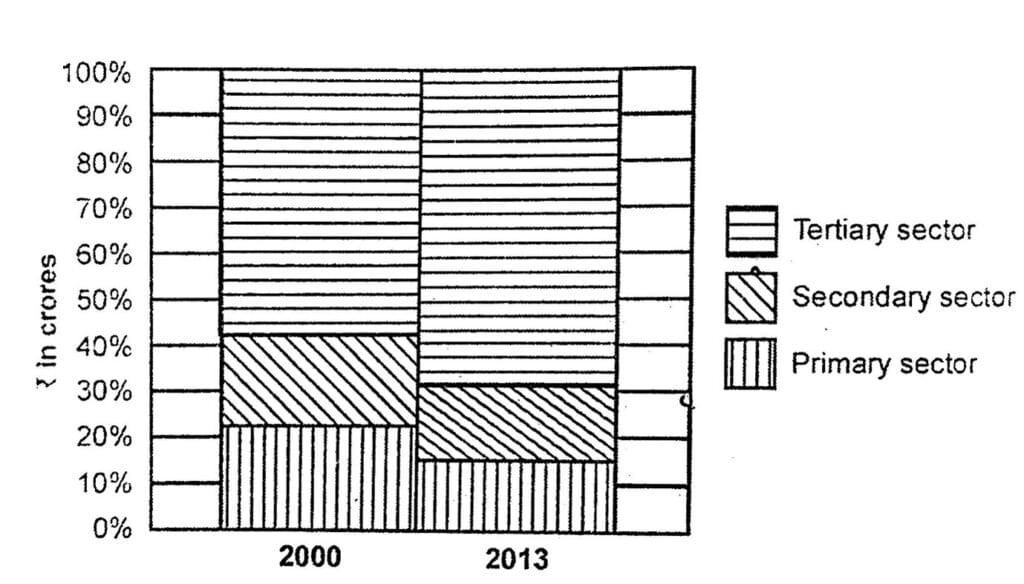
(iii) The contribution of the primary sector to the GDP has declined, whereas the shares of the secondary and tertiary sectors have shown growth.