Chapter 10 - The Human Eye and the Colorful World (Ncert Solutions)
Ultimate NCERT Solutions for Chapter 10 – The Human Eye and the Colorful World
Updated Solution 2024-2025 Updated Solution 2024-2025
NCERT Solutions for Class 10 Science, Chapter 10 – The Human Eye and the Colorful World, (Question/Answers, Activity & Projects)
Chapter 10 – The Human Eye and the Colorful World
Questions
Q 1. What is meant by power of accommodation of the eye?
Ans 1: The power of accommodation of the eye refers to the ability of the eye to change its focus, allowing us to see objects clearly at different distances. This is done by the lens inside the eye, which becomes thicker or thinner to focus on nearby or distant objects.
Q 2. A person with a myopic eye cannot see objects beyond 1.2 m distinctly. What should be the type of the corrective lens used to restore proper vision?
Ans 2: A person with myopia (nearsightedness) can see nearby objects clearly but struggles with distant ones. Since this person’s far point is 1.2 m, they need a concave (diverging) lens to correct their vision. This lens will spread out light rays so they focus correctly on the retina, allowing distant objects to appear clear.
Q 3. What is the far point and near point of the human eye with normal vision?
Ans 3: The far point of the human eye with normal vision is the farthest distance at which objects can be seen clearly without any strain. For most people, this is infinity (or very far away).
The near point is the closest distance at which the eye can focus on an object clearly. For a person with normal vision, this is about 25 cm from the eye.
In short:
- Far point = Infinity (very far objects).
- Near point = 25 cm (close objects).
Q 4. A student has difficulty reading the blackboard while sitting in the last row. What could be the defect the child is suffering from? How can it be corrected?
Ans 4: The student likely has myopia (nearsightedness), a condition where distant objects, like the blackboard, appear blurry. This happens because the eye focuses light in front of the retina instead of directly on it.
Correction: Myopia can be corrected using concave lenses in glasses or contact lenses, which help focus the light properly on the retina.
Activity 10.1
- Fix a sheet of white paper on a drawing board using drawing pins.
- Place a glass prism on it in such a way that it rests on its triangular base. Trace the outline of the prism using a pencil.
Ans: The purpose of fixing the glass prism on the white paper is to clearly outline its shape and to ensure the prism remains stationary during the experiment, allowing accurate tracing and measurements of the angles and positions of the pins.
- Draw a straight-line PE inclined to one of the refracting surfaces, say AB, of the prism.
Ans: Drawing the straight-line PE inclined to one of the refracting surfaces (AB) of the prism is important to study the behavior of light as it enters and refracts within the prism. The angle of incidence is measured with respect to this line, which is crucial for analyzing the refraction and the angles involved.
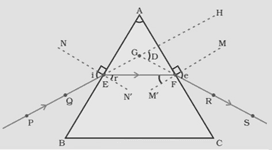
- Fix two pins, say at points P and Q, on the line PE as shown in Fig. 10.4.

Figure 10.4 Refraction of light through a triangular glass prism
Ans: The pins at points P and Q are used as markers to trace the path of the light ray along the line PE. By fixing the pins, you can observe the images of these pins through the other face (AC) of the prism, which helps in determining the refraction and emergence of light as it passes through the prism.
- Look for the images of the pins, fixed at P and Q, through the other face AC.
Ans: Looking for the images of the pins through the other face AC allows you to trace the path of the refracted light after it passes through the first face (AB). This step helps in understanding how light bends inside the prism, which is fundamental to studying refraction.
- Fix two more pins, at points R and S, such that the pins at R and S and the images of the pins at P and Q lie on the same straight line.
Ans: Fixing two more pins at points R and S ensures that the images of the pins at P and Q and the new pins at R and S lie on the same straight line. This helps in determining the exact path of the light ray as it emerges from the second face of the prism, and aids in verifying the geometry of the light’s travel through the prism.
- Remove the pins and the glass prism.
Ans: The pins and the glass prism are removed to clear the workspace and prepare for drawing the necessary lines, angles, and markings. It also helps in simplifying the diagram, leaving only the geometric path of the light ray to analyze.
- The line PE meets the boundary of the prism at point E (see Fig. 10.4). Similarly, join and produce the points R and S. Let these lines meet the boundary of the prism at E and F, respectively. Join E and F.
Ans: The line PE intersects the prism at point E. Similarly, extend the lines through points R and S until they meet the prism at points E and F. Then, join points E and F.
- Draw perpendiculars to the refracting surfaces AB and AC of the prism at points E and F, respectively.
Ans: Joining points E and F and drawing perpendiculars to the refracting surfaces AB and AC helps in constructing the angles of incidence, refraction, and emergence. The perpendiculars provide a reference for measuring these angles relative to the surfaces of the prism, which are crucial in understanding the behavior of light as it refracts through the prism.
- Mark the angle of incidence (∠i), the angle of refraction (∠r) and the angle of emergence (∠e) as shown in Fig. 10.4.
Ans:
- Angle of incidence (∠i) is the angle between the incident ray (PE) and the normal (perpendicular) to the refracting surface AB at point E.
- Angle of refraction (∠r) is the angle between the refracted ray inside the prism and the normal to the surface AC at point E.
- Angle of emergence (∠e) is the angle between the emergent ray (EF) and the normal to the surface AC at point F.
Activity 10.2
- Take a thick sheet of cardboard and make a small hole or narrow slit in its middle.
- Allow sunlight to fall on the narrow slit. This gives a narrow beam of white light.
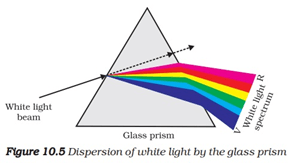
- Now, take a glass prism and allow the light from the slit to fall on one of its faces as shown in Fig. 10.5.
- Turn the prism slowly until the light that comes out of it appears on a nearby screen.
- What do you observe? You will find a beautiful band of colours. Why does this happen?

Ans: Observation: When the white light passes through the glass prism, it will spread out into a beautiful band of colors. This band will typically consist of the colors of the visible spectrum, arranged from red at the top to violet at the bottom. The colors are red, orange, yellow, green, blue, indigo, and violet.
Why does this happen?
This phenomenon is known as dispersion of light. It occurs because light is made up of different colors (each having a different wavelength), and when light passes through the prism, each color bends by a different amount. The shorter wavelengths (like violet) bend more than the longer wavelengths (like red), causing the white light to spread out and form a spectrum.
Chapter 10 The Human Eye and the Colorful World, Question/Answer, Activity & Projects
Updated Solution 2024-2025
This complete solution is prepared as per the latest syllabus of 2024-25. If you have any further queries, feel free to ask!
Exercise
Q 1. The human eye can focus on objects at different distances by adjusting the focal length of the eye lens. This is due to:
(a). presbyopia.
(b). accommodation.
(c). near-sightedness.
(d). far-sightedness.
Ans 1: (b). accommodation: Accommodation is the process by which the eye lens changes its shape to focus on objects at different distances. This is achieved by the ciliary muscles altering the curvature of the lens.
Q 2. The human eye forms the image of an object at its
(a). cornea.
(b). iris.
(c). pupil.
(d). retina.
Ans 2: (d) retina: The human eye forms the image of an object on the retina, which is the light-sensitive layer at the back of the eye. The lens focuses light onto the retina, where the image is captured and then sent to the brain for interpretation.
Q 3. The least distance of distinct vision for a young adult with normal vision is about
(a). 25 m.
(b). 2.5 cm.
(c). 25 cm.
(d). 2.5 m.
Ans 3: (c) 25 cm: The least distance of distinct vision for a young adult with normal vision is about 25 cm.
This is the typical distance at which a person with normal vision can see objects clearly without strain.
Q 4. The change in focal length of an eye lens is caused by the action of the
(a). pupil.
(b). retina.
(c). ciliary muscles.
(d). iris.
Ans 4: (c). ciliary muscles: The ciliary muscles control the shape of the eye’s lens, which allows it to change its focal length and focus on objects at different distances. This process is known as accommodation.
Q 5. A person needs a lens of power –5.5 diopters for correcting his distant vision. For correcting his near vision, he needs a lens of power +1.5 dioptre. What is the focal length of the lens required for correcting (i) distant vision, and (ii) near vision?
Ans 5: To find the focal length of a lens, we use the formula: Focal length (f )= 1 / Power (P)
Corrective Lens Calculations for Vision
(i) Correcting Distant Vision
The required lens power is –5.5 diopters.
Using the lens formula: f = 1 / (–5.5) = –0.18 meters = –18 cm
(ii) Correcting Near Vision
Required power: +1.5 diopters
Formula used : f = 1 / P
f = 1 / 1.5 = 0.67 meters = 67 cm
The positive value indicates a converging lens, used to correct hypermetropia (far-sightedness).
Q 6. The far point of a myopic person is 80 cm in front of the eye. What is the nature and power of the lens required to correct the problem?
Ans 6: A myopic person can see nearby objects clearly but struggles with distant ones. The far point of their vision is the farthest distance they can see clearly, which in this case is 80 cm in front of the eye.
To correct myopia, a concave lens is needed, which diverges light rays, allowing the person to see distant objects clearly. The lens power (P) is calculated using the formula: P = 1 / f
where f is the focal length. Here, the far point is 80 cm, so the lens needs to bring distant objects to this point. Convert the distance to meters: f = − 0.80m
Now, calculate the power: P = 1 / (–0.80) = –1.25 diopters
So, the required lens is a concave lens with a power of -1.25 D.
Q 7. Make a diagram to show how hypermetropia is corrected. The near point of a hypermetropia eye is 1 m. What is the power of the lens required to correct this defect? Assume that the near point of the normal eye is 25 cm.
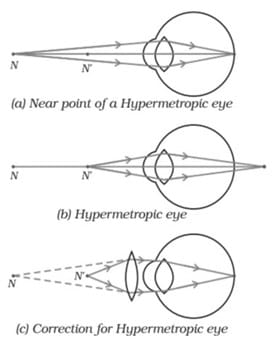
Ans 7: Diagram Showing Correction of Hypermetropia
Hypermetropia (Farsightedness):
In a hypermetropic eye, the light rays from a nearby object focus behind the retina because the eyeball is too short or the lens cannot provide enough converging power.
Correction:
A convex (converging) lens is used to bend the light rays inwards so that they converge correctly on the retina.
Calculating the Power of the Corrective Lens
Given:
Near point of hypermetropic eye (v) = 1 m (farthest distance for clear vision without strain).
Near point of normal eye (u) = 25 cm = 0.25 m (desired near point after correction).
The corrective lens must form a virtual image of an object at 25 cm (0.25 m) at the hypermetropic eye’s near point (1 m).
Using the Lens Formula: 1/f = 1/v – 1/u
Here:
(v) = 1 m (virtual image, hence negative sign).
u=−0.25m (object distance, negative as per convention).
Substitute values: 1/f = 1/(-1) – 1/(-0.25)
= -1 + 4
= 3 m
So, focal length (f) is: f= 1 / 3 m = 0.33 m
Power of the Lens (P): P = 1 / f = + 3D ( Convex Lens )
Final Answer
A convex lens of +3 diopters is required to correct the hypermetropia.
(Note: The diagram would visually depict the light rays converging properly on the retina after passing through the convex lens.)

Q 8. Why is a normal eye not able to see clearly the objects placed closer than 25 cm?
Ans 8: A normal eye cannot see objects clearly closer than 25 cm because the lens of the eye cannot adjust enough to focus on very close objects. This happens due to a limit in the eye’s ability to change the shape of the lens, a process called accommodation. At distances closer than 25 cm, the lens cannot bend light rays sharply enough to form a clear image on the retina.
Q 9. What happens to the image distance in the eye when we increase the distance of an object from the eye?
Ans 9: When we increase the distance of an object from the eye, the image formed by the eye moves farther away from the retina. To keep the image clear and in focus, the eye’s lens adjusts its shape. The eye’s muscles change the curvature of the lens, making it thicker to focus on faraway objects. This process is called accommodation, helping us see distant objects clearly.
Q 10. Why do stars twinkle?
Ans 10: Stars twinkle because their light passes through Earth’s atmosphere before reaching our eyes. As the light travels, it bends and scatters due to the movement of air and temperature changes in the atmosphere. This makes the light appear to flicker, or “twinkle.” If you were in space, where there’s no atmosphere, stars wouldn’t twinkle at all!
Q 11. Explain why the planets do not twinkle.
Ans 11: Planets do not twinkle because they are much closer to Earth than stars. Unlike stars, which appear as tiny points of light, planets look like small disks. The Earth’s atmosphere causes the light from stars to bend (twinkle), but the light from planets averages out because of their larger size. This makes their light steady, so planets shine without twinkling.
Q 12. Why does the sky appear dark instead of blue to an astronaut?
Ans 12: The sky appears dark to astronauts because they are in space, where there is no atmosphere to scatter sunlight. On Earth, the atmosphere scatters blue light from the sun, making the sky look blue. In space, without this scattering, the sky looks black.
Chapter 10 – The Human Eye and the Colorful World, Question/Answer, Activity & Projects
Updated Solution 2024-2025
This complete solution is prepared as per the latest syllabus of 2024-25. If you have any further queries, feel free to ask!