Chapter-5-Minerals and Energy Resources (GEOGRAPHY) for Class 10
Ultimate NCERT Solutions for
Chapter-5-Minerals and Energy Resources
Updated Solution 2025-2026 Updated Solution 2025-2026
NCERT Solutions for Class 10 Geography,Ch-5-Minerals and Energy Resources
(Exercises, Question/Answers & Activities)
Chapter-5-Minerals and Energy Resources
ACTIVITY AND IN TEXT QUESTIONS
Q 1. Dig a little deeper and find out how many minerals are used to make a light bulb?
Ans 1: A light bulb is made using several essential minerals:
- tungsten (for the filament due to its high melting point),
- glass (for the outer shell, offering protection and visibility),
- aluminum (for the base, providing stability and conductivity),
- copper (for the wiring, due to its excellent electrical conductivity).
These minerals work together to create a durable and efficient light source.
Q 2. Dig a little deeper and collect “Nutritional Facts” printed on food labels.
Ans 2: Parle-G Biscuit Nutritional Facts:
Each serving of Parle-G biscuits provides 453 calories, with 13g of fat and 77.5g of carbohydrates, including 0.6g of dietary fiber. It also contains 6.5g of protein and 15mg of calcium.
Q 3. Dig a little deeper: What is the difference between an open pit mine, a quarry and an underground mine with shafts?
Ans 3: Open-Pit Mining: This method involves removing minerals or rocks by creating an open pit on the surface. It’s typically used when the desired minerals are located close to the earth’s surface and the overburden (layers of earth and rock covering the deposit) is relatively thin. Heavy machinery is employed to remove this surface material and extract the exposed minerals.
Quarrying: This type of mining focuses on extracting building materials like dimension stone and is generally shallower than open-pit mining. Quarries are commonly used for construction purposes rather than for mining valuable minerals.
Underground Mining with Shafts: When valuable minerals are found deep below the earth’s surface or in hard rock veins, underground mining with shafts is often employed. This method uses vertical shafts equipped with elevators to transport workers and equipment into and out of the mine. Shaft mining is one of the deepest methods of extracting minerals.
Q 4. Collect information about cross country natural gas pipelines laid by GAIL (India) under “One Nation One Grid”.
Ans 4: Under the “One Nation One Grid” initiative, GAIL (India) has significantly expanded India’s natural gas pipeline infrastructure to create a unified gas network. The first major pipeline, the Hazira-Vijaipur-Jagdishpur (HVJ) pipeline, covered 1,700 km and connected Mumbai High and Bassein gas fields with various fertilizer, power, and industrial sectors in northern and western India. Since then, the network has grown to around 18,500 km, and future expansion aims to reach 34,000 km, enhancing connectivity to all regions, including the North Eastern states. This expansion aims to create a cohesive Gas Grid, linking production sources with consumption centers nationwide.
Q 5. Dig a little deeper: Superimpose the maps showing distribution of iron ore, manganese, coal, iron and steel industry. Do you see any correlation. Why?
Ans 5: Correlation: Iron ore, manganese, and coal are commonly found in proximity to each other, leading to the establishment of iron and steel industries in these regions.
Reasons:
- Essential Raw Materials: Iron ore and manganese are fundamental inputs for the iron and steel industry.
- Energy Needs: Large quantities of coal are essential for generating the energy required in the melting process.
- Cost-Efficient Location: Transporting these heavy raw materials over long distances is costly, so industries are strategically set up in areas rich in iron, manganese, and coal deposits to minimize transportation expenses.
This proximity to resources supports the efficient operation and development of the iron and steel industries.
Q 6. Dig a little deeper: Locate the mines of Bauxite on the physical map of India.
Ans 6:

Q 7. Dig a little deeper: Study the maps to explain why Chhota Nagpur is a storehouse of minerals?
Ans 7: Chhota Nagpur: Overview of Mineral Resources
- Location: Eastern India, primarily in Jharkhand, with parts in Bihar, Odisha, West Bengal, and Madhya Pradesh.
- Geography: Characterized by high plateaus and hills formed from ancient Precambrian rocks.
- Key Geological Formations:
- Singhbhum Group: Rich in iron ore and copper.
- Damodar Valley: Notable for extensive coal deposits.
- Hazaribagh and Ranchi Areas: Contain mica and bauxite resources.
- Mineral Diversity:
- Coal: Significant reserves, especially in the Jharia coalfield.
- Iron Ore: High-quality deposits vital for the steel industry.
- Copper: Important for the electronics sector.
- Mica: Historically a major production area.
- Economic Impact: Mineral wealth has spurred industrial development, attracting mining companies and creating jobs, thereby contributing to economic growth.
- Environmental Concerns: Mining activities raise issues like deforestation and pollution, emphasizing the need for sustainable practices.
- Conclusion: Chhota Nagpur’s mineral resources are vital for economic development, but balancing growth with environmental sustainability is essential to protect the region’s natural heritage.
Q 8. Dig a little deeper: Make a list of items where substitutes are being used instead of minerals? Where are these substitutes obtained from?
Ans 8:
Mineral items | Substitutes | Substitutes obtained from |
1. Metal chairs 2. Thermal power (obtained from coal) 3. Metallic body of electronic items 4. Petroleum | Plastic Hydel power Plastic body CNG (Compressed Natural Gas) | Chemicals River water, rainwater Chemicals Beneath the earth |
Q 9. Name some river valley projects and write the names of the dams built on these rivers.
Ans 9:
- Bhakra-Nangal Dam: Located on the Satluj River, this dam plays a crucial role in irrigation and hydroelectric power generation.
- Gandhi Sagar Dam: Found on the Chambal River, this dam is significant for its role in water management and flood control.
- Damodar Valley Project: This project includes four major dams—Tilayya, Konar, Maithan, and Panchet—constructed on the Damodar River and its tributaries, aiming to provide irrigation, flood control, and power generation.
- Tungabhadra Project: Situated on the Tungabhadra River, this project is essential for irrigation and hydroelectric power production.
- Nagarjun Sagar Dam: Built on the Krishna River, this dam serves as a key source of irrigation and power supply.
- Tawa Dam: Located on the Tawa River, this dam contributes to irrigation and hydroelectric energy generation.
- Koyna Dam: This dam, constructed on the Koyna River, is primarily used for hydroelectric power generation and irrigation.
- Hirakud Dam: Positioned on the Mahanadi River, this dam is one of the longest earth dams in the world and plays a vital role in flood control and irrigation.
- Idukki Dam: Found on the Periyar River, this dam is crucial for hydroelectric power generation and water supply.
- Rihand Dam: Constructed on the Rihand River, this dam supports irrigation and hydroelectric power projects.
- Upper Indravati Project: This project consists of several dams, including Indravati Dam, Podagada Dam, Kapur Dam, and Muran Dam, all located on the Indravati River, focusing on irrigation and power generation.
Q 10. Locate the 6 nuclear power stations and find out the states where they are located.
Ans 10:
Nuclear Power Station | State |
(i) Narora (ii) Rawatbhatta (iii) Kakrapara (iv) Tarapur (v) Kaiga (vi)Kalpakkam | Uttar Pradesh Rajasthan Gujarat Maharashtra Karnataka Tamil Nadu |
Q 11. Collect information about thermal hydel power plant located in your state. Show them on the map of India.
Ans 11:
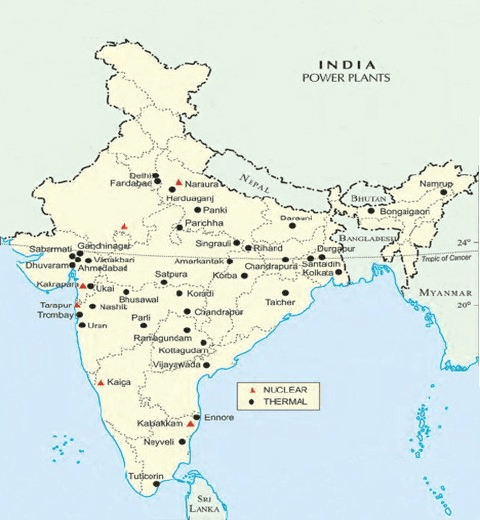
Q 12. Collect information about newly established solar power plants in India.
Ans 12:
S.No. | Name of Solar Power Plant | State |
1 2 3 4 5 6 7 | Kurnool Ultra Mega Solar Park Kamuthi Solar Power Project Bhadla Solar Park Charanka Solar Park Sakri Solar Plant Welspun Solar Plant Dhirubhai Ambani Solar Park | Andhra Pradesh Tamil Nadu Rajasthan Gujarat Maharashtra Maharashtra Rajasthan |
EXERCISES
1. Multiple choice questions:
(i) Which one of the following minerals is formed by decomposition of rocks leaving a residual mass of weathered material?
(a) coal
(b) bauxite
(c) gold
(d) zinc
Ans (i) (a) coal
(ii) Koderma in Jharkhand is the leading producer of which one of the following minerals?
(a) bauxite
(b) mica
(c) iron ore
(d) copper
Ans (ii) (b) mica
(iii) Minerals are deposited and accumulated in the strata of which of the following rocks?
(a) sedimentary rocks
(b) metamorphic rocks
(c) igneous rocks
(d) none of the above
Ans (iii)(a) sedimentary rocks
(iv) Which one of the following minerals is contained in the Monazite sand?
(a) oil
(b) uranium
(c) thorium
(d) coal
Ans (iv) (c) thorium
2. Answer the following questions in about 30 words:
(i) Distinguish between the following in not more than 30 words:
(a) Ferrous and non-ferrous minerals:
Ans a:
- Ferrous minerals contain iron, like iron ore and magnetite.
- Non-Ferrous Minerals do not contain iron, including metals like aluminum, copper, and zinc.
(b) Conventional and non-conventional sources of energy:
Ans b:
- Conventional energy sources are traditional, like fossil fuels and nuclear power
- Non-Conventional Sources include renewables like solar, wind, and hydro, emphasizing sustainability and lower environmental impact.
(ii) What is a mineral?
Ans (ii): A mineral is a naturally occurring, inorganic solid with a definite chemical composition and crystalline structure, forming the building blocks of rocks and essential for various geological processes.
(iii) How are minerals formed in igneous and metamorphic rocks?
Ans (iii): Minerals in igneous rocks form from cooling magma or lava, while in metamorphic rocks, they arise from the alteration of existing minerals under heat and pressure.
(iv) Why do we need to conserve mineral resources?
Ans (iv): We need to conserve mineral resources to ensure sustainability, protect ecosystems, reduce environmental degradation, support future generations, and maintain economic stability by managing finite resources responsibly.
3. Answer the following questions in about 120 words:
(i) Describe the distribution of coal in India.
Ans (i):
- Approximately 75% of India’s coal reserves are found in the northeastern part of the southern peninsula, primarily within the Damodar River valley region, which includes the states of Jharkhand and West Bengal. Significant deposits are also located in Odisha, Chhattisgarh, and Madhya Pradesh.
- In addition to these major areas, coal reserves can be found in various other river valleys, including the Mahanadi, Godavari, Son, Tawa, and Wardha. States such as Andhra Pradesh, Maharashtra, Assam, and Uttar Pradesh also host substantial coal deposits.
- Key coal fields in India include Raniganj, Jharia, Karanpura, Chandrapura, Giridih, Deogarh, Rajmahal, Ramgarh, Korba, Singrauli, Talcher, Singreni, and Chanda.
(ii) Why do you think that solar energy has a bright future in India?
Ans (ii): The Future of Solar Energy in India
Solar energy holds significant promise for India due to several key factors:
(a) As a tropical nation, India benefits from abundant sunlight throughout the year, making it an ideal location for harnessing solar power.
(b) The establishment of solar plants is feasible in rural and remote regions, facilitating energy access in areas that may lack traditional energy infrastructure.
(c) By reducing reliance on firewood and dung cakes for energy, solar energy can help protect the environment and ensure a sustainable supply of manure for agricultural purposes.
ACTIVITY
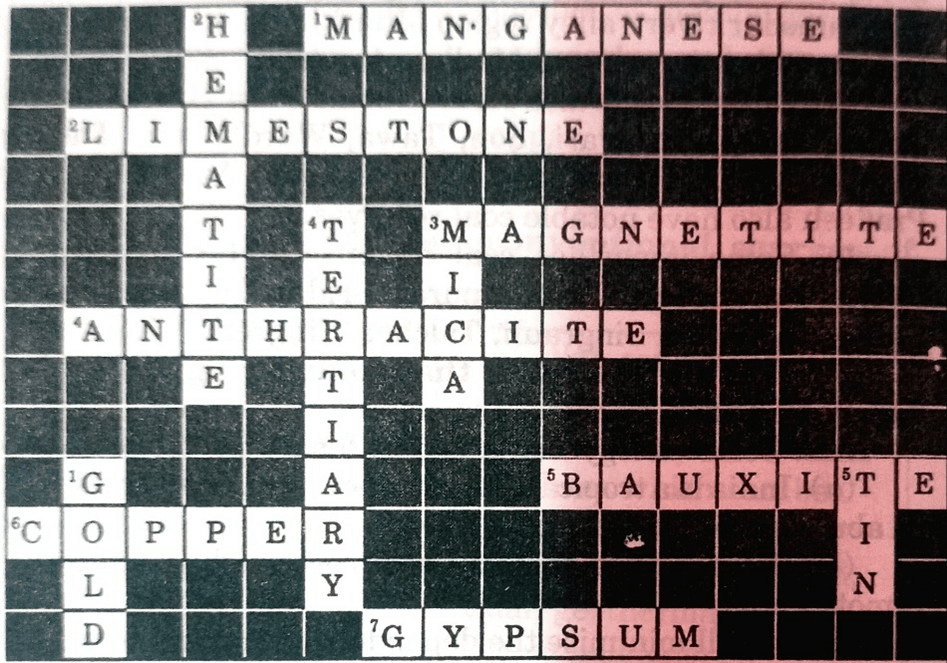
1. Fill the name of the correct mineral in the crossword given on the next page:
Across:
- A ferrous mineral (9)
- Raw material for cement industry (9)
- Finest iron ore with magnetic properties (9)
- Highest quality hard coal (10)
- Aluminum is obtained from this ore (7)
- Khetri mines are famous for this mineral (6)
- Formed due to evaporation (6)
Down:
- Found in placer deposit (4)
- Iron ore mined in Bailadila (8)
- Indispensable for electrical industry (4)
- Geological age of coal found in north east India (8)
- Formed in veins and vein deposits (3)
Ans 1: