
Chapter – 4 – Political Parties (Political Science) for Class 10
Ultimate NCERT Solutions for Chapter-4-Political Parties
Updated Solution 2025-2026 Updated Solution 2025-2026
NCERT Solutions for Class 10 (Pol. Science) Ch-4-Political Parties
(Exercises, Question/Answers & Activities)
Chapter-4-Political Parties
ACTIVITY AND IN-TEXT QUESTIONS
In-text Question
Q 1. Okay, granted that we can’t live without political parties. But tell me what grounds do people support a political party?
Ans 1: There is nothing inherently wrong with any political party. In a democracy, the true power lies with the people. If we uphold the right values in our thoughts and actions, the parties will be compelled to follow suit, as they reflect our society and its values. Even if a party fails to act responsibly, we must remember that our votes are what sustain them.
Let Us Revise
Q 1. Categorise these photographs by the functions of political parties they illustrate. Find one photograph or news clipping from your own area for each of the functions listed above.
Ans 1:
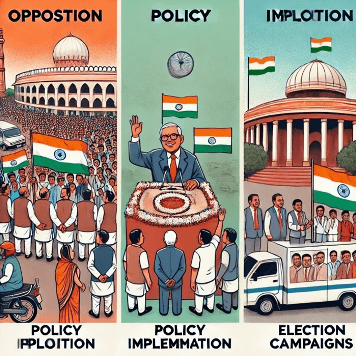
(i) Left: Depicts the political party in its role as opposition.
(ii) Top (Right): Shows the implementation of policies and programs.
(iii) Bottom (Right): Represents parties contesting elections.
In-text Question
Q 2. Kishenji is no more. What would be your advice to these four activists? Should they form a new political party? Can a political party become a moral force in politics? What should that party be like?
Ans 2: (i) These activists should consider establishing a new political party. Although they may not have widespread support at first, maintaining a strong ethical foundation will help them gradually earn the trust of the people. Only then can they contribute meaningfully to society, addressing the urgent need for positive change in today’s political landscape.
(ii) Yes, absolutely.
(iii) Yes, the party can achieve this by fulfilling its promises. As it demonstrates its commitment through actions, public support is likely to grow quickly.
(iv) The party should prioritize addressing the pressing issues faced by the people. It should select candidates genuinely committed to serving the community, ideally individuals who are familiar with local issues and come from the area they represent. Even if this party doesn’t secure enough seats to form a government, it could still play a vital role as a strong opposition or a pressure group.
Let Us Revise
Q 1. Let us apply what we have learnt about party systems to the various states within India. Here are three major types of party systems that exist at the State level. Can you find the names of at least two States for each of these types:
- Two-party system
- Multi-party system with two alliances
- Multi-party system
Ans 1:
- Two-Party System: States that follow a two-party system include Rajasthan, Gujarat, Himachal Pradesh, and Madhya Pradesh.
- Multi-Party System with Two Alliances: This system is seen in states like Maharashtra, Jammu & Kashmir, Jharkhand, and West Bengal.
- Multi-Party System: States that have a broader multi-party system are Bihar, Uttar Pradesh, and Tamil Nadu.
In-text Question (Pago 79)
Q 1. Does the cartoon reflect the data graphics shown in the previous page?
Ans 1: Yes
In-text Question
Q 1. Why don’t parties give enough tickets to women? Is that also due to lack of internal democracy?
Ans 1:
- It is widely recognized that a patriarchal mindset prevails in much of Indian society. Men often assert their authority, and politics is no different. If political parties begin to nominate more women candidates, power will gradually shift towards them—something that the current Indian mindset is still not fully prepared to embrace.
- This situation clearly reflects a deficiency in internal democracy. It is essential that at least one-third of the seats contested by political parties be reserved for women.
Let Us Revise
Q 1. Can you identify which of the challenges described in this section are being highlighted in these cartoons (on Page 83 to 85). What is the way to curb the misuse of money and muscle Power in Politics?
Ans 1: The cartoons emphasize the difficulties political parties encounter due to the prevalent reliance on financial resources and physical force in politics.
In-text Question
Q 1. Do you agree that this form of reforming political parties will be acceptable to them?
Ans 1: We certainly hope that is the case, as it benefits not just them but also our democratic system. Ultimately, these efforts are aimed at reinforcing democracy. There is also a recognition of the need for reform. We believe that all political parties would welcome a fair political landscape.
EXERCISES
Q 1. State the various functions political parties perform in a democracy.
Ans 1: Political parties carry out several key functions, including:
- Participating in electoral contests.
- Presenting a variety of policies and programs for voters to choose from.
- Playing a crucial role in the legislative process and law-making.
- Acting as the opposition party.
- Establishing and managing the government.
- Influencing public opinion.
- Facilitating access for citizens to government services and welfare initiatives.
Q 2. What are the various challenges faced by political parties?
Ans 2:
(i) Internal democracy is lacking within the political parties, resulting in many potential leaders being denied their rights.
(ii) There are instances of dynastic succession in these parties, which hinders the emergence of capable leadership.
(iii) The use of financial resources and coercive tactics during elections diminishes the development of democracy and undermines the significance of authentic leaders within the party.
(iv) The political parties share similar ideologies, leading to a scarcity of substantial options for voters.
Q 3. Suggest some reforms to strengthen parties so that they perform their functions well.
Ans 3:
(i) Legislation should be enacted to oversee the internal operations of political parties, ensuring adherence to their constitutions.
(ii) It is essential to reserve one-third of the seats for women candidates across all levels within the organization.
(iii) There should be government funding available for electoral processes.
(iv) Citizens should exert influence on political parties by utilizing petitions, public campaigns, and demonstrations.
(v) Finally, political parties can enhance their effectiveness if individuals who are committed to improvement choose to join them.
Q 4. What is a political party?
Ans 4: A political party is an organized group of individuals who unite to participate in elections, aiming to establish and manage a government by gaining political power.
Q 5. What are the characteristics of a political party?
Ans 5: The following are key features of a political party:
(i) A political party consists of individuals who unite to participate in elections and share governance.
(ii) The party formulates a set of policies and programs aimed at benefiting society as a whole.
(iii) It aims to put these policies into action by garnering public support through electoral victories.
(iv) A political party embodies a fundamental political division within society.
(v) It is identified by the ideologies it represents, the policies it advocates, and the interests it seeks to protect.
Q 6. A group of people who come together to contest elections and hold power in the government is called a ________.
Ans 6: political party.
Q 7. Match List I (organizations and struggles) with List II and select the correct answer using the codes given below the lists:
Political Party (LIST – I) | Category (list – II) |
1. Congress Party | A. National Democratic Alliance |
2. Bhartiya Janata Party | B. State party |
3. Communist Party of India (Marxist) | C. United Progressive Alliance |
4. Telugu Desam Party | D. Left Front |
1 | 2 | 3 | 4 | |
(a) | C | A | B | D |
(b) | C | D | A | B |
(c) | C | A | D | B |
(d) | D | C | A | B |
Ans 7: (c): C, A, D, B.
Political Party | Category |
1. Congress Party | C. United Progressive Alliance |
2. Bhartiya Janata Party | A. National Democratic Alliance |
3. Communist Party of India (Marxist) | D. Left Front |
4. Telugu Desam Party | B. State party |
Q 8. Who among the following is the founder of the Bahujan Samaj Party?
- Kanshi Ram
- Sahu Maharaj
- B.R. Ambedkar
- Jotiba Phule
Ans 8: The founder of the Bahujan Samaj Party (BSP) is A. Kanshi Ram.
Q 9. What is the guiding philosophy of the Bhartiya Janata Party?
- Bahujan Samaj
- Revolutionary democracy
- Integral humanism
- Modernity
Ans 9: The guiding philosophy of the Bharatiya Janata Party (BJP) is C. Integral Humanism. This philosophy was articulated by Deendayal Upadhyaya and emphasizes the integration of the individual with society and the nation, focusing on holistic development and cultural values.
Q 10. Consider the following statements on parties:
- Political parties do not enjoy much trust among the people.
- Parties are often rocked by scandals involving top party leaders.
- Parties are not necessary to run governments.
Which of the statements given above are correct?
(a) A, B and C
(b) A and B
(c) B and C
(d) A and C
Ans 10: (b) A and B
Q 11. Read the following passage and answer the questions given below:
Muhammad Yunus is a famous economist of Bangladesh. He received several international honours for his efforts to promote economic and social development for the benefit of the poor. He and the Grameen Bank he started jointly, received the Nobel Peace Prize for the year 2006. In February 2007, he decided to launch a political party and contest in the parliamentary elections. His objective was to foster proper leadership, good governance and build a new Bangladesh. He felt that only a political party different from the traditional ones would bring about new political culture. His party would be democratic from the grassroots level.
The launching of the new party, called Nagarik Shakti (Citizen’s Power), has caused a stir among the Bangladeshis. While many welcomed his decision, some did not like it. “Now I think Bangladesh will have a chance to choose between good and bad and eventually have a good government,” said Shahedul Islam, a government official. “That government, we hope, would not only keep itself away from corruption but also make fighting corruption and black money a top priority,”
But leaders of traditional political parties who dominated the country’s politics for decades were apprehensive. “There was no debate (over him) winning the Nobel, but politics is different — very challenging and often controversial,” said a senior leader of the Bangladesh Nationalist Party. Some others were highly critical. They asked why he was rushing into politics. “Is he being planted in politics by mentors from outside the country”, asked one political observer.
Do you think Yunus made a right decision to float a new political party?
Do you agree with the statements and fears expressed by various people? How do you want this new party organised to make it different from other parties? If you were the one to begin this political party, how would you defend it?
Ans 11: The passage discusses Muhammad Yunus’s decision to launch a political party in Bangladesh, which has generated a variety of reactions. Here are answers to the questions based on the passage and general reasoning:
- Do you think Yunus made a right decision to float a new political party?
Ans 1: Whether Yunus made a right decision can be subjective. On one hand, establishing a new party like Nagarik Shakti could be seen as a bold step towards fostering good governance and combating corruption in Bangladesh, particularly if it genuinely offers a fresh perspective and prioritizes the needs of the people. His intention to create a party that promotes democratic values from the grassroots level could fill a gap in the political landscape that many Bangladeshis may feel is missing. On the other hand, entering the political arena could expose him to significant challenges and criticisms, particularly from established political entities.
- Do you agree with the statements and fears expressed by various people?
Ans 2: The statements reflect a range of opinions that are common in political discourse. Supporters view Yunus’s entry into politics as a potential opportunity for change, suggesting that it could lead to better governance. Their hope for a government free from corruption is a common desire among citizens in many countries. However, the apprehensions of traditional political leaders highlight the challenges of transitioning from social entrepreneurship to politics. They raise valid concerns about the complexities of political dynamics, including the potential for controversies. The fear that he might be influenced by outside mentors is also not uncommon in political contexts, where new entrants are often scrutinized.
- How do you want this new party organized to make it different from other parties?
Ans 3: To make Nagarik Shakti different from other parties, the organization could focus on:
- Grassroots Participation: Establishing local committees that are genuinely representative of the community’s needs and concerns, ensuring that all voices are heard.
- Transparency and Accountability: Implementing clear guidelines and practices for financial transparency, decision-making, and accountability at all levels of the party to combat corruption.
- Policy Focus: Developing a platform centered on evidence-based policies that address pressing social and economic issues, derived from thorough research and community engagement.
- Youth Engagement: Actively involving young people in leadership roles and decision-making processes to foster a new generation of leaders.
- Social Entrepreneurship: Incorporating Yunus’s expertise in social business into the party’s agenda, promoting sustainable economic development and social welfare initiatives.
- If you were the one to begin this political party, how would you defend it?
Ans 4: If I were to defend Nagarik Shakti, I would emphasize:
- Mission and Vision: Clearly articulate the party’s mission to promote social and economic justice, emphasizing the importance of ethical governance and community empowerment.
- Proven Track Record: Highlight Yunus’s accomplishments with the Grameen Bank and his commitment to poverty alleviation and social development, showcasing that the party is rooted in a successful model of change.
- Inclusivity: Stress the importance of an inclusive political process that engages citizens from all walks of life, ensuring that everyone has a stake in the political discourse.
- Critique of Traditional Politics: Address the shortcomings of established political parties, focusing on their history of corruption and lack of responsiveness to citizens’ needs.
- Commitment to Reform: Assure the public that the party is committed to reforming the political culture in Bangladesh, with specific plans to tackle corruption and promote good governance.
By combining these elements, the party could present itself as a credible alternative in the Bangladeshi political landscape.