
Chapter-2- Federalism (Political Science) for Class 10
Ultimate NCERT Solutions for Chapter 2 Federalism
Updated Solution 2025-2026 Updated Solution 2025-2026
NCERT Solutions for Class 10 (Political Science) Chapter 2 Federalism
(Exercises, Question/Answers & Activities)
Chapter 2 Federalism
ACTIVITY AND IN-TEXT QUESTIONS
In-Text Question
Q 1. I am confused. What do we call the India government? Is it Union, Federal or Central?
Ans 1: India is a federal state, as it was formed by a “holding together” approach. Therefore, the government at the center is referred to as the central government.
In-Text Question
Q 1. Though only 25 of the world’s 193 countries have federal political system, their citizens make up 40 per cent of the world’s population. Most of the large countries of the world are federations. Can you notice an exception to this rule in this map?
Ans 1: That’s correct! China stands out as an exception to the rule that large, populous countries tend to adopt a federal political system. Despite its vast land area and large population, China operates under a unitary political system, where the central government holds the primary authority, and local governments have limited autonomous power. This differs from federations like the United States, India, and Brazil, where regional governments have constitutionally guaranteed powers separate from the central government.
Intext Question
Q 1: If federalism works only in big countries, why did Belgium adopt it?
Ans 1: Belgium, despite being a small country, has a diverse population with multiple linguistic groups, each having unique interests. These differences could potentially lead to social conflict if not managed properly. To prevent social unrest and maintain political stability, Belgium implemented a federal system of power-sharing.
Let Us Revise
Q1. Some Nepalese citizens were discussing the proposals on the adoption of federalism in their new constitution. This is what some of them said:
Khag Raj: I don’t like federalism. It would lead to reservation of seats for different caste groups as in India.
Sarita: Ours is not a very big country. We don’t need federalism.
Babu Lal: I am hopeful that the Terai areas will get more autonomy if they get their own state government.
Ram Ganesh: I like federalism because it will mean that powers that were earlier enjoyed by the king will now be exercised by our elected representatives.
If you were participating in this conversation what would be your response to each of these? Which of these reflect a wrong understanding of what federalism is?
What makes India a federal country?
Ans 1: My Response to Each Comment:
- To Khag Raj: Federalism doesn’t necessarily mean reservations based on caste; it’s about distributing power across different levels of government, which may or may not include caste-based reservations.
- To Sarita: Federalism isn’t about the country’s size but about creating local governance structures to address regional needs and issues more effectively.
- To Babu Lal: Federalism could give Terai more autonomy, allowing local governments to focus on their specific needs, though they would still work within a national framework.
- To Ram Ganesh: You’re right! Federalism shifts power to elected representatives, allowing for a more democratic and locally responsive system of governance.
Misunderstandings of Federalism:
- Khag Raj and Sarita’s statements reflect a misunderstanding. Federalism doesn’t necessarily imply caste reservations, nor is it solely needed for large countries.
What Makes India a Federal Country: India is a federal country because it has multiple levels of government (central, state, and local), each with defined powers and responsibilities as per its constitution. This setup allows local governance and representation across its diverse regions.
In-Text Question (Page 16)
Q 1: Isn’t that strange? Did our Constitution makers not know about federalism? Or did they wish to avoid talking about it?
Ans 1: Our Constitution’s framers were indeed familiar with federalism but chose not to emphasize it explicitly. At the time, India’s democracy was in its early stages, and efforts were focused on unifying the many independent princely states. Providing too much autonomy then could have risked further fragmentation of the country. The framers anticipated that as democracy matured, necessary adjustments would be made to the Constitution to enhance federalism. Therefore, they left this matter open, allowing future leaders and the people to decide on it.
Intext Question (Page 17)
Q 1. If agriculture and commerce are state subjects, why do we have ministers of agriculture and commerce in the Union cabinet?
Ans 1: A separate ministry for agriculture and commerce is essential in the Union cabinet due to the need for states to interact in matters of trade and agriculture. When states engage in the exchange of commercial and agricultural commodities, there may be situations where one state acts arbitrarily, potentially causing issues related to price control, taxation, and other regulatory concerns. Additionally, the nation must manage agricultural and commercial matters with other countries, further emphasizing the need for dedicated oversight at the Union level.
Let Us Listen to Radio (Page 17)
Q 1. Listen to one national and one regional news bulletin broadcast by All India Radio daily for one week. Make a list of news items related to government policies or decisions by classifying these into the following categories:
- News items that relate only to the Central Government,
- News items that relate only to your or any other State Government,
- News items about the relationship between the Central and State Governments.
Ans 1: Students, do yourselves.
[hint]: To compile your list of news items related to government policies or decisions from All India Radio over one week, you can follow this outline. Here’s a structured approach to help you organize your findings:
Central Government News Items
- Announcement of New Schemes: Details about a new welfare scheme launched by the central government aimed at poverty alleviation.
- Legislative Changes: Updates on amendments to national laws, such as labor or environmental regulations.
- Budget Allocations: Information regarding budget approvals for various sectors like education, health, or infrastructure.
State Government News Items
- State Schemes: Launch of a new health initiative or educational program specific to your state.
- Policy Changes: Amendments in state laws, such as changes to taxation or local governance.
- Infrastructure Projects: News on state-funded projects like road construction or public transport improvements.
Central and State Government Relationship News Items
- Collaborative Initiatives: Reports on joint ventures between the central and state governments for disaster management or development programs.
- Funding Announcements: News regarding funds released by the central government for state-level projects.
- Policy Coordination: Discussions or agreements between central and state officials on issues like health, education, or agriculture.
Methodology
- Daily Listening: Tune into one national and one regional news bulletin each day.
- Note-taking: Jot down relevant news items immediately after listening, categorizing them as you go.
- Review: At the end of the week, review your notes and ensure each item is accurately classified.
This structure will help you create a comprehensive overview of government-related news from your selected broadcasts.
Let Us Revise (Page 18)
Q 1. Pokharan, the place where India conducted its nuclear tests, lies in Rajasthan. Suppose the Government of Rajasthan was opposed to the Central Government’s nuclear policy, could it prevent the Government of India from conducting the nuclear tests?
Ans 1: No, the Government of Rajasthan cannot prevent the Government of India from conducting nuclear tests. Under the Indian Constitution, the central government has the authority to make decisions on defense and national security matters, including nuclear policy. State governments do not have the power to challenge or stop such activities that fall under the jurisdiction of the central government, especially in areas critical to national security.
Q 2. Suppose the Government of Sikkim plans to introduce new textbooks in its schools. But the Union Government does not like the style and content of the new textbooks. In that case, does the state government need to take permission from the Union Government before these textbooks can be launched?
Ans 2: Yes, the state government of Sikkim needs to seek permission from the Union Government before launching new textbooks, as education is a concurrent subject in India. This means both the state and central governments have a role in regulating educational content, and the Union Government may require compliance with national standards.
Q 3. Suppose the Chief Ministers of Andhra Pradesh, Chhattisgarh and Orissa have different policies on how their state police should respond to the naxalites. Can the Prime Minister of India intervene and pass an order that all the Chief Ministers will have to obey?
Ans 3: No, the Prime Minister of India cannot unilaterally intervene and impose orders that all Chief Ministers must obey regarding state police policies. Police and law enforcement fall under the jurisdiction of state governments as per the Constitution of India. However, the Prime Minister can facilitate discussions, provide support, or coordinate efforts through central agencies to address Naxalite issues.
Let Us Read the Map (Page 19)
[Note: See Map in your textbook.]
Q 1. Has your village or town remained under the same state since independence? If not, what was the name of the earlier state?
Ans 1: No, it used to be part of Uttar Pradesh, and it is now known as Uttarakhand.
Q 2. Can you identify names of three state in 1947 that have changed later?
Ans 2:
- Madhya Pradesh used to be known as the Central Province.
- Punjab belonged to the North-West Province.
- Rajasthan was included in the region known as Rajputana.
Q 3. Identify any three states which have been carved out of a bigger state.
Ans 3:
(1) Jharkhand from Bihar.
(2) Chhattisgarh from Madhya Pradesh.
(3) Uttaranchal from Uttar Pradesh.
In-Text Question
Q 1. Why Hindi? Why not Bangla or Telugu?
Ans 1: The Constitution of India designates Hindi and English as the official languages of the country. However, as a federal government, it cannot enforce its language preferences on those who speak other languages. The Union Government actively promotes Hindi as the official language, reflecting the fact that approximately 40% of the population speaks it. This approach illustrates the flexibility of the Union, allowing states to maintain their own official languages. This respect for diverse languages and cultures ensures that individuals are free to communicate in their preferred languages, with each state having its designated official language.
Let Us Read the Cartoon (Page 21)
Q 1. Here are two cartoons showing the relationship between Centre and State. Should the State go to the Centre with a begging bowl? How can the leader of a coalition keep the partners of government satisfied?
Ans 1:
(1) No, a state should not approach the central government in a submissive manner.
(2) A coalition leader can maintain harmony among government partners by distributing power equitably and collaborating on a “common minimum program” that has been agreed upon by all coalition members.
In-Text Question (Page 21)
Q 1. Are you suggesting that regionalism is good for our democracy? Are you serious?
Ans 1: Regionalism cannot positively contribute to our democracy. In a diverse nation like India, characterized by a rich tapestry of cultures, languages, and traditions, our strength lies in this diversity. The beauty of India is enhanced by its variety, but this does not imply that one region should thrive at the expense of another. Our progress and development depend on the advancement of all regions. It is essential to foster a sense of mutual trust and unity among us. Therefore, I firmly believe that regionalism has no place in our democratic framework.
In-Text Questions (Page 22)
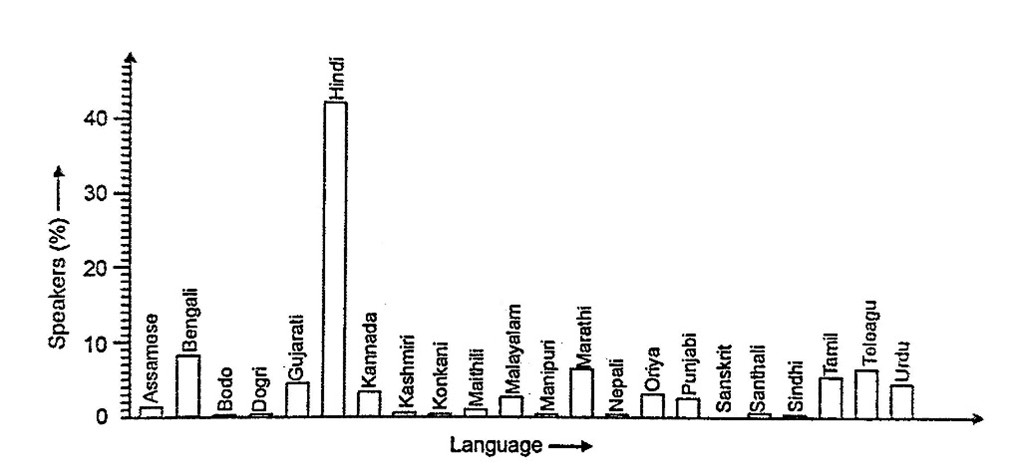
Scheduled languages of India
Language | Proportion of Speakers (%) |
Assamese | 1.26 |
Bengali | 8.03 |
Bodo | 0.12 |
Dogri | 0.21 |
Gujarati | 4.58 |
Hindi | 43.63 |
Kannada | 3.61 |
Kashmiri | 0.56 |
Konkani | 0.19 |
Maithili | 1.12 |
Malayalam | 2.88 |
Manipuri | 0.15 |
Marathi | 6.86 |
Nepali | 0.24 |
Oriya | 3.10 |
Punjabi | 2.74 |
Sanskrit | N |
Santhali | 0.61 |
Sindhi | 0.23 |
Tamil | 5.70 |
Telugu | 6.70 |
Urdu | 4.19 |
Q 1. Make a bar or pie chart on the basis of this information.
Ans 1:
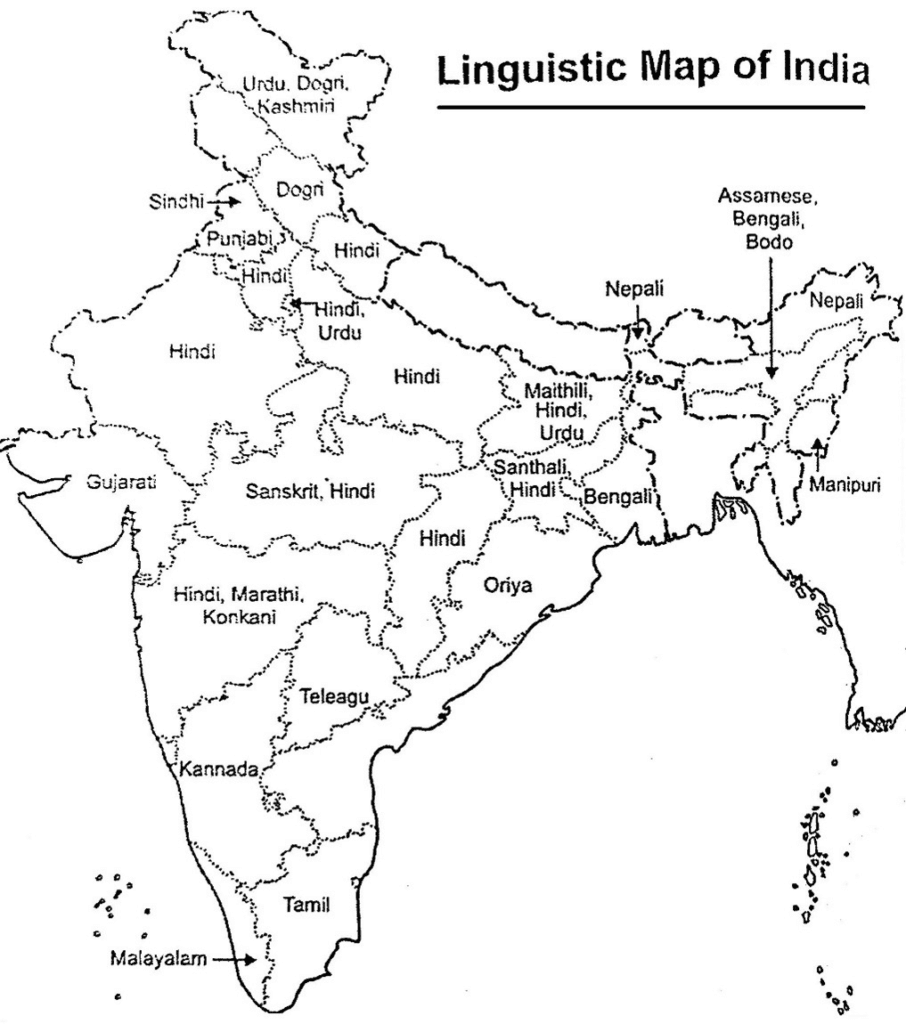
Q 2. Prepare a map of linguistic diversity of India by shading the region where each of these languages is spoken on the map of India.
Ans 2:
Q 3. Find out about any three languages that are spoken in India but are not included in this table.
Ans 2: Bhojpuri, Chhattisgarhi, Rajasthani
In-Text Questions (Page 23)
Q 1. Take the example of your own state or any other state that was affected by linguistic reorganisation. Write a short note for or against the argument given by the author here on the basis of that example.
Ans 1: The linguistic reorganization of states in India, particularly the formation of states like Karnataka, offers a compelling example to analyze the arguments for and against such reorganization. Proponents argue that linguistic reorganization fosters administrative efficiency, cultural identity, and regional pride. For instance, Karnataka, formed in 1956, united Kannada-speaking populations from various regions, enabling better governance and cultural cohesion.
However, opponents argue that this reorganization can lead to regional disparities and ethnic tensions. In Karnataka, the inclusion of diverse linguistic groups has occasionally sparked conflicts over resource allocation and representation, challenging the unity intended by the reorganization.
In conclusion, while linguistic reorganization can enhance cultural identity and governance, it may also lead to unforeseen regional tensions, suggesting that careful management and inclusivity are vital for its success.
In-Text Questions (Page 25)
Q 1. Prime Minister runs the country. Chief Minster runs the state. Logically, then the Chairperson of Zilla Parishad should run the district. Why does the D.M. or Collector administer the district?
Ans 1: The political leader of the Zilla Parishad is the president, who guides all decision-making processes. The District Magistrate (DM), on the other hand, serves as the administrative leader, responsible for implementing the Parishad’s decisions. This arrangement exemplifies the concept of power sharing, similar to the distribution of authority between the legislative and executive branches. Therefore, it is accurate to state that the DM oversees the administration of the district.
Intext Questions (Page 25)
Q 1. What do this newspaper clippings have to say about efforts of decentralisation in India?
Ans 1: The newspaper articles focus on the topic of Panchayats, which serve as a mechanism for decentralizing authority in India. Their primary purpose is to facilitate self-governance at the local level.
- The articles highlight a significant rise in the number of women elected to Panchayats, indicating greater female involvement in the political sphere.
- Additionally, these reports indicate that justice has become more accessible and affordable for the community.
- Furthermore, it is noted that Panchayats receive direct funding from the central government.
Let Us Find Out (Page 26)
Q 1. Find out about the local government in the village or town you live in.
If you live in a village, find out the names of the following:
your Panch or ward member, your Sarpanch, your Panchayat Samiti, the Chairperson of your Zilla Parishad. Also find out when did the last meeting of the Gram Sabha take place and how many people took part in that.
If you live in urban areas, find out the name of your municipal councilor, and the municipal chairperson or mayor. Also find out about the budget of your municipal corporation, municipality and the major items on which money was spent.
Ans 1: Students, do yourselves.
[hint]: To gather information about the local government in your area, follow these steps:
For Village Residents:
- Panchayat Information:
- Panch or Ward Member: Find the name of your local ward member.
- Sarpanch: Identify the name of your Sarpanch (head of the village council).
- Panchayat Samiti: Look up your Panchayat Samiti’s name and members.
- Chairperson of Zilla Parishad: Identify the Chairperson of your district council (Zilla Parishad).
- Gram Sabha Meeting:
- Last Meeting Date: Find out when the last Gram Sabha meeting occurred.
- Participation: Note how many people attended that meeting.
For Urban Residents:
- Municipal Information:
- Municipal Councilor: Identify the name of your local municipal councilor.
- Municipal Chairperson/Mayor: Find out the name of the municipal chairperson or mayor.
- Budget Information:
- Municipal Corporation Budget: Research the total budget of your municipal corporation or municipality.
- Major Expenditures: Identify major items or sectors where the budget was spent.
You can obtain this information through local government websites, community boards, or by visiting the local government office.
EXERCISES
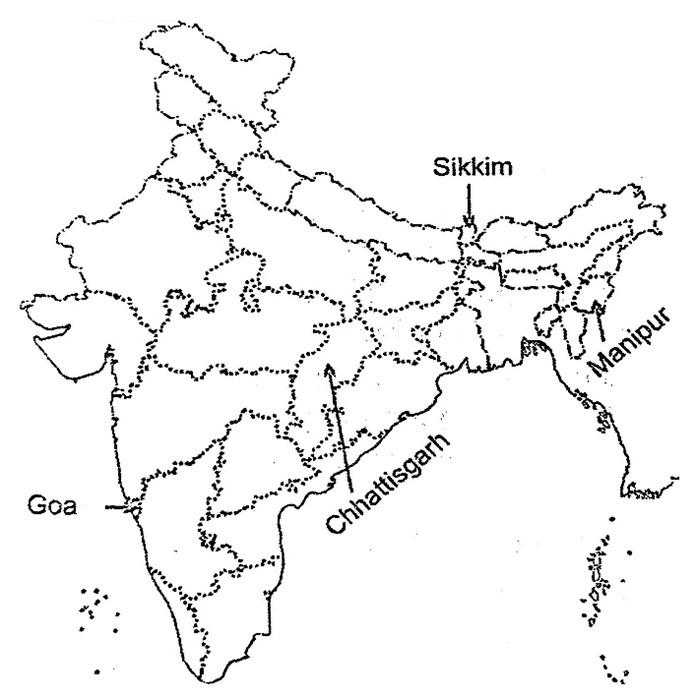
Q 1. Locate the following states on a blank outline political map of India: Manipur, Sikkim, Chhattisgarh and Goa.
Ans 1:
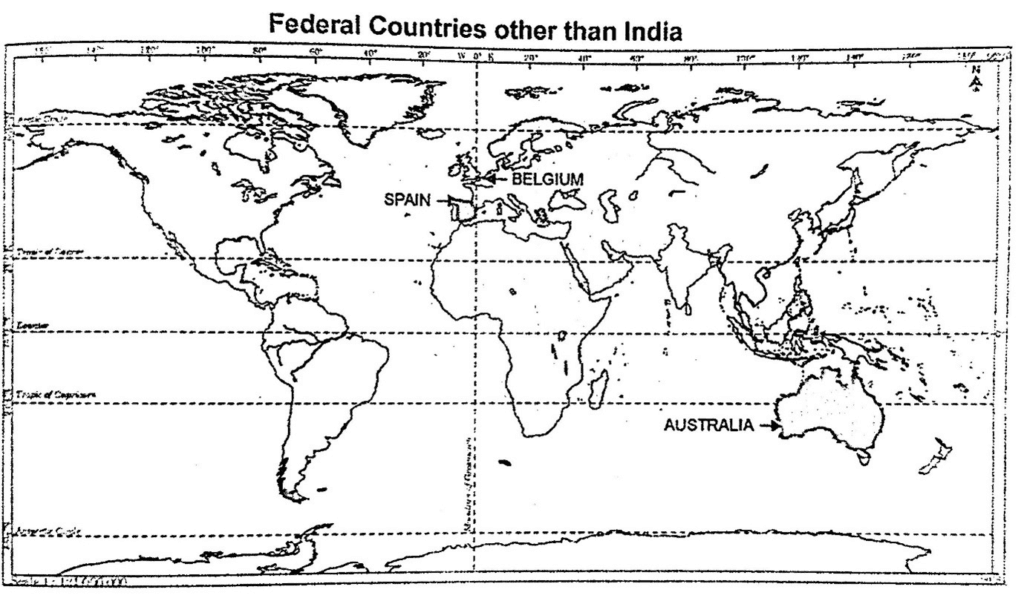
Q 2. Identify and shade three federal countries (other than India) on a blank outline political map of the world.
Ans 2:
Q 3. Point out one feature in the practice of federalism in India that is similar to and one feature that is different from that of Belgium.
Ans 3:
(1) Similar feature: Both Belgium and India operate under a three-tier system of government.
(2) Different feature: Belgium includes a community government as its third tier, which is organized by community groups, whereas India has a local self-government system that is not organized by race or caste.
Q 4. What is the main difference between a federal form of government and a unitary one? Explain with an example.
Ans 4:
(1) In a federal system of government, authority is distributed across various levels, including the different branches of government—executive, legislative, and judiciary—as well as among different tiers such as central, state, and local governments. Countries like India, Belgium, the United States, and Australia are examples of federal systems.
(2) In a unitary system of government, the national authority retains all the power. Any additional levels of government, such as states or provinces, act as sub-units and are subordinate to the central government. These local entities must comply with directives issued by the national government. Countries like Sri Lanka and China exemplify the unitary form of governance.
Q 5. State any two differences between the local government before and after the Constitutional amendment in 1992.
Ans 5:
Aspect | Local Government (Before 1992) | Local Government (After 1992) |
Elections | Regular elections were not conducted. | Regular elections for local government bodies are now constitutionally mandated. |
Powers and Resources | Local governments lacked independent powers and resources. | Local governments are granted specific powers and a share of revenue from state governments. |
Q 6. Fill in the blanks:
Since, the United States is a _______type of federation, all the constituent States have equal powers
and States are ________ vis-a-vis the federal government. But India is a ______ type of federation
and some States have more power than others. In India the _________ government has more powers.
Ans 6: Since the United States is a coming together type of federation, all the constituent States have equal powers and States are strong vis-à-vis the federal government. But India is a holding together type of federation and some States have more power than others. In India, the central government has more powers.
Q 7. Here are three reactions to the language policy followed in India. Give an argument and an example to support any of these positions.
Sangeeta: The policy of accommodation has strengthened national unity.
Arman: Language based states have divided us by making everyone conscious of their language.
Harish: This policy has only helped to consolidate the dominance of English over all other languages.
Ans 7: I concur with Sangeeta’s viewpoint that the policy of accommodation has played a crucial role in reinforcing national unity. Initially, Hindi was established as the official language, and subsequently, English was removed from its official status. This decision caused significant discontent among many people in the southern regions, particularly in Tamil Nadu, where the backlash manifested in a militant movement.
India is inherently diverse, with over 114 major languages spoken across the nation, and it is vital to honor and respect each of these languages. They collectively enrich our linguistic heritage, and it is essential that we allow them to thrive together.
In contrast, Sri Lanka serves as an example of how linguistic disparities can escalate into civil conflict. Therefore, it is accurate to assert that being adaptable and embracing an accommodating policy has bolstered our national unity.
Q 8. The distinguishing feature of federal government is:
(a) National government gives some powers to the provincial government.
(b) Power is distributed among the legislature, executive and judiciary.
(c) Elected officials exercise supreme power in the government.
(d) Governmental power is divided between different levels of government.
Ans 8: (d) Governmental power is divided between different levels of government.
Q 9. A few subjects in various Lists of the Indian Constitution are given here. Group them under the Union, State and Concurrent Lists as provided in the table below.
A. Defense; B. Police; C. Agriculture; D. Education; E. Banking; F. Forests; G. Communication; H. Trade; I. Marriages
Ans 9:
Union List | State List | Concurrent List |
A. Defense | B. Police | D. Education |
E. Banking | C. Agriculture | F. Forests |
G. Communication | H. Trade | I. Marriages |
Q 10. Examine the following pairs that give the level of government in India and the powers of the government at that level to make laws on the subjects mentioned against each. Which of the following pairs is not correctly matched?
(a) State government | State List |
(b) Central government | Union List |
(c) Central and State governments | Concurrent List |
(d) Local governments | Residuary powers |
Ans 10: (d) Local governments – Residuary powers.
Q 11. Match List I with List II and select the correct answer using the codes given below the lists:
List I | List II |
1. Union of India | A. Prime Minister |
2. State | C. Governor |
3. Municipal Corporation | D. Mayor |
4. Gram Panchayat | B. Sarpanch |
1 | 2 | 3 | 4 | |
(a) | D | A | B | C |
(b) | B | C | D | A |
(c) | A | C | D | B |
(d) | C | D | A | B |
Ans 11: (c) A, C, D, B.
Q 12. Consider the following statements:
- In a federation the powers of the federal and provincial governments are clearly demarcated.
- India is a federation because the powers of the Union and State Governments are specified in the Constitution and they have exclusive jurisdiction on their respective subjects.
- Sri Lanka is a federation because the country is divided into provinces.
- India is no longer a federation because some powers of the States have been devolved to the local government bodies.
Which of the statements given above are correct?
(a) A, B and C
(b) A, C and D
(c) A and B only
(d) B and C only
Ans 12: (c) A and B only.