
Chapter-1-The Rise of Nationalism in Europe (History) for Class 10
Ultimate NCERT Solutions for Ch-1-The Rise of Nationalism in Europe
Updated Solution 2025-2026 Updated Solution 2025-2026
NCERT Solutions for Class 10 (History)Ch-1-The Rise of Nationalism in Europe
(Exercises, Question/Answers & Activities)
Ch-1-The Rise of Nationalism in Europe
ACTIVITY AND IN-TEXT QUESTIONS
Activity
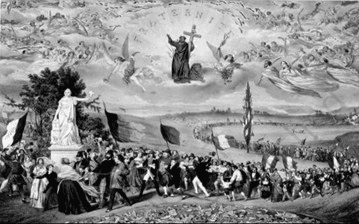
Q 1. In what way do you think this print (Fig. 1) depicts a Utopian vision?
Ans 1:
- Figure 1 illustrates the vision of a world composed of democratic and social republics.
- It presents numerous nations that aspire to achieve the milestone of becoming democratic and socially inclusive republics.
- This scenario represents an ideal situation, and therefore, the figure portrays a utopian vision, as such a reality would be unlikely to exist.
Discuss (Page 4)
Q 1. Summarise the attributes of a nation, as Renan understands them. Why, in his view, are nations important?
Ans 1 (a): Attributes of a nation according to Ernst Renan
Ernst Renan believed that a nation is based on a strong feeling of large-scale solidarity among its people. This unity is created through shared experiences, memories, and mutual consent to live together.
According to him, a true nation does not forcefully annex or control another territory against the will of its people. Consent and freedom are essential elements of national unity.
Renan also stated that the existence of a nation guarantees the freedom of its people. A nation allows its citizens to live with self-determination and collective identity.
(b) Difference between a modern state and a nation-state
A modern state refers to a political system where centralized authority exercises control over a defined territory. In this system, the rulers and the citizens have clearly separated roles and identities.
A nation-state, on the other hand, is formed when both the rulers and the citizens share a common identity. This identity is usually based on shared history, culture, language, and collective struggle. The people and the government see themselves as part of one united community.
In-text Question (Page 8)
Q 1. How did nationalism and the idea of the nation- state emerge?
Ans 1:
Nationalism and the concept of the nation-state developed among Europe’s culturally diverse and regionally different social groups. People began to feel a shared identity based on common language, culture, and history.
With the changes brought by industrialisation, a new middle class emerged. This class included workers, industrialists, entrepreneurs, and professionals.
The liberal and educated members of the middle class wanted to unite culturally similar groups. Their desire for unity gave rise to the feeling of nationalism.
Over time, this growing sense of shared identity led to the formation of modern nation-states in Europe.
Discuss (Page 10)
Q 1. Describe the political ends that (Friedrich) List hopes to achieve through economic measures.
Ans 1: (a) According to Professor List, economic liberalism and reforms play a crucial role in fostering a sense of national identity. This national sentiment, in turn, can help achieve various political objectives, such as:
(i) Individual freedom
(ii) Equality for all under the law
(iii) Protection of private property
(iv) Governance based on the consent of the people
(v) Elimination of aristocratic and clerical privileges
(vi) Establishment of a constitutional and representative government through a parliamentary system
Activity (Page 11)
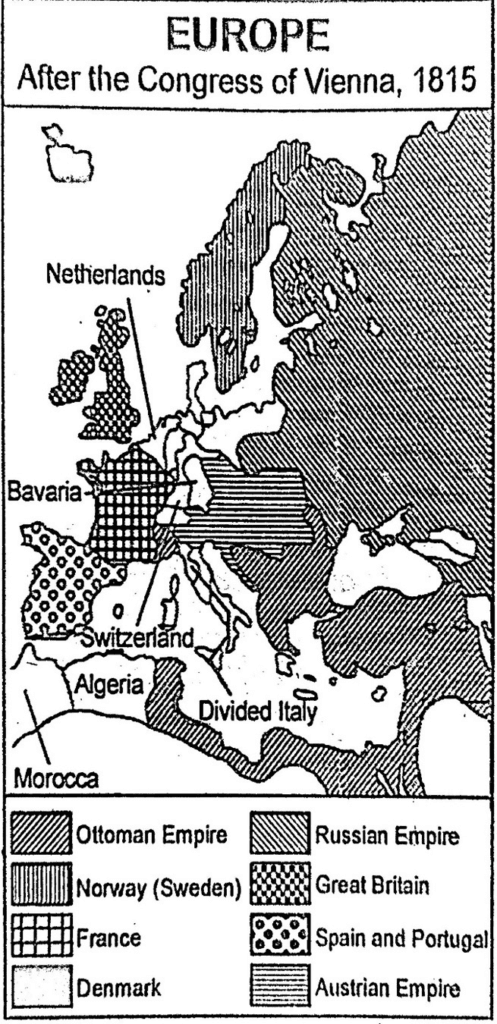
Q 1. Plot on a map of Europe the changes drawn up by the Vienna Congress.
Ans 1:
Discuss (Page 11)
Q 1. What is the caricaturist trying to depict?
Ans 1: The caricature aims to portray the conservative monarchies of 19th-century Europe, which suppressed the growth of liberal ideas and individual freedoms. In the illustration, thinkers are present within the society, yet they lack the power to express their thoughts openly.
Discuss (Page 15)
Q 1. Discuss the importance of language and popular traditions in the creation of national identity.
Ans 1:
- The language and cultural traditions of a specific region or nation foster a sense of shared history, collective experience, and unity among its people.
- These elements bring individuals together, creating a bond of pride and solidarity.
- This shared cultural identity helps people feel united as a nation, enhancing a sense of national unity and cohesion.
Discuss (Page 16)
Q 1. Describe the cause of the Silesian weavers’ uprising. Comment on the viewpoint of the journalist.
Ans 1:
- The main cause of the Silesian weavers’ uprising was the reduction in their wages. Contractors, who provided the raw materials and collected the completed textiles, paid the weavers extremely low amounts for their labor. When the weavers demanded fair payment, the contractors responded by assaulting them.
- The journalist’s perspective that the workers’ suffering was severe and that contractors exploited them unfairly is reasonable and entirely valid.
Activity (Page 16)
Q 1. Imagine you are a weaver who saw the events as they unfolded. Write a report on what you saw.
Ans 1:
- The weavers, who put in great effort to meet deadlines, did not receive fair compensation for their work.
- When they demanded reasonable payment from the contractors, they were met with scolding and even physical assault.
- This sparked a strong reaction among the weaving community. They organized themselves and, in an act of protest, forcefully entered the contractor’s residence.
- There, they caused damage, and the contractor, shocked by the sudden confrontation, fled. The following day, he returned with military support, leading to the tragic killing of the weavers.
Discuss (Page 18)
Q 1: Compare the positions on the question of women’s rights voiced by the three writers cited above. What do they reveal about liberal ideology?
Ans 1: (1) The three authors mentioned above provide distinct perspectives on women’s rights.
(i) The first author was against granting any political rights to women.
(ii) The second author criticized men who possessed political rights while simultaneously supporting women’s right to participate politically.
(iii) The third author advocates for women’s rights and presents a comparative analysis of the political rights of men and women.
(2) All three writers highlight significant divisions within liberal ideology regarding women’s rights, indicating that liberal thinkers and writers held differing views on this issue.
Activity (Page 20)
Q 1. Describe the caricature. How does it represent the relationship between Bismark and the elected deputies of Parliament? What interpretation of democratic processes is the artist trying to convey?
Ans 1:
(1) In the cartoon, Bismarck is depicted as lifting and manipulating a hunter high above him, while the other deputies appear to be in a state of fear.
(2) To protect themselves and demonstrate their respect, they have all chosen to crouch beneath the parliament benches.
(3) This illustration illustrates Bismarck’s dominance over the intellects of the German parliamentarians, highlighting his significant influence over his colleagues.
(4) The artist employs humor to critique the democratic system, suggesting that democracy merely serves as a facade, while in truth, it is Bismarck’s autocratic rule that prevails in the Parliament.
Activity (Page 21)
Q 1. Look at figure 14(a) (from textbook). Do you think that the people living in any of these regions thought of themselves as Italians?
Ans 1: In 1858, Italy was fragmented into seven distinct states. The northern territories were controlled by the Austrian Habsburgs, the central region was governed by the Pope, and the southern parts were under Spanish influence. The only exception was Sardinia-Piedmont, which was led by an Italian royal family. Additionally, the Italian language had not yet developed a standardized form, featuring numerous regional and local dialects. As a result, the inhabitants of these areas, apart from those in Sardinia-Piedmont, likely did not identify as Italians.
Q 2. Examine Figure 14 (b). Which was the first region to become a part of unified Italy? Which was the last region to join? In which year did the largest number of states join?
Ans 2: Savoy Sardinia was the initial territory to unite with Italy, while the final area to become part of the nation was the Papal States. The period from 1858 to 1860 saw the highest number of states joining the unification.
Activity (Page 22)
Q 1. The artist has portrayed Garibaldi as holding on to the base of the boot, so that the king of Sardinia- Piedmont can enter it from the top. Look at the map of Italy once more. What statement is this caricature making?
Ans 1: The boots depicted in the caricature represent the Kingdom of the Two Sicilies, located in southern Italy. Garibaldi was instrumental in their capture and subsequently transferred them to the King of Sardinia-Piedmont, who was later declared the King of a unified Italy. This image reflects the unification of Italy and highlights Garibaldi’s significant contributions to this historical event.
Activity (Page 24)
Q 1. With the help of the chart in box 3 (T.B. Page 24), identify the attributes of Veit’s Germania and interpret the symbolic meaning of the painting. In an earlier allegorical rendering of 1836, Veit had portrayed the Kaiser’s crown at the place where he has now located the broken chain. Explain the significance of this change.
Ans 1:
(1) Philip Veit’s painting of Germania represents the birth of the German nation. It reflects a new era filled with liberal and nationalist ideas.
(2) The figure of Germania shows that the nation is becoming strong and confident. It is ready to defend itself or maintain peaceful relations with its neighbours.
(3) The broken chains in the image symbolize Germany’s freedom from autocratic and monarchical rule.
(4) Germania wears a crown of oak leaves, which stands for courage, bravery, and honour.
(5) In Veit’s earlier 1836 painting, the Kaiser’s crown represented monarchy. In the later version, the broken chains show that the people have rejected royal power and gained independence.
Activity (Page 24)
Q 1: Describe what you see in Fig. 18. What historical events could Hübner be referring to in this allegorical vision of the nation?
Ans 1:
(1) In Julius Hübner’s artwork, Germania is depicted fallen before the Kaiser’s crown and scepter. This imagery represents the unsuccessful attempt to unite all Germans, which began at the Church of St. Paul during the Frankfurt parliament.
(2) The crown and scepter signify that the Frankfurt parliament was dissolved by the monarchy and military forces.
Activity (Page 25)
Q 1. Look once more at Fig. 10. Imagine you were a citizen of Frankfurt in March 1848 and were present during the proceedings of the Parliament. How would you
(a) as a man seated in the hall of deputies, and
(b) as a woman observing from the galleries, relate to the banner of Germania hanging from the ceiling?
Ans 1:
(a) If I were a man sitting in the hall of deputies, I would view the banner of Germania as a realization of our aspirations.
(b) From my perspective as a woman watching from the galleries, I would see the banner of Germania as a reflection of some liberal-nationalist principles.
EXERCISES
Write in Brief:
Q 1. Write a note on:
(a) Guiseppe Mazzini
Ans (a): Guiseppe Mazzini was a pivotal figure in the Italian unification movement and a prominent political thinker of the 19th century. Here are some key points about him:
- Early Life: Born on June 22, 1805, in Genoa, Italy, Mazzini was educated in law and initially pursued a career in that field before turning to politics.
- Nationalism and Republicanism: Mazzini was a strong advocate for nationalism and republicanism. He believed in the unification of Italy and the establishment of a democratic republic as essential for the country’s progress.
- Founding of Young Italy: In 1831, Mazzini founded the organization “Young Italy,” which aimed to promote the cause of Italian unification among the youth and inspire them to fight for a united Italy.
- Political Exile: Due to his revolutionary activities, Mazzini faced imprisonment and was forced into exile multiple times throughout his life, living in countries such as France and England.
- Role in the 1848 Revolutions: Mazzini played a significant role in the uprisings of 1848, advocating for a republican government. He briefly served as the head of the Roman Republic in 1849, though it was short-lived.
- Legacy: Mazzini’s ideas about nationalism, democracy, and social justice influenced later generations of political leaders and thinkers. He is often regarded as one of the founding fathers of modern Italy and a key figure in the wider European nationalist movements.
- Philosophy: Mazzini’s writings emphasized the importance of duty to the nation and humanity. He believed that individuals should work for the common good and that democracy should be based on moral and ethical principles.
Mazzini’s vision for Italy and his commitment to republicanism have left a lasting impact on Italian politics and the broader European nationalist movement.
(b) Count Camillo de Cavour
Ans (b): Count Camillo de Cavour was a pivotal figure in the unification of Italy during the 19th century. Here are some key points about his life and contributions:
- Early Life and Background: Born on August 10, 1810, in Turin, Cavour came from an aristocratic family. He studied economics and agriculture, gaining a strong foundation in political and economic theory.
- Political Career: Cavour became involved in politics in the 1840s, initially serving as a member of the Sardinian parliament. He was appointed Prime Minister of the Kingdom of Sardinia in 1852.
- Liberal Policies: Cavour was a proponent of liberal economic policies, including modernization, infrastructure development, and industrialization. He believed that a strong economy was essential for a unified Italy.
- Diplomatic Skill: Cavour was known for his diplomatic prowess. He sought alliances, notably with France under Napoleon III, to support the unification efforts against Austria, which controlled significant territories in Italy.
- Role in Italian Unification: Cavour played a crucial role in the military campaigns against Austria in 1859, which resulted in the annexation of Lombardy. He also supported Giuseppe Garibaldi’s campaigns in southern Italy, which further advanced the unification movement.
- Kingdom of Italy: Cavour’s efforts culminated in the establishment of the Kingdom of Italy in 1861, where he became the first Prime Minister. He continued to work towards consolidating the new nation until his death in 1861.
- Legacy: Cavour is remembered as one of the founding fathers of modern Italy. His vision for a united Italy, combined with his strategic diplomacy and economic policies, left a lasting impact on the country’s political landscape.
(c) The Greek War of independence.
Ans (c): The Greek War of Independence (1821-1832)
- Background: The Greek War of Independence was a successful struggle by Greek revolutionaries against the Ottoman Empire, which had ruled Greece since the mid-15th century. The war was part of a larger wave of revolutions in Europe, influenced by Enlightenment ideas and the success of the American and French revolutions.
- Outbreak of the War: The war began in 1821, when the secret society known as the Philiki Eteria (Society of Friends) initiated a revolt. Key figures in the revolution included leaders like Alexander Ypsilantis, Theodoros Kolokotronis, and Georgios Karaiskakis.
- Major Battles and Events: Significant battles included the Siege of Tripolitsa, the Battle of Navarino, and the Fall of Missolonghi. The conflict saw the participation of various factions and regions, and it was characterized by a mix of military engagements and guerrilla warfare.
- International Support: The Greek struggle garnered sympathy and support from many Europeans and Americans. Prominent figures, including Lord Byron, traveled to Greece to aid the revolution. The international response culminated in military intervention by Britain, France, and Russia, particularly after the Battle of Navarino in 1827, which saw a decisive victory for the allied forces against the Ottoman navy.
- Outcome: The war concluded in 1832 with the Treaty of Constantinople, which recognized Greece as an independent state. Initially, Greece was much smaller than today, encompassing the Peloponnese and parts of central Greece, with further territorial expansion occurring in subsequent years.
- Cultural Impact: The war inspired a resurgence of Greek national identity and culture, contributing to the broader European nationalist movements of the 19th century. It also led to significant changes in the political landscape of Europe, challenging the established order of empires and contributing to the decline of Ottoman control in the Balkans.
(d) Frankfurt Parliament
Ans (d): The Frankfurt Parliament, officially known as the Frankfurt Assembly, was a significant event in the history of German unification and liberal movements in the mid-19th century. Here are some key points:
- Historical Context: Convened in 1848, the Frankfurt Parliament was a response to the revolutionary wave that swept across Europe, aiming to unify the German states and establish a constitutional government.
- Meeting Place: The assembly took place in the Paulskirche (St. Paul’s Church) in Frankfurt am Main, symbolizing a move toward democratic representation and civic rights.
- Composition: The parliament comprised representatives from various German states, including intellectuals, politicians, and bourgeois leaders, reflecting a wide range of political opinions.
- Goals: The primary aim was to draft a constitution for a unified Germany, promoting principles like civil liberties, individual rights, and parliamentary democracy.
- Constitution Draft: In 1849, the assembly produced a constitution that proposed a federal state, civil rights, and a parliamentary system; however, it was never fully implemented.
- Failure and Legacy: The parliament ultimately failed to achieve its goals due to internal divisions, lack of support from monarchs, and the absence of military backing. Nevertheless, it laid the groundwork for future unification efforts and inspired later democratic movements in Germany.
- Historical Impact: The Frankfurt Parliament is considered a pivotal moment in the struggle for German democracy, influencing future political thought and action, leading to the eventual unification of Germany in 1871.
(e) The Role of Women in Nationalist Struggles:
Ans (e): Here’s a short note on the role of women in nationalist struggles, highlighting key points:
- Active Participation: Women played crucial roles in nationalist movements across the globe, actively participating in protests, demonstrations, and political organizations. They often mobilized communities and organized events that raised awareness about colonial oppression.
- Leadership and Organization: Many women emerged as leaders within nationalist movements, taking on significant roles in political organizations and movements. Figures like Sarojini Naidu in India and Emmeline Pankhurst in the UK exemplify women’s leadership in the fight for independence and rights.
- Advocacy for Rights: Women’s participation in nationalist struggles often went hand in hand with demands for gender equality. They fought for rights such as suffrage, education, and legal reforms, seeking to establish a more equitable society alongside national independence.
- Cultural Preservation: Women were instrumental in preserving and promoting cultural identities that colonial powers sought to undermine. They often played vital roles in revitalizing traditional practices and languages, linking the struggle for independence to cultural renaissance.
- Sacrifice and Resilience: Many women endured significant personal sacrifices, facing violence, imprisonment, and social ostracism for their involvement in nationalist movements. Their resilience and courage were pivotal in sustaining the momentum of these struggles.
- Post-Independence Impact: After achieving independence, many women continued to advocate for their rights and participation in governance, highlighting the ongoing struggle for equality and representation in newly formed nations.
- Intersectionality: Women’s involvement in nationalist struggles varied based on class, ethnicity, and region, reflecting an intersectional approach. Different groups of women brought unique perspectives and priorities to the independence movements, enriching the discourse.
Q 2. What steps did the French revolutionaries take to create a sense of collective identity among the French people?
Ans 2: The French Revolution implemented several measures and practices aimed at fostering a shared sense of identity among the populace:
- Concepts of La Patrie and Le Citoyen: The notions of “fatherland” (la patrie) and “citizen” (le citoyen) were established to replace the former royal ideologies. These concepts aimed to grant equal rights to all individuals.
- Introduction of a New National Symbol: A tricolor flag was adopted to serve as a new national emblem, symbolizing the revolutionary spirit and ideals.
- Centralized Administrative Structure: A centralized administrative framework was put in place to ensure that laws were applied uniformly to all citizens.
- Promotion of a National Language: Regional languages were seen as barriers to the unification of the nation, leading to their discouragement. French was promoted as the common language for both spoken and written communication.
- Standardization of Weights and Measures: To streamline commerce and eliminate various internal tariffs and duties, a uniform system of weights and measures was established.
Q 3. Who were Marianne and Germania? What was the importance of the way in which they were portrayed?
Ans 3:
(1) Marianne symbolizes the French nation, while Germania represents the German nation.
(2) These figures personify their respective countries, transforming the abstract concept of a nation into a tangible representation.
Q 4. Briefly trace the process of German unification.
Ans 4:
(1) In 1848, the liberal middle class within the German Confederacy convened at the Frankfurt Parliament with the aim of unifying Germany as a single nation. However, the assembly ultimately concluded with victories for monarchical, military, and aristocratic powers.
(2) Subsequently, Otto Von Bismarck, the Chief Minister of Prussia, took the lead in the movement for the unification of the German states. He organized military campaigns and mobilized the bureaucracy against the nations that had control over various German territories.
(3) Over the course of seven years, he engaged in three significant wars against Austria, Denmark, and France, emerging victorious in each. This series of conflicts effectively completed the unification of Germany.
(4) In January 1871, during a ceremony at Versailles, King William I of Prussia was declared the German Emperor.
Q 5. What changes did Napoleon introduce to make the administrative system more efficient in the territories ruled by him?
Ans 5: The following instances support the need for revolutionary administrative reforms initiated by Napoleon:
- The Napoleonic Code: Established in 1804, this code abolished hereditary privileges and introduced the principle of legal equality, ensuring the right to property for all individuals.
- Rural Administrative Reforms: The administrative framework underwent simplification, leading to the dissolution of the feudal system. Consequently, peasants were liberated from obligations to serfs and manorial estates.
- Urban Reforms: Restrictions imposed by guilds were lifted, and significant improvements were made to transport and communication infrastructure.
- Trade Reforms: The implementation of uniform laws, standardized weights and measures, along with a common national currency, significantly fostered the growth of trade and benefitted merchants.
Discuss
Q 1. Explain what is meant by the 1848 revolution of the liberals. What were the political, social and economic ideas supported by the liberals?
Ans 1:
1848 Revolution of the Liberals:
The 1848 revolution was led by educated middle-class Europeans. They demanded independent nation-states, equal laws, and individual freedoms. Their goal was to replace autocratic rulers with constitutional governments.
Political ideas:
Liberals wanted a government based on the consent of the people. They opposed kings, autocracy, and clerical power. They supported a constitutional and representative government selected through Parliament and protected property rights.
Social ideas:
Liberals believed in equality for all citizens. They demanded the right to vote and the freedom to take part in government.
Economic ideas:
They supported free markets and wanted to remove state restrictions on the movement of goods and capital.
Q 2. Choose three examples to show the contribution of culture to the growth of nationalism in Europe.
Ans 2: It is reasonable to assert that culture significantly influenced the concept of the nation. Culture encompasses various elements such as language, folk songs, folk dances, music, and operas. Let’s explore how these components contributed to the development of nationalism.
- Language: In Poland, the Polish language was prohibited in educational institutions. In response, Polish emerged as the language of congregations in churches, symbolizing resistance against Russian oppression in Europe.
- Folk Tales: The Brothers Grimm gathered numerous folk tales, using them as a tool to combat French domination in Germany.
- Music: In Poland, music played a vital role in sustaining national sentiments.
- Operas and Folk Dances: Kurpinski utilized operas to honor the national struggle, while folk dances such as the polonaise and mazurka served as symbols of Polish nationalism.
Q 3. Through focus on any two countries, explain how nations developed over the nineteenth century.
Ans 3: In the nineteenth century, nations developed in many ways. For example,
(1): Throughout the nineteenth century, various nations underwent significant transformations. For instance, Italy emerged as a unified state after a prolonged series of conflicts involving the forces of Sardinia-Piedmont and various rulers, including Austria. However, it was through adept diplomatic strategies that the military ultimately achieved their objectives.
(ii): In contrast, Britain’s history during this period lacks the narrative of widespread violence. In Britain, the English ethnic group dominated other ethnic communities by dismantling their national identities, which included the removal of national symbols, traditional clothing, and anthems. Instead, they promoted their own national flag, symbols, and anthem.
Q 4. How was the history of nationalism in Britain unlike the rest of Europe?
Ans 4: (1) Dominance over Scotland:
(i) In 1707, the Act of Union was enacted, establishing the United Kingdom of Great Britain. This legislation allowed England to exert its authority over Scotland.
(ii) Consequently, the power imbalance within the Union led to the suppression of Scottish political institutions and cultural practices. The British Parliament was largely controlled by English representatives, which resulted in the Scottish people being prohibited from using their native language and wearing traditional attire.
(2) Dominance over Ireland:
(i) Ireland was characterized by a division between Protestants and Catholics, with Catholics comprising the majority. England chose to support the Protestant population to maintain control over the Catholic majority.
(ii) In response to England’s actions, the Catholics initiated a revolt. This uprising was ultimately quelled, leading to Ireland’s incorporation into Great Britain in 1801.
Q 5. Why did nationalist tensions emerge in the Balkans?
Ans 5:
(1) The Balkans was a diverse region populated by various ethnic groups. During this time, it was under the control of the Ottoman Empire, which was experiencing a period of decline.
(2) Concurrently, the Slavs—who represented many of these ethnic groups—were significantly influenced by the rise of liberal and nationalist ideas. As a result, these groups began to aspire to establish their own nation-states.
(3) However, relations among these groups were far from amicable; they were marked by ongoing conflicts and rivalries. Each group sought to expand its territory at the expense of the others.
(4) This turmoil occurred alongside the interests of major European powers—such as Russia, France, and Austria-Hungary—who aimed to assert their influence over the Balkans for their own political, economic, and military objectives.
Consequently, these factors contributed to the emergence of nationalist tensions within the region.
PROJECT
Q 1. Find out more about nationalist symbols in countries outside Europe. For one or two countries, collect examples of pictures, posters or music that are symbols of nationalism. How are these different from European examples?
Ans 1: Some of the nationalist symbols of the countries other than European countries are as under:
S. No. | National Symbols | America | Russia | China | India |
1. | Flag | 50 stars on blue colour background surrounded by red and white strips | Three horizontal stripes in white blue and red color | Red flag with one big and five small yellow colour stars | 3 strips in orange, white and green color with Chakra in the middle (white strip) |
2. | Bird | Bald Eagle | Double-headed (bice phallic) Eagle | Chinese Dragon | Peacock |
3. | Flower | The Rose | Camomile (a variety of sunflower) | Peony | The Lotus |
4. | Anthem | “The Star-Spangled Banner” by Francis Scott Key | “Hymn of the Russian Federation” by Sergey Mikhalkov | “The March of the Volunteers” | “Jana Gana Mana” by Rabindranath Tagore |
5. | Music | “God Bless America” by Irving Berlin (Patriotic) | “Grom pobedy, razdavaysya!” by Gavrila Derzhavin | “The Plum Blossom” “The East is Red” | “Vande Mataram” by Bankim Chandra Chattopadhyay |
These national symbols differ significantly from those of European nations in how they express the unique nationalist sentiments of their respective countries.