
Chapter-2-Forest and wildlife resources (Geography) for Class 10
Ultimate NCERT Solutions for Ch-2-Forest and wildlife resources
Updated Solution 2025-2026 Updated Solution 2025-2026
NCERT Solutions for Class 10 Geography, Ch-2-Forest and wildlife resources
(Exercises, Question/Answers & Activities)
Ch-2-Forest and wildlife resources
ACTIVITY AND IN TEXT QUESTIONS
Q 1: Find out stories prevalent in your region which are about the harmonious relationship between human beings and nature.
Ans 1: As the sheep roamed through the jungle, it suddenly heard the cry of a baby. Following the sound, it came upon a human child lying alone on the grass. The sheep gently picked up the child and began to care for him.
Over time, the child grew up among the jungle animals. His companions included a monkey, a cat, a rabbit, a bear, a deer, and even a snake. The child learned to swing from tree branches, climb high up in the trees, and live as if he were part of the animal family.
One day, hunters arrived in the jungle and began hunting. Seeing the danger, the boy courageously confronted them, defending his animal friends. The hunters were amazed to see a human boy living in the wild. Although he didn’t speak their language, he managed to communicate that harming animal was wrong and that they, too, had families who would grieve their loss. The hunters, moved by his message, decided to stop hunting animals.
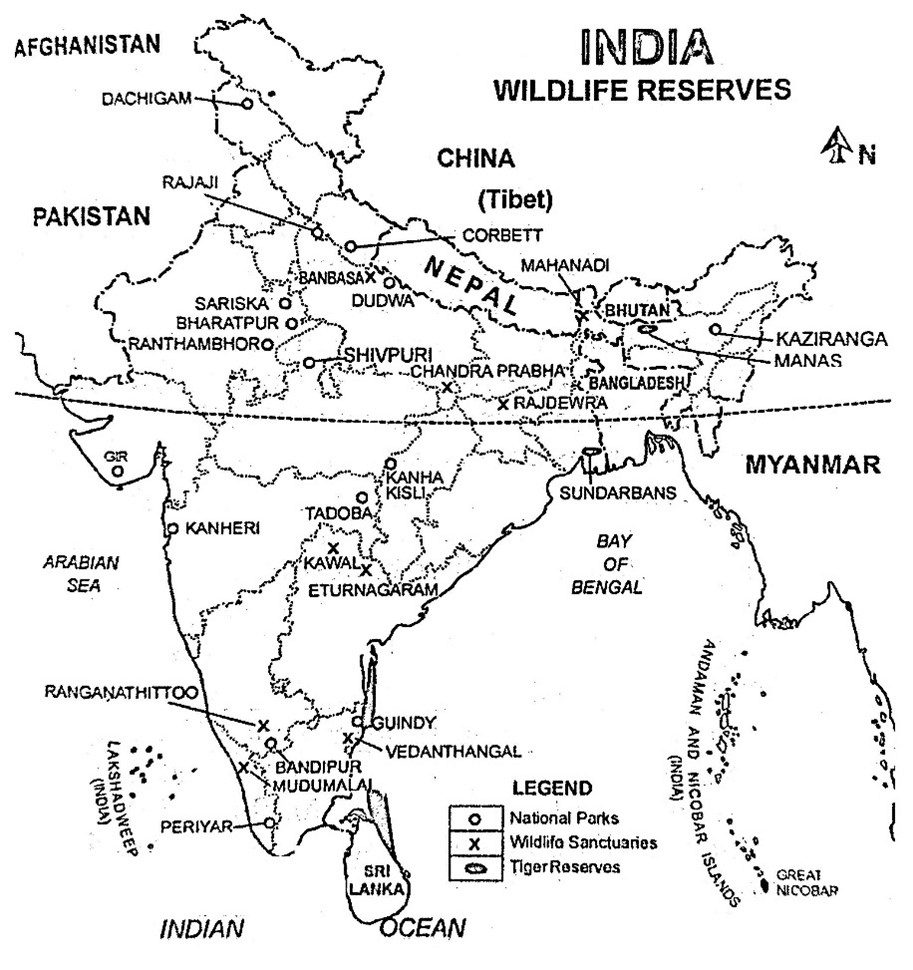
Q 2: Collect more information on the wildlife sanctuaries and national parks of India and cite their locations on the map of India.
Ans 2: See on the map.
Activity
Q 1: Write a short essay on any practices, which you may have observed and practised in your everyday lives to conserve and protect the environment around you.
Ans 1: Practices to Conserve and Protect the Environment:
- Reducing Waste: I practice waste segregation by separating recyclables from non-recyclables, ensuring proper disposal and recycling of materials.
- Using Reusable Bags: I always carry reusable bags while shopping to minimize plastic waste and encourage others to do the same.
- Conserving Water: I turn off the tap while brushing my teeth and fix leaks promptly to conserve water and reduce wastage.
- Energy Conservation: I switch off lights and unplug electronics when not in use, and use energy-efficient appliances to reduce electricity consumption.
- Planting Trees: I participate in community tree-planting initiatives, understanding the importance of trees in providing oxygen and reducing carbon footprints.
- Composting: I compost kitchen waste, reducing the amount of garbage sent to landfills and creating nutrient-rich soil for gardening.
- Using Public Transport: I prefer public transport, biking, or walking for short distances to decrease carbon emissions and reduce traffic congestion.
- Supporting Local Produce: I buy locally sourced fruits and vegetables, which reduces transportation emissions and supports local farmers.
- Educating Others: I share knowledge about environmental issues and sustainable practices with family and friends to foster a community of environmentally conscious individuals.
- Participating in Clean-Up Drives: I engage in local clean-up drives, helping to remove litter from parks and beaches, thus enhancing community spaces and protecting wildlife.
EXERCISES
1. Multiple choice questions:
(i) Which of the following conservation strategies do not directly involve community participation?
(a) Joint forest management
(b) Chipko movement
(c) Beej Bachao Andolan
(d) Demarcation of wildlife sanctuaries
Ans: (i) – (d) Demarcation of wildlife sanctuaries
2. Match the following:
(1) Reserved forests | (a) Other forests and wastelands belonging to both government and private individuals and communities. |
(2) Protected forests
| (b)forests are regarded as most valuable as far as the conservation of forests and wildlife resources. |
(3) unclassed forests | (c) Forest lands are protected from any further depletion |
Ans 2:
(1) Reserved forests | (b)forests are regarded as most valuable as far as the conservation of forests and wildlife resources. |
(2) Protected forests
| (c) Forest lands are protected from any further depletion |
(3) unclassed forests | (a) Other forests and wastelands belonging to both government and private individuals and communities. |
3. Answer the following questions in about 30 words.
(i) What is biodiversity? Why is biodiversity important for human lives?
Ans (i): Biodiversity encompasses a vast array of wildlife and cultivated species, each unique in structure and role, yet all interconnected through a network of interdependencies. This diversity is vital for human survival, as we coexist within a complex ecological web. Our existence relies heavily on this intricate system, highlighting our dependency on the rich variety of life that sustains the environment.
(ii) How have human activities affected the depletion of flora and fauna? Explain.
Ans (ii): Human activities contributing to the depletion of flora and fauna include:
- Agricultural Expansion: A primary driver of forest depletion, as land is cleared for crop cultivation.
- Shifting Cultivation: Traditional farming methods that involve periodically clearing forested areas for temporary cultivation.
- Large-Scale Development Projects: Infrastructure and urban development lead to significant habitat loss.
- Mining: Extractive industries that cause deforestation and disrupt ecosystems.
- Habitat Destruction and Overexploitation: Activities such as hunting, poaching, pollution, poisoning, and forest fires are key factors reducing biodiversity in India.
Additional factors include unequal access to resources, imbalanced consumption patterns, and unequal responsibility for environmental protection, which further exacerbate environmental degradation.
4. Answer the following questions in about 120 words.
(i) Describe how communities have conserved and protected forests and wildlife in India?
Ans (i): Communities in India have taken various initiatives to protect forests and wildlife:
(a) In the Alwar district of Rajasthan, residents from five villages have designated around 1,200 hectares of forest land as the Bhairodev Dakav ‘Sonchuri’. They established their own rules to prohibit hunting and actively safeguard the area’s wildlife from external threats.
(b) Certain trees hold spiritual significance for local communities. For instance, the Mundas and Santhals in the Chhotanagpur region revere the Mahua and Kadamba trees, while communities in Odisha and Bihar consider tamarind and mango trees sacred, often using them in wedding rituals.
(c) Near Bishnoi villages in Rajasthan, animals like blackbucks (chinkara), nilgai, and peacocks coexist peacefully with the community. Residents uphold a strong cultural ethic that protects these animals from harm.
(ii) Write a note on good practices towards conserving forest and wildlife.
Ans (ii): To promote forest and wildlife conservation, several key practices have been implemented in India:
- The Indian Wildlife (Protection) Act, established in 1972, introduced essential measures to safeguard natural habitats.
- This program primarily aims to protect endangered species by enforcing hunting bans, granting legal protection to habitats, and limiting wildlife trade.
- The government has also set up various National Parks and Wildlife Sanctuaries as dedicated conservation areas.
- Additionally, the central government launched targeted initiatives to protect specific species facing severe threats.
- Recently, animals like the Indian elephant, blackbuck, great Indian bustard, and snow leopard have received full or partial legal protection against hunting and trade across India.