
Unit 6 - Mijbil the Otter (Ncert Solutions) for Class 10 English
Ultimate NCERT Solutions for Unit 6 Mijbil the Otter
Updated Solution 2024-2025 Updated Solution 2024-2025
NCERT Solutions for Class 10 English, Unit 6 Mijbil the Otter
Question Answer, Grammar & Comprehension
Unit 6 Mijbil the Otter
Let’s Begin
Q 1. You have read the chapter ‘Mijbil the Otter’. Discuss with your partner the commitment the author had towards Mijbil, what arrangements he made for his pet. What good care did he take like getting fish, taking it for a walk or exercise, providing things, and space to play etc. Make a list and then share with other friends in the class.
Ans 1: Role-Play: The Author’s Commitment Towards Mijbil the Otter
Characters: Riya and Neha
Topic: A friendly conversation about how the author, Gavin Maxwell, cared for his pet otter, Mijbil.
Riya: Hey Neha! How are you?
Neha: I’m great, Riya! What about you?
Riya: I’m doing good too. So, what did you think about the author’s commitment towards Mijbil in the story?
Neha: Oh, Gavin Maxwell was truly dedicated. He treated Mijbil with so much love and care. He didn’t just see him as a pet, but more like a friend or family member.
Riya: I agree. Bringing Mijbil all the way from Iraq to London was a big step. He made sure Mijbil was safe and comfortable during the whole journey. That shows real responsibility.
Neha: Absolutely! Do you remember what kind of daily care he gave to Mijbil?
Riya: Yes! He really took good care of him:
- He gave him fish, which was Mijbil’s favorite food.
- He took him for daily walks on a leash.
- He gave Mijbil lots of space to play, especially in the bathroom.
- He also gave him toys like marbles, rubber balls, and a terrapin shell.
- Most importantly, he observed Mijbil’s habits and allowed him to be playful and curious.
Neha: Oh yes! Mijbil even made his own water slide in the bathroom! The author understood that otters love water and let him enjoy it.
Riya: Right! And remember when Mijbil got hurt and was bleeding? The author got so scared and immediately comforted him with love and care.
Neha: And during the flight, when the air-hostess allowed Mijbil to come out of the box, the author was so thankful. Mijbil trusted him so much that he just sat quietly on his lap.
Riya: Their bond was really special—full of love, trust, and understanding. It shows how beautiful the relationship between a human and an animal can be when there is care and compassion.
[Scene Ends with a Smile]
Q 2. Find out which illustrations will go with your list.

Ans 2: The Illustrations to the Author’s Care and Commitment:
- Image (Top Left) – The author taking Mijbil for a walk on a leash.
This matches the point: “He took him for daily walks using a leash.” - Image (Top Middle) – Mijbil sitting on the author’s lap.
This shows the bond and affection between Mijbil and the author. It matches: “He comforted Mijbil with love and care.” - Image (Top Left Box) – Mijbil inside a locked box.
This represents Mijbil being transported during the journey. Matches: “He brought Mijbil from Iraq to London, ensuring his safety during the flight.” - Image (Top Right) – Mijbil playing in water under a tap.
Perfectly fits: “He let Mijbil enjoy water play in the bathtub.” - Image (Bottom Left) – Mijbil climbing a wall.
This shows Mijbil exploring freely. Matches: “He gave Mijbil space to play and allowed him to follow his natural behavior.” - Image (Bottom Right) – Mijbil playing with a ball in the living room.
This fits the point: “He provided Mijbil with toys like balls, rubber fruits, and shells.”
Q 3. Mijbil is an active animal who shows many emotions. Refer to the chapter and complete the following Table.
What Mijbil does | How Mijbil feels |
1. Plunges, rolls in water | Goes wild with joy. |
2. | |
3. | |
4. | |
5. | |
6. |
Ans 3: Table: Mijbil’s Actions and Emotions
What Mijbil does | How Mijbil feels |
1. Plunges, rolls in water | Goes wild with joy |
2. Plays with marbles and toys | Feels playful and curious |
3. Runs around the flat | Is excited and energetic |
4. Climbs up curtains and walls | Feels adventurous and active |
5. Lies quietly on the author’s lap | Feels safe, calm, and loved |
6. Screeches and makes noises | Tries to express emotions or communicate |
Reading Comprehension
Text I
The following is a story of a baby Civet cat that fell from a tree and was raised by humans. It is a true story from Assam written by Rommel Shanmugam who is a conservation photographer. Through his photo stories, he seeks to inculcate in children a love for nature and wildlife.
Civet cats are found in most parts of India. They are also called toddy cats. They live on palm trees and love to drink the sweet sap, which is collected by toddy tappers to make wine! Dharini and his family rescues and rehabilitate wild animals. These are mostly babies or animals that cannot look after themselves.
“Baby Bhakat”
Hi! My name is Bhakat. I am a baby Civet cat. I am three-month-old. Shhh! I am taking a nap with my brothers. Yes, I live in a family of humans. They treat me like their own Baby!
My home is a little thatched hut by a river in a small village in Assam. The hut has an earthen floor and mud-splattered walls. Its doors are always open. I come and go as I please! Mama takes care of all three of us! Her name is Anjali. She cooks, cleans and plays with me. I secretly think she loves me the most. She lets me be real naughty!
Mama is about to make brunch! She is making roti and vegetables. I don’t like vegetables, but I like fruits. I love meat. I am omnivorous. Mama always feeds me before anyone else! I love things dipped in milk. They are yummy!
The man of the house is Dharini. If not for him, I would not be alive today! My civet mother built a nest for me in a very tall coconut tree. One night I slipped and fell to the ground! When villagers found me, they took me to Dharini. Dharini loves animals. I began to live in his home. I was very small. I could not walk. I ate and slept a lot!
Do you know why my eyes are so large? That’s because I am a nocturnal animal. I sleep in the day and am active in the night. My large eyes help me see better in the dark! I also have a very long tail! It helps me balance on tree-tops and branches. I mostly live on trees, though I do come down to the ground. Animals like me are called arboreal!
Inside Dharini’s house, I always snooze in the rafters. I like being high up; it reminds me of trees! One day I woke up to find a strange sight, Dharini’s house was filling with water! In the night, the river behind the house started overflowing its banks! Inside everything was helter-skelter. Things were piled on top of one another! The monsoon had arrived!
Dharini and Anjali carried us babies outside the house! There was water everywhere and it was very muddy! But the sun was out and it was not raining! I stayed high on the fence and made sure even my long tail did not get wet! Dharini went to pick snails.
Snails had climbed branches and walls to escape drowning in the flood! Every gardener knows that snails eat plants. By eating snails, I ensure that they do not overrun your garden. I maintain the balance of life in nature!
When it floods, you find fish everywhere! Dharini cast his net in the garden and began catching fishes. They are kept in a pan of water to keep them alive and fresh to eat!
Montu, my brother, tried to be naughty! He caught me and threatened to dip me in water! He got a scolding from Dharini. I hate to be in water! Back inside the house, it is time for me to play with Mama! I shall rest awhile and then be up again at night. Mama always leaves a midnight snack by the lantern!
–Rommel Shunmugam
Now read the following questions and tick the right answer.
Q.1. Dharini—
(a) is the land owner
(b) loves animals
(c) is a gardener
(d) is father of Bhakat
Ans 1: (b) loves animals
Q.2. Civet cats are also called___________________.
(a) Baby cats
(b) Night cats
(c) Toddy cats
(d) Snail cats
Ans 2: (c) Toddy cats
Q.3. Baby Bhakat loves to eat___________________.
(a) roti
(b) vegetables
(c) fruits
(d) meat
Ans 3: (d) meat
Q.4. Baby Bhakat hates to___________________.
(a) eat snails
(b) be in water
(c) play with Mama
(d) sleep in the rafter
Ans 4: (b) be in water
Q.5. The home for the Bhakat is_________________________.
(a) a garden near a river
(b) the roof of the little hut
(c) a little hut by a river
(d) the nest in a coconut tree
Ans 5: (c) a little hut by a river
Q.6. Tick the statement which is not true.
(a) Dharani and Anjali treat Bhakat as their own baby.
(b) They keep the door closed to keep Bhakat safe.
(c) Anjali plays with Bhakat and lets it be naughty.
(d) Anjali feeds Bhakat before anyone else.
Ans 6: (b) They keep the door closed to keep Bhakat safe.
(Correct Explanation: The doors are always open, and Bhakat comes and goes as he pleases.)
Unit 6 Mijbil the Otter (Grammar & Comprehension)
Updated Solution 2024-2025
TEXT I
Read the passage given below and answer the questions that follow.
It’s not easy having Elephants in your backyard.
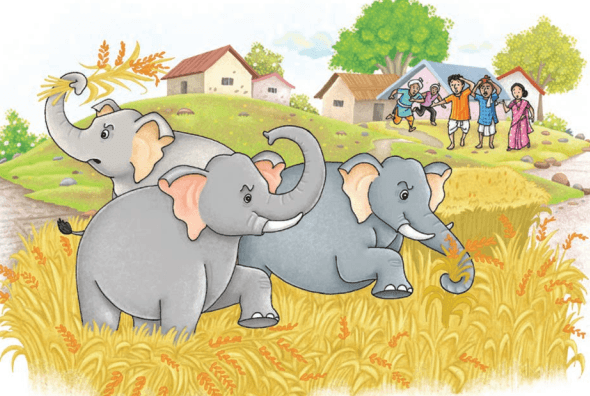
Around the world, as communities expand, and natural wild places are reduced, people and wildlife are increasingly coming into conflict over living space and food.
It might be baboons in Namibia attacking young goats or elephants in Nepal eating crops or European bears and wolves killing livestock. The problem is universal, affects rich and poor, and is bad news for all concerned.
The impacts are often huge. People lose their crops and livestock (and therefore a source of income and food security), property, and sometimes their lives—even a severe injury caused by wildlife can result in a loss of livelihood. The animals, some of which are already threatened or even endangered, are sometimes killed in retaliation or to prevent future conflicts.
Human-wildlife conflict is happening more and more, affecting a lot of different species. The effects of climate change will probably make the problem worse.
How we are tackling human-wildlife conflict
The solutions are often specific to the wildlife or area concerned, and are often creative and simple—for instance planting a barrier of crops that repel the animals (elephants and some other wildlife don’t like chilli, for example).
An important aspect of the work is that it benefits both the animals and local people and actively involves the communities concerned (in the case of chilli, it can be sold to increase income). It’s about finding solutions that lead to mutually beneficial coexistence.
The work has also often led to people being more enthusiastic and supportive of conservation, and has demonstrated that people can live alongside wildlife while developing sustainable livelihoods.
(Source: https://www.wwf.org.uk/what-we-do/area-of-work/ preventing-human-wildlife-conflict)
Q.1. What happens when communities expand?
_____________________________________________________ _____________________________________________________
Ans 1: When communities expand and natural wild spaces are reduced, people and wildlife come into conflict over living space and food.
Q.2. What is the meaning of “impact” in the passage? How it is affecting people and their life?
_____________________________________________________ _____________________________________________________
Ans 2: “Impact” means the effect or influence of one thing on another. In the passage, the impact includes people losing their crops, livestock, property, and sometimes even their lives. It also affects their income and food security. Severe injuries can lead to a loss of livelihood.
Q.3. What will make the human-wildlife conflict more intense?
_____________________________________________________ _____________________________________________________
Ans 3: Climate change will probably make human-wildlife conflict worse.
Q.4. The passage talks about one solution to tackle
human-wildlife conflict. What is it?
_____________________________________________________
_____________________________________________________
Ans 4: One solution mentioned is planting a barrier of crops that repel animals, such as chilli plants. These not only keep animals like elephants away but can also be sold to generate income.
Q.5. These types of creative and simple solutions lead to— (Tick the statement(s) which is/are not true.)
(a) active community involvement.
(b) generate income naturally.
(c) mutually beneficial coexistence.
(d) people live with wildlife happily.
(e) be more enthusiastic and supportive of conservation
(f) developing sustainable livelihood.
Ans 5: The incorrect statement is:
(b) generate income naturally. (The passage mentions that chilli can be sold to increase income, but this is a planned benefit, not something that happens “naturally” without effort.)
TEXT II
Read the passage given below and answer the questions that follow.
“Animal rights”
People who support animal rights recognise that all animals have an inherent worth, a value completely separate from their usefulness to humans. Every being with a will to live has the right to live free from exploitation and suffering.
All animals have the ability to suffer in the same way and to the same degree that humans do. They feel pain, pleasure, fear, frustration, loneliness, and familial love. Whenever we consider doing something that would interfere with their needs, we are morally obligated to take them into account.
People often ask if animal rights mean that animals should have the right to vote or drive a car. Of course, that would be silly because those aren’t rights that would benefit animals. But animals have the right not to suffer at the hands of humans and to live their lives free from suffering and exploitation because they have an interest in doing so. That is the difference between equal consideration and equal treatment.
Almost everyone cares about animals in some context, whether it’s a beloved family companion, an irresistibly cute kitten or a majestic wild animal seen in a documentary. After all, we each have some built-in capacity for empathy and compassion, as can be seen from the lengths that children often go to in order to help animals.
Logically and morally, there is no reason to differentiate in the way we treat the animals we share our homes with and those who are farmed for food. They are all individuals, with the same capacity to feel pain and fear. Animal rights help us to look past the arbitrary distinctions between different species, to rediscover our innate compassion, and to respect all animals equally.
Anyone who cares about animals can start putting these principles into practice every single day with the food they eat, the clothes they wear, and the products they buy. These choices are a form of non-violent protest that makes a real difference both by reducing the profits of corporations that harm or kill animals and by creating a growing market for cruelty-free food, fashion, services, and entertainment.
(Source: https://www.peta.org.uk/action)
Q.1. What do the people who support animal rights recognise?
_____________________________________________________ _____________________________________________________
Ans 1: People who support animal rights recognise that all animals have an inherent worth, completely separate from their usefulness to humans, and that they deserve to live free from exploitation and suffering.
Q.2. As human beings, what are our moral obligations towards animals?
_____________________________________________________ _____________________________________________________
Ans 2: We are morally obligated to consider animals’ needs and avoid actions that cause them suffering, as they feel pain, fear, and emotions just like humans.
Q.3. What is the right of animals as mentioned in paragraph three?
_____________________________________________________ _____________________________________________________
Ans 3: Animals have the right not to suffer at the hands of humans and to live free from exploitation, as they have an interest in avoiding suffering—even if they don’t need human-like rights (such as voting).
Q.4. Why should we rediscover our empathy, compassion, and respect for animals?
____________________________________________________
____________________________________________________
Ans 4: We should rediscover these values because all animals, whether pets or farmed animals, have the same capacity to feel pain and fear. Recognizing this helps us move past arbitrary species distinctions and treat them with fairness.
Q.5. Anyone who cares about animals can start putting “these principles” into practice. What are “these principles”?
_____________________________________________________ _____________________________________________________
Ans 5: These principles” refer to:
- Respecting animals’ right to live free from suffering and exploitation.
- Making daily ethical choices (e.g., cruelty-free food, clothing, and products).
- Supporting non-violent protest through consumer decisions that reduce harm to animals.
Vocabulary
Q 1. The following words are from the text you have read. The synonyms for each word are given. Find the odd one out.
(a) serious, grave, ridiculous, stern, solemn
Ans (a): serious, grave, ridiculous, stern, solemn
- Odd one out: ridiculous
- Serious, grave, stern, solemn all mean something of great importance or severity.
- Ridiculous means absurd or silly—the opposite in meaning.
(b) suitable, unfitting, appropriate, right, proper
Ans (b) suitable, unfitting, appropriate, right, proper
- Odd one out: unfitting
- Suitable, appropriate, right, proper all mean correct or well-matched.
- Unfitting means unsuitable—the antonym.
(c) hostile, unfriendly, averse, agreeable, unreceptive
Ans (c) hostile, unfriendly, averse, agreeable, unreceptive
- Odd one out: agreeable
- Hostile, unfriendly, averse, unreceptive all suggest opposition or resistance.
- Agreeable means pleasant or willing—the opposite.
(d) peaceful, harmonious, quiet, serene, violent
Ans (d) peaceful, harmonious, quiet, serene, violent
- Odd one out: violent
- Peaceful, harmonious, quiet, serene all describe calmness.
- Violent means forceful or aggressive—the antonym.
(e) appalling, atrocious, wonderful, awful, dreadful
Ans (e) appalling, atrocious, wonderful, awful, dreadful
- Odd one out: wonderful
- Appalling, atrocious, awful, dreadful all describe something extremely bad.
- Wonderful means excellent—the opposite.
Q 2. Look at the two sentences given below. These are from the text. Look at the words in italics. These are used as verbs. They can be used as nouns as well.
(a) By then it had crossed my mind…
(b) Camusfearna, ringed by water…
The noun forms of these two verbs are ‘cross’ and ‘ring’.
(a) I’ve put a cross on the map to show where the river Mahanadi is.
(b) She put the ring back in the jewellery box.
A list of words is given below. Make sentences using these words as verb and noun.
(c) Book
______________________________________________________ ______________________________________________________
Ans (c) Book
- Noun: I borrowed a fascinating book from the library.
- Verb: We need to book our train tickets in advance.
(d) Mail
______________________________________________________ ______________________________________________________
Ans (d) Mail
- Noun: I received an important mail from my teacher.
- Verb: Please mail the documents by tomorrow.
(e) Cable
______________________________________________________ ______________________________________________________
Ans (e) Cable
- Noun: The cable connecting the TV was damaged.
- Verb: The workers will cable the new internet connection today.
(f) Sack
______________________________________________________ ______________________________________________________
Ans (f) Sack
- Noun: The farmer carried a sack of potatoes.
- Verb: The manager had to sack the employee for misconduct
(g) End
______________________________________________________ ______________________________________________________
Ans (g) End
- Noun: We reached the end of the road.
- Verb: Let’s end this argument now.
(h) Head
______________________________________________________ ______________________________________________________
Ans (h) Head
- Noun: She has a headache, so she massaged her head.
- Verb: He will head the new project team.
(i) Colour
______________________________________________________ ______________________________________________________
Ans (i) Colour
- Noun: Her favourite colour is blue.
- Verb: The children love to colour pictures in their books.
(j) Lead
______________________________________________________ ______________________________________________________
Ans (j) Lead (Note: Pronounced differently as noun vs. verb)
- Noun (Pronounced “led”): This pencil has a broken lead.
- Verb (Pronounced “led”): She will lead the team to victory.
Grammar
Q 1. You have read about “noun modifiers” in the chapter ‘Mijbil the Otter’, page 112. These give more information about a noun, hence are called noun modifiers. These are adjectives or adjective phrases. Let us look at more of the adjective phrases and their usage.
Example: I went to a party. It was a Christmas party. The party was lovely.
I went to a lovely Christmas party.
Now, join the sentences given below and make a simple sentence with an adjective phrase.
(a) I bought a Maruti car. The colour is blue. It is sporty.
I bought ______________________car.
(b) He made a speech. The speech was short.
The speech was interesting. He made ____speech.
(c) Suresh went to a house. It was decorated beautifully.
Suresh went _______________house.
(d) She bought a dress. It is a designer one but frightfully expensive.
She bought ____________________dress.
(e) The food was tasty. It was prepared quickly.
_____________________food was tasty.
Ans 1: Here are the joined sentences with adjective phrases (noun modifiers) as required:
(a): Original: I bought a Maruti car. The colour is blue. It is sporty.
Joined: I bought a sporty blue Maruti car.
(b): Original: He made a speech. The speech was short. The speech was interesting.
Joined: He made a short, interesting speech.
(c): Original: Suresh went to a house. It was decorated beautifully.
Joined: Suresh went to a beautifully decorated house.
(d): Original: She bought a dress. It is a designer one but frightfully expensive.
Joined: She bought a frightfully expensive designer dress.
(e): Original: The food was tasty. It was prepared quickly.
Joined: The quickly prepared food was tasty.
Q 2. Use the correct form of the word given in the bracket and fill in the blanks. One has been done for you. His behaviour was disappointing. I expected him to be more polite. People present there were disappointed. (disappoint)
(a) The death of 40 jawans was_______________. We were _______________when we heard the news. (shock)
(b) I met an ____________________person in the party. He was _________________in tasting each and every dish kept in the food counter. (interest)
(c) Ravi is not very _________________to visit new places. He tells his friends no place is _________________compared to his village in Ranikhet. (excite)
(d) She got a new guest in her house. She was_______________. by his handling the pups. His voice was more ________________when he was calling these pups near him. (amuse)
(e) It is very humid in the Summers. I don’t like this weather. This weather is________________. I am ________________as I sweat a lot. Children are ________________as they can’t play outside. (disgust)
Ans 2: Here are the correct forms of the words filled in the blanks:
(a) The death of 40 jawans was shocking. We were shocked when we heard the news. (shock)
(b) I met an interesting person in the party. He was interested in tasting each and every dish kept in the food counter. (interest)
(c) Ravi is not very excited to visit new places. He tells his friends no place is exciting compared to his village in Ranikhet. (excite)
(d) She got a new guest in her house. She was amused by his handling the pups. His voice was more amusing when he was calling these pups near him. (amuse)
(e) It is very humid in the Summers. I don’t like this weather. This weather is disgusting. I am disgusted as I sweat a lot. Children are disgusted as they can’t play outside. (disgust)
Q 3. You have read about how to describe a repeated action in the past by using ‘would’ or ‘used to’. Go through the rules again and fill in the blanks with ‘would’ or ‘used to’ as appropriate.
(a) Every day she ________________come home from work with a rose to give to her mother.
(b) I _______________lend him my books when he was preparing for his examination.
(c) He _______________visit his friend in the hospital every evening.
(d) Each time I called him he ______________________come immediately.
(e) During his hostel life, he _______________eat all kinds of food without grumbling.
(f) When I was a child, I _______________believe that fire flies were small fire balls.
Ans 3: Here are the sentences filled in with ‘would’ or ‘used to’ as appropriate:
(a) Every day she would come home from work with a rose to give to her mother.
-Repeated past action, ‘would’ is preferred for regular habits in storytelling-
(b) I used to lend him my books when he was preparing for his examination.
-Past habit that no longer happens; ‘used to’ emphasizes the discontinued action-
(c) He would visit his friend in the hospital every evening.
-Repeated past action, ‘would’ fits for routines in narratives-
(d) Each time I called him, he would come immediately.
-Habitual response in the past; ‘would’ is natural for repeated reactions-
(e) During his hostel life, he used to eat all kinds of food without grumbling.
-Past habit with a discontinued situation; ‘used to’ highlights the change-
(f) When I was a child, I used to believe that fireflies were small fireballs.
-Past state/belief; ‘used to’ is required for states of being, not actions-
Editing
Q 1. Use capital letters, full-stops, commas, and inverted commas wherever necessary in the following paragraph.
the land of the Bisnois in rajasthan is known for conservation of wildlife. it is a living religion to the Bishnois. It is said This is probably only one religion in the world that is founded on the principles of conserving nature. It has followers over ten lakhs. For these many people protection of living beings is a way of life for the ishnois tree is sacred and their empathy and love extend to all living beings on earth.
They protect the ecosystem that surrounds the village which is a safe haven for blackbucks chinkaras vultures great Indian bustards peacocks etc they protect them from poachers and provide them plenty vegetation they keep water in the stone vessels for the animals to drink from, and hang water filled pots from the branches for the birds.
Ans 1: The land of the Bisnois in Rajasthan is known for conservation of wildlife. It is a living religion to the Bishnois. It is said, “This is probably the only religion in the world that is founded on the principles of conserving nature.” It has followers over ten lakhs. For these many people, protection of living beings is a way of life. For the Bishnois, tree is sacred, and their empathy and love extend to all living beings on earth. They protect the ecosystem that surrounds the village, which is a safe haven for blackbucks, chinkaras, vultures, great Indian bustards, peacocks, etc.
They protect them from poachers and provide them plenty vegetation. They keep water in the stone vessels for the animals to drink from and hang water-filled pots from the branches for the birds.
Q 2. Parts of sentences are given below. Rearrange the parts and write meaningful sentences in the space provided. Use appropriate punctuation marks.
(a) a town in Iraq/ in large numbers/ otters are found/ in the marshes near Basra.
(b) to the market/ we were fatigued/ having walked so far/on account of
(c) 40 paramilitary personnel/ the suicide car/ pulwana district killed/ bombing in
(d) india’s first semi-high speed train,/ was flagged off with excitement/ the inaugural trip of/ Vande Bharat Express,
(e) the eastern hemisphere/ the longer than all/ the Nile is said to be/ other rivers in
Ans 2: Here are the rearranged sentences with correct punctuation:
(a): Otters are found in large numbers in the marshes near Basra, a town in Iraq.
(b): We were fatigued on account of having walked so far to the market.
(c): The suicide car bombing in Pulwama district killed 40 paramilitary personnel.
(d): The inaugural trip of India’s first semi-high-speed train, Vande Bharat Express, was flagged off with excitement.
(e): The Nile is said to be longer than all other rivers in the eastern hemisphere.
Listening
Q 1: Following is a story of Gangaram, a 130 years old crocodile, who died in a Chhattisgarh village. Listen to the story carefully and answer the questions that follow. You can listen to the recorded story or ask your teacher, sibling or friend to read the story aloud.
The incident took place in Bawamohatra, a village in Bemetra district of Chhattisgarh. The residents of Bawamohatra gathered near the community pond and started weeping after they saw that the crocodile had died. The villagers were emotionally attached to the reptile and were heartbroken after his death. About 500 people of the small village attended the last rites of their beloved crocodile, Gangaram. The over three-meter-long crocodile was buried in Chhattisgarh’s Bawamohatra village after his last rites were performed by the villagers. A forest department official estimated that the crocodile was 130 years old. The crocodile was carried to its funeral on a tractor decorated with flowers and garlands.
The villagers say Gangaram was friendly. Even the kids of the village could swim around him. He had never harmed or attacked anyone. He was not a crocodile but a friend and a divine creature for them, who was worshipped in this village. Some say that he would even eat rice and dal which was served by the villagers and kids. He was very understanding and if he saw anyone swimming near him, he used to go to the other side of the pond. Villagers used to identify themselves with the crocodile as people used to call this village—Magarmachha vala gaaon, the Crocodile’s village.
In fact, the villagers now wish to build a statue of Gangaram near the pond to remember their friend, who got the village a new name. It may be weird, but it could be an example of how humans and animals can coexist without harming each other.
- Why did the residents gather near the village pond?
______________________________________________________
______________________________________________________
Ans 1: The residents gathered near the village pond because they saw that Gangaram, the crocodile, had died.
- Why were the villagers crying?
______________________________________________________
______________________________________________________
Ans 2: The villagers were crying because they were emotionally attached to Gangaram and were heartbroken by his death.
- Who was Gangaram?
______________________________________________________
______________________________________________________
Ans 3: Gangaram was a friendly, 130-year-old crocodile who lived in the village pond and was considered a divine creature and a friend by the villagers.
- How big was he?
______________________________________________________
Ans 4: He was over three meters long.
- How old was he?
______________________________________________________
Ans 5: He was estimated to be 130 years old.
- Give three reasons to justify Gangaram was friendly:
Ans 6:
(1) Children could swim around him safely.
(2) Gangaram never harmed or attacked anyone.
(3) Gangaram was very understanding and would move away if someone swam near him.
- What was the new name given to the village and why?
______________________________________________________
______________________________________________________
Ans 7: The village was called “Magarmachha vala gaaon” (The Crocodile’s Village) because Gangaram became a symbol of the village, and people identified the village with him.
- What will the villagers do to remember their friend?
______________________________________________________
______________________________________________________
Ans 8: The villagers plan to build a statue of Gangaram near the pond to honor his memory.
Speaking
Q 1. We all have seen hand puppets on YouTube or during story telling sessions. Try to make one hand puppet of an Otter. The situation is: Mijbil playing with water and spilling water everywhere. Write a few dialogues between Mijbil and Maxwell. Be the characters and exchange dialogues.
Maxwell: Oh! Mijbil, what have you done?
Mijbil: He, he _____________________________________________
_____________________________________________
Maxwell: _____________________________________________
_____________________________________________
Mijbil: _____________________________________________
_____________________________________________
Maxwell: _____________________________________________
_____________________________________________
Mijbil: _____________________________________________
_____________________________________________
Ans 1:
Maxwell:
(shaking his head, arms crossed):
“Oh! Mijbil, what have you done? The bathroom floor is a swimming pool now!”
Mijbil:
(grinning, splashing paws):
“He, he! Water is FUN! Look, I made tiny waves—just like the marsh back home!”
Maxwell:
(trying to mop up, sighing):
“But the soap is floating away, and my socks are soaked! How did you even turn the tap on?”
Mijbil:
(rolling happily in the puddle):
“Tap? Easy! I nudged it with my nose. Humans make such fun toys!”
Maxwell:
(laughing despite himself):
“You’re a clever little rascal. Next time, warn me before you flood the house!”
Mijbil:
(diving into a bucket, splashing Maxwell):
“No warnings! Surprise waves are the BEST! Come play, hooman!”
Q2. You have read a story ‘The Bond of Love’ in the class IX textbook, Beehive. In this story, the author talks about a sloth bear that his wife kept as a pet. The sloth bear was sent to the Zoo when it became too big to be kept at home. Now, discuss in a group of four, the following points, list views, and then share in the class.
(a) Keeping any big wild animal, like the sloth bears, at home.
(b) Keeping unusual pets for pleasure
(c) Using tigers, lions, dancing bears in circus
(d) Making the monkeys dance, cock fighting, bull fighting for amusement
Ans 2: Below is a sample group discussion dialogue on the points raised in ‘The Bond of Love’ from the class IX textbook, Beehive. In this dialogue, four students—Riya, Neha, Aarav, and Kabir—share their views on keeping wild or unusual animals as pets and using them for entertainment purposes.
Riya: Let’s begin with the first point: keeping big wild animals like sloth bears at home. In the story, we see that the sloth bear was initially a pet, but as it grew larger, it became unsafe to keep at home. What do you think?
Neha: I believe that keeping wild animals in a domestic setting isn’t suitable. Big wild animals need space, natural habitats, and specialized care. When kept at home, their natural instincts are stifled, and it can be dangerous to both the animal and the people around.
Aarav: True. It not only limits the animal’s freedom but also raises ethical questions regarding animal welfare. Such an animal might feel stressed or confined, which can cause health or behavioral issues.
Kabir: Also, having a wild animal at home risks disrupting the balance of nature. These animals are meant to live in the wild where they can express their natural behaviors. When we keep them as pets, it forces them into an environment that isn’t suited for them.
Riya: Moving to the second point: keeping unusual pets for pleasure. What are your thoughts on this topic?
Neha: Unusual pets can be fascinating, but there is a need for responsibility. Some people keep exotic species because they’re rare or unique, but that should be done with an understanding of the animal’s needs and under proper care conditions.
Aarav: I agree. The main issue is whether the owner can meet all the physical, behavioral, and emotional needs of the animal. Otherwise, the animal’s well-being can be compromised. People often underestimate the complexities of caring for exotic species.
Kabir: Plus, keeping unusual pets might sometimes encourage illegal trade and exploitation if people start valuing these animals merely for their uniqueness or for trend purposes rather than for the companionship or ecological balance.
Riya: Now, let’s talk about using tigers, lions, and dancing bears in circuses. This is a controversial subject.
Neha: Using these animals for entertainment is problematic because it involves forcing them into unnatural situations. In a circus, these animals are not able to engage in normal behaviors like hunting or roaming freely, which makes it both cruel and stressful for them.
Aarav: Absolutely. Moreover, the conditions in circuses—small cages, continuous travel, and performance training—can lead to physical and mental health issues. It’s a practice that often compromises the dignity of these magnificent animals.
Kabir: Many people now argue that circuses should find alternative acts that don’t involve wild animals. It’s about evolving our form of entertainment to ensure animal rights and welfare are respected.
Riya: Lastly, let’s consider making monkeys dance, cock fighting, and bull fighting for amusement.
Neha: I think using animals for such activities is outright exploitation. Forcing animals to perform unnatural tricks like dancing or to engage in violent activities like cock fighting and bull fighting is unethical. It shows a lack of respect for their natural behaviors.
Aarav: Yes, it’s not fair to subject animals to such treatment solely for human amusement. These practices often involve harsh training methods and can be very stressful or even harmful to the animals.
Kabir: It’s important to raise our voices against such forms of entertainment. Instead, we should be promoting ways to interact with wildlife that are educational and respectful of animal welfare.
Riya (concluding): So, to summarize our discussion:
- (a) Keeping Big Wild Animals at Home: It’s neither safe nor ethical. Big wild animals need natural habitats for their well-being.
- (b) Keeping Unusual Pets for Pleasure: Should be approached with responsibility, ensuring that owners can meet the animals’ specialized needs; otherwise, it leads to exploitation.
- (c) Using Tigers, Lions, Dancing Bears in Circuses: It is often cruel due to confinement and unnatural living conditions, and it puts animal welfare at risk.
- (d) Making Monkeys Dance, Cock Fighting, Bull Fighting: Such practices are exploitative, stressful, and inhumane, as they use animal suffering for entertainment.
Neha: That’s right, and it also highlights the need for better animal rights and more sustainable, ethical ways of coexistence with wildlife.
Aarav: Discussions like these are important because they help us understand our responsibilities towards the animals, we share the planet with.
Kabir: Exactly. Awareness is the first step toward change.
Writing
Q 1. Based on the above points, write a paragraph giving your points of view. You can highlight on the loss of natural habitat, cruelty, loss of freedom etc.
Ans 1: Paragraph on Ethical Treatment of Animals:
Keeping wild animals as pets or using them for entertainment may seem exciting, but it causes immense harm. Wild animals like sloth bears or tigers lose their natural habitats and freedom when confined to homes or circuses. They suffer cruelty—chains, cages, and forced training that breaks their spirit. For example, dancing bears endure painful nose piercings, while circus animals live in constant stress.
Even “unusual pets” like monkeys or exotic birds face neglect due to improper care. These practices disrupt ecosystems and teach cruelty disguised as tradition or fun. Instead, we must respect animals by protecting their habitats, supporting wildlife sanctuaries, and choosing humane entertainment. True love for animals means letting them live freely, not as prisoners for our pleasure.
Q2. Read these quotations and write one paragraph in the context of ‘Animal Rights’.
(a) “The greatness of a nation and its moral progress can be judged by the way its animals are treated.”
– Mahatma Gandhi
(b) When it comes to pain, love, joy, loneliness and fear, a rat is a pig is a dog is a boy. Each one values his or her life and fights the knife.”
– PETA founder, Ingrid E. Newkirk
Ans 2: The quotations by Mahatma Gandhi and Ingrid E. Newkirk strongly emphasize the importance of compassion and equality in how we treat animals. Gandhi’s words highlight that the moral fabric of any society is reflected in its treatment of animals, implying that kindness to animals is a true measure of a nation’s ethical development. Similarly, Ingrid Newkirk’s quote challenges the notion of species hierarchy, reminding us that all living beings, regardless of whether they are animals or humans, experience emotions like pain, fear, and love.
Both quotes underline the idea that animals are sentient beings who deserve respect, empathy, and protection. Animal rights, therefore, are not just about preventing cruelty but about recognizing the intrinsic value of every living creature and ensuring their right to live free from suffering and exploitation.
Project
Q 1. In a group of four, conduct research on the following question and write a report on the findings. What animals can be exported or imported under law? (Customs seizures show a variety of animals from reptiles, lizards, leopards to pythons, venomous reptile. These are carried in tiny suitcases and smuggled.)
Ans 1: Report on the Legal Export and Import of Animals
Research Question:
What animals can be exported or imported under law?
Introduction:
Illegal smuggling of animals, including reptiles, lizards, leopards, and pythons, has become a serious issue worldwide. Many of these animals are transported in cruel and inhumane ways, often hidden in small containers or suitcases. To protect wildlife and prevent animal cruelty, both national and international laws regulate which animals can be legally traded across borders.
Findings:
1. Legal Frameworks Governing Animal Trade:
- CITES (Convention on International Trade in Endangered Species of Wild Fauna and Flora):
This international agreement between governments ensures that the trade of wild animals and plants does not threaten their survival. It classifies animals into three appendices:- Appendix I: Species threatened with extinction (e.g., tigers, elephants). Trade is generally banned.
- Appendix II: Species not necessarily threatened with extinction, but trade is controlled (e.g., some reptiles and birds).
- Appendix III: Species protected in at least one country that has asked other CITES members for assistance in controlling the trade.
2.Indian Laws on Animal Import and Export:
- Wildlife (Protection) Act, 1972:
This act prohibits the hunting, capturing, and trade of wild animals listed in its schedules.- Export or import of wild animals and birds protected under this act is banned without special permission from the government.
- Customs Act, 1962:
Animals brought into the country without proper documents or licenses are seized by customs officials. - Directorate General of Foreign Trade (DGFT) Rules:
Only animals listed in the DGFT’s permitted list can be legally imported or exported. Pets like dogs, cats, fish, and some exotic birds and reptiles may be allowed under strict regulations.
3. Commonly Smuggled Animals:
Despite the laws, many animals are illegally traded, including:
- Snakes and venomous reptiles
- Exotic lizards
- Turtles and tortoises
- Leopard cubs and other endangered species
4. Reasons for Smuggling:
- High demand in exotic pet trade
- Use in traditional medicines
- Skins and body parts used in fashion or for decoration
Conclusion:
The legal import and export of animals are tightly regulated to protect endangered species and ensure animal welfare. However, illegal smuggling remains a major challenge. It is important to spread awareness, strengthen enforcement, and support wildlife protection laws to stop this cruel and dangerous trade. Citizens must be informed and responsible to help conserve our natural biodiversity.
Q 2. Make a team of four students. Imagine a unique animal or bird as a pet. Draw the animal and write the following information about it.
(a) Name of the pet and draw the animal on a chart paper.
(b) My pet: (Make a table like the following and write its specifications)
Has | Can | Is |
For example: webbed feet, long legs. fat legs, etc. heavy body, very light weight, soft fur, feather, sense of smell, etc.
| Swim, fly, run, grow tall, small size, hunt, carry weight, guard the house, etc. communicate, sing, speak, make variety of sounds to communicate, show affection, emotion, etc. | Warm-blooded, mammal, good swimmer, largest animal, smallest animal, good hunter, etc. sensitive, ferocious, short tempered, docile, smart, etc. |
(c) What all do you have to do to keep the animal with you at home? (You can refer to the dos and don’ts given on page no. 102 of the textbook First Flight.)
(d) Prepare a write up, share it in the class, and put it on the wall for the class to read.
Notes
_____________________________________________
_____________________________________________
_____________________________________________
_____________________________________________
_____________________________________________
_____________________________________________
_____________________________________________
Ans 2: Here’s a fun and creative response you and your team can use for your project. You can also draw the pet based on the description given below. Feel free to customize the details, colors, and features when creating your chart paper.
(a) Name of the Pet and Drawing
Name of the Pet: Fluffaroo
Description for Drawing:
Fluffaroo is a unique mix between a rabbit and a parrot. It has soft rainbow-colored fur, long floppy ears, and bright feathered wings that allow it to fly. Its eyes sparkle like stars, and it has a small heart-shaped tail. It hops like a bunny but also soars like a bird!
(Draw this on chart paper with vibrant colors!)
(b) My Pet – Specifications Table
Has | Can | Is |
Soft rainbow fur | Fly short distances | Warm-blooded |
Feathered wings | Hop like a bunny | A mix of mammal and bird |
Sparkling eyes | Carry light objects | Very affectionate |
Heart-shaped tail | Sense danger with sharp hearing | Loyal and playful |
Long floppy ears | Sing different melodies | Extremely intelligent |
(c) What do you have to do to keep the animal with you at home?
To keep Fluffaroo happy and healthy at home:
1. Do:
- Build a safe, cozy space with room to hop and fly.
- Feed it fresh fruits, nuts, and leafy greens daily.
- Give it attention and affection—it loves cuddles!
- Let it fly and exercise for at least an hour every day.
- Teach it songs—it enjoys learning new tunes.
- Take it to the vet regularly.
2. Don’t:
- Don’t keep it in a cage all day—it needs freedom.
- Don’t shout or scare it—it’s sensitive to loud sounds.
- Don’t leave it alone for too long—it gets lonely.
- Don’t feed it junk food or sweets.
(d) Write-Up to Share with Class and Put on the Wall
Meet Fluffaroo – Our Dream Pet!
Fluffaroo is a magical creature like no other! With soft rainbow fur, floppy ears, and shiny wings, it brings joy wherever it goes. It hops around playfully, flies across the room, and even sings sweet songs to cheer us up. Fluffaroo is not just a pet—it’s a best friend who can feel, understand, and love like us. We take care of it by giving it healthy food, space to fly, and lots of love. Fluffaroo teaches us to be gentle, responsible, and kind. Wouldn’t it be amazing to have a Fluffaroo in every home?
Team Members: (Name 1), (Name 2), (Name 3), (Name 4)
Class/Section: _________
Unit 6 Mijbil the Otter (Grammar & Comprehension)
Updated Solution 2024-2025
This complete solution is prepared as per the latest syllabus of 2024-25. If you have any further queries, feel free to ask! 😊