
Ch-1-Resources and Development (GEOGRAPHY) for Class 10
Ultimate NCERT Solutions for Ch-1-Resources and Development
Updated Solution 2025-2026 Updated Solution 2025-2026
NCERT Solutions for Class 10 Geography, Ch-1-Resources and Development
(Exercises, Question/Answers & Activities)
Ch-1-Resources and Development
ACTIVITY AND IN-TEXT QUESTIONS
IN-TEXT QUESTIONS: (PAGE 1)
Q 1. Can you identify and name the various items used in making life comfortable in our villages and towns. List the items and name the material used in their making.
Figure 1.1
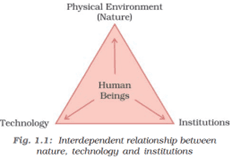
Figure 1.2
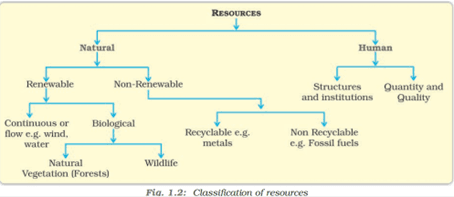
Ans 1: Yes, based on the given passage and the Fig. 1.2: Classification of resources, here’s a detailed list of items used in villages and towns that make life comfortable, along with the materials used in their making and the type of resources they relate to:
🏠 1. Housing Materials
Item | Material Used | Type of Resource |
Bricks | Clay, water (Abiotic) | Natural, Non-renewable |
Cement | Limestone, clay (Abiotic) | Natural, Non-renewable |
Wood for furniture/roofing | Timber (Biotic) | Natural, Renewable |
Iron rods | Iron ore (Abiotic) | Natural, Non-renewable |
Paints | Minerals, chemicals | Natural/Human-made |
⚙️ 2. Tools and Machinery
Item | Material Used | Type of Resource |
Tractors, ploughs | Iron, rubber, fuel | Natural (Fossil fuels), Recyclable metals |
Electric motors/pumps | Copper, steel, plastic | Natural, Recyclable |
Solar panels | Silicon, aluminum | Natural, Renewable Energy |
🚜 3. Agriculture
Item | Material Used | Type of Resource |
Hand tools | Iron, wood | Natural, Recyclable |
Irrigation pipes | Plastic (Human-made) | Human Resource (Technology) |
Fertilizers | Chemicals | Human-made resources |
🛋️ 4. Domestic Items
Item | Material Used | Type of Resource |
Chairs/tables | Wood, plastic | Biotic (Wood), Human-made (Plastic) |
Cooking vessels | Aluminum, stainless steel | Recyclable metals |
LPG stoves | Iron, rubber pipes | Non-renewable + Human-made |
💡 5. Electricity & Communication
Item | Material Used | Type of Resource |
Electric wires | Copper, rubber | Natural (Recyclable) |
Bulbs/Fans | Glass, copper, plastic | Human-made |
Mobile phones | Lithium, plastic, silicon | Human-made, Natural (Abiotic) |
🚰 6. Water Supply & Sanitation
Item | Material Used | Type of Resource |
Water tanks | Cement, plastic | Abiotic & Human-made |
Pipes | PVC/plastic | Human-made |
Handpumps | Iron, steel | Natural (Recyclable) |
📚 7. Social Infrastructure
Item | Material Used | Type of Resource |
School benches | Wood, steel | Biotic + Recyclable |
Hospital equipment | Plastic, metal | Human-made |
Summary:
These materials and tools are not just free gifts of nature. They become resources only after human intervention, technological processing, and institutional usage, reflecting the interdependent relationship shown in Fig. 1.1 and Fig. 1.2 (nature, technology, institutions).
ACTIVITY (PAGE 3)
Q1. Imagine if the oil supply gets exhausted one day, how would this affect our lifestyle?
Ans 1: If the oil supply were to be depleted, it would significantly impact our daily lives in several ways:
- The movement of people would be heavily disrupted, as the majority of vehicles rely on oil as a primary fuel source.
- The transportation system would also suffer, making it difficult for people to access essential goods and commodities required for day-to-day life.
Q2. Plan a survey in your colony/village to investigate people’s attitude towards recycling of the domestic/ agricultural wastes. Ask questions about:
(i) What do they think about resources they use?
(ii) What is their opinion about the wastes, and its utilisation?
Ans 2: Alok, a Class X student, organized a survey in his neighborhood to understand waste management practices across different economic backgrounds. He selected three individuals, each from distinct economic statuses, to ensure diverse perspectives. His interviewees were:
- Dr. Anita Desai
- Mrs. Sulekha (a homemaker)
- Shanti Bai (a domestic worker at Alok’s home)
- Interview with Dr. Anita Desai:
Alok scheduled his interview with Dr. Anita for Sunday, knowing her clinic would be closed that day. He prepared a set of questions in advance to stay focused.
Alok began by greeting her, and Dr. Anita invited him in and encouraged him to proceed with his questions. Alok asked about her wooden furniture, and she explained that they keep damaged furniture in storage for potential reuse. She mentioned that they sell old newspapers to hawkers for recycling and dispose of vegetable waste in dustbins for collection. Regarding plastic toys and utensils, she appreciated their light weight and durability, noting that they could be sold for recycling when no longer usable.
- Interview with Mrs. Sulekha:
Alok then visited Mrs. Sulekha, who welcomed him and was eager to help with his project. When asked about her iron folding bed, she said it would be disposed of on the roadside if it broke beyond repair, as she believed it couldn’t be sold. She mentioned throwing vegetable waste in the dustbin for collection, giving broken plastic items to those in need, and selling old newspapers to hawkers for extra income.
- Interview with Shanti Bai:
Lastly, Alok interviewed Shanti Bai, who responded to his questions willingly. She explained that she disposes of vegetable waste in the street outside her home. She values empty plastic containers, using them for water or grain storage, and has a wooden cot, which she would repair or eventually use as firewood rather than discard. Unlike others, Shanti Bai did not consider selling waste items, as they still held utility for her household.
- Conclusion:
Alok observed that individuals from higher economic backgrounds, such as Dr. Anita, seemed more conscious about recycling and reusing household items. Mrs. Sulekha’s recycling practices appeared financially motivated rather than environmentally driven. Shanti Bai, from a lower economic background, repurposed items out of necessity, valuing objects that others might consider waste. containers to collect water. The economically weaker class is not much aware about recycling domestic wastes.
Q : What resources are being developed in your surroundings by the community/village panchayats/ward level communities with the help of community participation?
Ans: In our surroundings, local communities, village panchayats, and ward-level bodies are actively participating in developing resources like clean water facilities, sanitation systems, and afforestation projects. These efforts reflect proper resource planning, ensuring sustainable use of land and water. Community involvement helps identify local needs, promotes equitable distribution, and ensures responsible use of natural resources, aligning with the idea that resources are not just gifts of nature, but products of human effort and planning.
ACTIVITY (PAGE 4)
Q 1. Prepare a list of resources found in your state and also identify the resources that are important but deficit in your state.
Ans 1: Students will answer this based on their respective state. For example, if the student is from Uttar Pradesh, the answer might look like this:
Resources Available in Uttar Pradesh:
- Abundant water resources from rivers like the Ganges and Yamuna
- Fertile soil resources supporting agriculture
- Rich agricultural resources, including crops such as wheat, sugarcane, and rice
Resource Deficits in Uttar Pradesh:
- Limited mineral resources
- Scarcity of petroleum and natural gas resources
ACTIVITY (PAGE 6)
1. Try to do a comparison between the two pie charts (Fig. 1.4) given for land use and find out why the net sown area and the land under forests have changed from 1960-61 to 2014-2015 very marginally.
Ans 1: Causes of Changes in Net Sown Area
- Government policies did not prioritize expanding agricultural land.
- Alternative methods to increase agricultural productivity were emphasized, such as the use of fertilizers and high-yield seed varieties.
Causes of Changes in Forest Cover
- Legal restrictions were placed on clearing forests.
- Public awareness initiatives promoted forest conservation.
- Efforts like afforestation programs were implemented to increase forest cover.
(PAGE 5)
Question: Find out reasons for the low proportion of net sown area in these states.
Ans: The states like Arunachal Pradesh, Mizoram, Manipur, and the Andaman & Nicobar Islands have a low proportion of net sown area due to several factors. These include hilly and forested terrain, making land unsuitable for farming. Dense forests, difficult topography, and poor soil quality reduce cultivable land. Inaccessibility, traditional lifestyles, and limited technology also restrict agricultural expansion. Thus, physical and human factors combined lead to low sown area in these regions.
EXERCISES
(i) Which one of the following is the main cause of land degradation in Punjab?
(a) Intensive cultivation
(b) Deforestation
(c) Over irrigation
(d) Overgrazing
Ans: (i) (c) Over irrigation
(ii). In which one of the following states is the terrace cultivation practised?
(a) Punjab
(b) Haryana
(c) Plains of Uttar Pradesh
(d) Uttaranchal
Ans: (ii) (d) Uttaranchal
(iii) In which of the following states black soil is predominantly found?
(a) Jammu and Kashmir
(b) Gujarat
(c) Rajasthan
(d) Jharkhand
Ans: (iii) (b) Gujarat
Q2. Answer the following questions in about 30 words:
(i) Name three states having black soil and the crop which is mainly grown in it.
Ans (i):
(a) Maharashtra, Gujarat, and Madhya Pradesh are three states known for having black soil.
(b) Cotton, sugarcane, and tobacco are the primary crops cultivated in these regions.
(ii) What type of soil is found in the river deltas of the eastern coast? Give three main features of this type of soil.
Ans (ii):
(a) Alluvial soils
(b) Three main features of this type of soil are as follows:
- Alluvial soils are very fertile, therefore, intensively cultivated.
- Alluvial soils contain adequate proportion of potash, phosphoric acid and lime.
- Alluvial soils consist of varied proportion of sand, silt and clay.
(iii) What steps can be taken to control soil erosion in the hilly areas?
Ans:
(a) Terraces can be constructed on sloped land, which helps in reducing soil erosion during cultivation.
(b) Farming practices can be adapted to follow the contour lines of the land, preventing water from flowing downhill and thereby conserving moisture.
Q3. Answer the following questions in about 120 words:
(i) Explain land use pattern in India and why has the land under forest not increased much since 1960-61?
Ans (i): India’s land use pattern is divided into categories such as agricultural land, forest area, pasture and grazing land, and wasteland. Wastelands include rocky and arid regions, deserts, and land used for non-agricultural purposes like housing, infrastructure, and industrial development.
As per recent data:
- Around 54% of India’s total land is cultivable or fallow.
- About 22.5% is covered by forests.
- Nearly 3.45% is used for grazing.
- The remaining land falls under wasteland and miscellaneous uses.
Despite environmental efforts, forest land has shown only a marginal increase—about 4% since 1960-61. This limited growth is mainly due to deforestation, mining, quarrying, and misuse of forest areas. These activities degrade land quality and hinder forest conservation initiatives, preventing significant expansion in forest cover.
(ii) How have technical and economic development led to more consumption of resources?
Ans(ii):
(a) Advances in technology introduce sophisticated equipment, which boosts production levels. This increase in production ultimately leads to a higher consumption of resources.
(b) Technological advancements also contribute to economic growth. As a country’s economic status improves, the demands and needs of its population tend to rise, which in turn results in greater resource consumption.
(c) Economic growth creates a conducive environment for the emergence of new technologies. This progress facilitates the transformation of various materials available in our surroundings into usable resources, leading to the consumption of these newly accessible resources.
PROJECT/ACTIVITY
1. Make a project showing consumption and conservation of resources in your locality.
Ans 1: Project Title: Resource Consumption and Conservation in My Locality
Introduction
This project examines the consumption and conservation of resources in my locality, focusing on water, electricity, and waste management.
- Resource Consumption
- Water: Average household uses 200 liters daily.
- Electricity: Average monthly usage is 300 kWh.
- Waste: Each household generates about 1 kg of waste daily.
- Conservation Efforts
- Water: Rainwater harvesting systems installed in 30% of homes.
- Electricity: Awareness campaigns promote energy-efficient appliances.
- Waste Management: Recycling initiatives and composting programs in schools.
- Findings
- Increased awareness leads to better resource management.
- Community participation is crucial for successful conservation efforts.
Conclusion
Promoting resource conservation can significantly reduce consumption and benefit the environment in our locality. Continued education and community engagement are essential.
2. Have a discussion in the class. How co-conserve various resources used in the school?
Ans 2: In class, we can discuss several ways to co-conserve resources used in our school:
- Water Conservation: Encourage shorter showers, fix leaks, and promote the use of water-saving fixtures.
- Energy Saving: Turn off lights and unplug devices when not in use. Use natural light whenever possible.
- Paper Reduction: Promote digital assignments and notes to reduce paper usage. Use both sides of paper when printing.
- Recycling Programs: Set up recycling bins for paper, plastic, and cans around the school.
- Food Waste Reduction: Encourage students to take only what they can eat in the cafeteria and compost food scraps.
- Awareness Campaigns: Organize events to raise awareness about resource conservation and involve everyone in the effort.
3. Imagine if oil supplies get exhausted, how will this affect our lifestyle?
Ans 3: If oil supplies were to be exhausted, our lifestyle would be significantly affected in several ways:
- Transportation: Reliance on oil for cars, trucks, and airplanes would lead to increased costs and limited travel options.
- Energy: Electricity generation would shift to alternative sources, potentially leading to power shortages during the transition.
- Food Production: Agriculture, heavily reliant on oil for machinery and fertilizers, would face disruptions, causing food shortages and higher prices.
- Consumer Goods: Many products, including plastics, are oil-based, leading to reduced availability and increased costs.
- Economic Impact: Industries reliant on oil would suffer, potentially resulting in job losses and economic instability.
Overall, a shift toward renewable energy and sustainable practices would become essential, but the transition could be challenging.
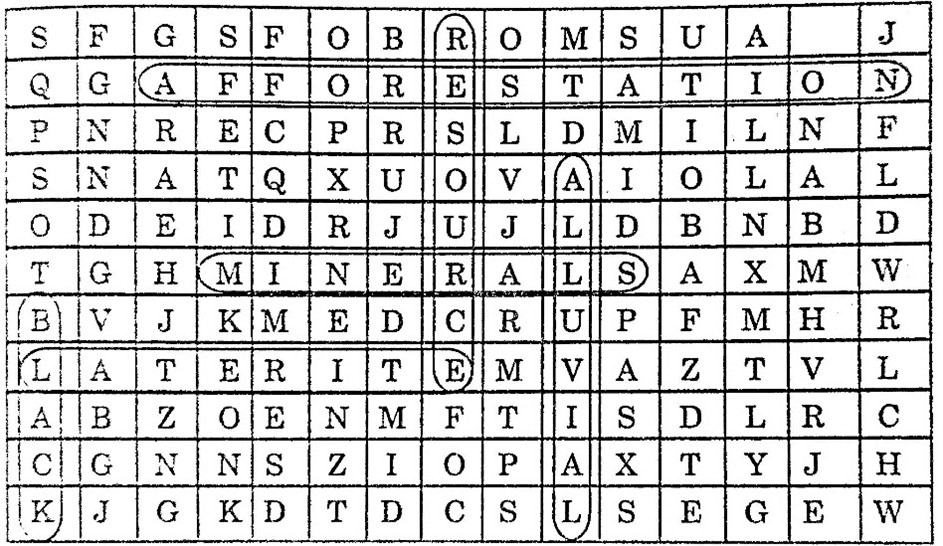
4. Solve the puzzle by following your search horizontally and vertically to find the hidden answers.
1. Natural endowments in the form of land, water, vegetation and minerals
Ans: Resource.
2. A type of non-renewable resource
Ans: Minerals.
3. Soil with high water-retaining capacity
Ans: Black.
4. Intensively leached soils of the monsoon climate
Ans: Laterite.
5. Plantation of trees on a large scale to check soil erosion
Ans: Afforestation.
6. The great plains of India are made up of these soils-
Ans: Alluvial.