
Chapter 1 - A Letter to God (Ncert Solutions) for Class 10 English
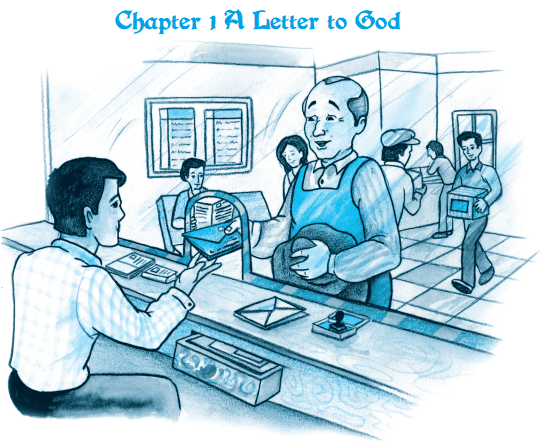
Ultimate NCERT Solutions for Chapter 1 A Letter to God
Updated Solution 2024-2025 Updated Solution 2024-2025
NCERT Solutions for Class 10 English, Chapter 1 A Letter to God
(Question/Answers, summary)
Chapter 1 A Letter to God
Summary of Chapter 1: “A Letter to God” (Eng)
The story “A Letter to God”, written by Gregorio López y Fuentes, is about a simple yet deeply faithful farmer named Lencho, who depends entirely on his crops for survival.
Lencho and his family live in a small house on a farm, eagerly awaiting rainfall to nourish their fields. When the long-awaited rain finally arrives, he feels overjoyed. However, his happiness turns to despair as a devastating hailstorm destroys his crops completely. Facing starvation, Lencho holds unwavering faith in God and decides to write a letter to God, asking for 100 pesos to sustain his family until the next harvest.
Lencho mails the letter, and the postmaster, moved by his faith, decides to help. He collects 70 pesos from his colleagues and sends it to Lencho, pretending it is from God. However, upon receiving the money, Lencho becomes upset, thinking that God had sent the full amount but the post office employees stole part of it. He writes another letter to God, requesting the remaining amount but asking God not to send it through the post office, as he considers them dishonest.
Theme & Message:
The story highlights unshakable faith, innocence, and irony. It emphasizes how faith can provide strength in tough times but also showcases irony in Lencho’s misunderstanding of human kindness. It teaches us about hope, trust, and the selfless nature of helping others.
Summary of Chapter 1: “A Letter to God” (In Hindi)
“भगवानकेनामपत्र“, ग्रेगोरियो लोपेज़ वाई फुएंटेस द्वारा लिखी गई एक कहानी है, जो लेन्चो नामक एक गरीब किसान की अटूट आस्था को दर्शाती है।
लेन्चो अपनी फसल और वर्षा पर निर्भर रहता है। जब बारिश होती है, तो वह बहुत खुश होता है, लेकिन जल्द ही भारी ओला वृष्टि से उसकी सारी फसल नष्ट हो जाती है। इस संकट में भी, लेन्चो का भगवान पर गहरा विश्वास बना रहता है। वह भगवान को एक पत्र लिख कर 100 पेसो मांगता है, ताकि वह और उसका परिवार जीवित रह सके।
डाकघर के पोस्ट मास्टर को लेन्चो की आस्था देखकर दया आ जाती है। वह अपने सहकर्मियों के साथ 70 पेसो इकट्ठा कर लेन्चो को भेज देता है और यह विश्वास दिलाता है कि यह भगवान ने भेजा है। लेकिन जब लेन्चो पत्र प्राप्त करता है, तो वह निराश हो जाता है, क्योंकि उसे पूरा पैसा नहीं मिलता। उसे लगताहै कि डाक घर के कर्मचारियों ने भगवान द्वारा भेजे गए पैसे चुरा लिए हैं। फिर वह भगवान को एक और पत्र लिखता है और बाकी पैसे मांगता है, लेकिन इस बार वह भगवान से अनुरोध करता है कि पैसे डाक के माध्यमसेनभेजे,
क्योंकि उसे डाक कर्मचारी बेईमान लगते हैं।
कहानी का संदेश एवं शिक्षा: यह कहानी अटूट विश्वास, मासूमियत और विडंबना को दर्शाती है। यह हमें सिखाती है कि कठिन परिस्थितियों में भी विश्वास बनाए रखना चाहिए। साथ ही, यह मानवता और दूसरों की मदद करने की भावना को भी उजागर करती है, लेकिन लेन्चो की भोली सोच और गलत फहमी से उत्पन्न विडंबना कहानी को एक दिलचस्प मोड़ देती है।
Activity
- One of the cheapest ways to send money to someone is through the post office. Have you ever sent or received money in this way? Here’s what you have to do. (As you read the instructions, discuss with your teacher in class the meanings of these words: counter, counter clerk, appropriate, acknowledgement, counterfoil, record. Consult a dictionary if necessary. Are there words corresponding to these English words in your languages?)
| Inside the post office, go to the counter marked ‘Money order’ |
| Buy a money order (Mo) from by paying 50 paise to the person behind the counter |
| Fill the appropriate boxes in the form (preferably in block letters) |
| Pay the counter clerk the amount of money to be sent along with the charges |
| Take back the (MO) acknowledgement counterfoil for your record |
Ans: Yes, I have sent and received money from relatives using this method.
The meaning of these words is:
- Counter: A long surface across which transactions take place.
- Counter Clerk: The person responsible for assisting customers with transactions.
- Appropriate: Suitable or correct.
- Acknowledgement: Confirmation or acceptance of something received.
- Counterfoil: A part of a receipt or cheque kept for record-keeping.
- Record: A documented account of activities or transactions.
Q. Fill out the Money Order form given below using the clues that follow the form.
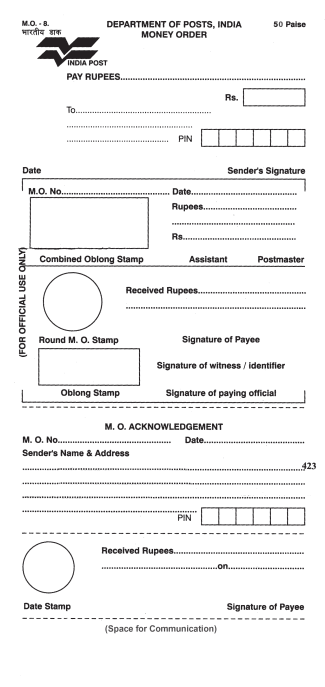
Ans: The filled form is shown below:
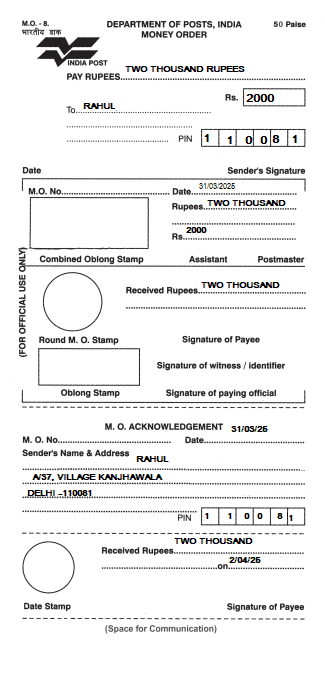
- Think about who you will send the money to, and how much. You might want to send money for a magazine subscription, or to a relative or a friend.
- Or you may fill out the form with yourself as sender and your partner as receiver. Use a part of your pocket money, and submit the form at the nearest post office to see how it’s done. See how your partner enjoys getting money by post!
- Notice that the form has three parts — the Money Order form, the part for official use and the Acknowledgement. What would you write in the ‘Space for Communication’?
Now complete the following statements.
(i) In addition to the sender, the form has to be signed by the PAYEE
(ii) The ‘Acknowledgement’ section of the form is sent back by the post office to the sender after the PAYEE signs it.
(iii) The ‘Space for Communication’ section is used for WRITING A NOTE TO THE PAYEE
(iv) The form has six sections. The sender needs to fill out FOUR sections and the receiver TWO
Oral Comprehension Check
Q 1: What did Lencho hope for?
Ans 1: Lencho, a hardworking farmer, eagerly wished for rain to nourish his ripening crops. He prayed for showers to ensure a good harvest, as a lack of rain would ruin the crop and result in a significant loss.
Q 2: Why did Lencho say the raindrops were like ‘new coins?
Ans 2: Lencho had grown corn crops that were almost ready for harvest. However, they still needed some rain to ensure a good yield. Since his income depended on the rain, he compared the raindrops to ‘new coins.’ He imagined the larger drops as ten-cent coins and the smaller ones as five-cent coins, symbolizing the wealth they would bring through a successful harvest.
Q 3: How did the rain change? What happened to Lencho’s fields?
Ans 3: The season began with favorable rains, and Lencho was hopeful for a great harvest. However, the weather quickly took a turn for the worse as strong winds and hailstorms arrived. Unfortunately, these harsh conditions completely ruined his crops.
Q 4: What were Lencho’s feelings when the hail stopped?
Ans 4: Lencho was heartbroken as he watched his ripe crops get destroyed by the hailstorm. Seeing his hard work go to waste filled him with deep sorrow. He knew that without the harvest, his family would struggle to get enough food and money to survive. The future seemed uncertain and full of hardships, leaving him feeling hopeless and worried.
Class 10 (English – First flight) Chapter 1 A Letter to God
Updated Solution 2024-2025
Oral Comprehension Check
Q 1: Who or what did Lencho have faith in? What did he do?
Ans 1: Despite facing hardships, Lencho had unwavering faith in God. He believed that God, watching over him from above, would understand his suffering and provide relief. Trusting in divine help, Lencho wrote a letter to God, requesting a hundred pesos to replant his crops, as his previous harvest was ruined by a hailstorm.
Q 2: Who reads the letter?
Ans 2: The postmaster read the letter because the address on it was unrealistic.
Q 3: What did the postmaster do then?
Ans 3: When the postmaster first saw the letter’s address, he laughed at the sender’s innocence. However, he soon realized that the letter might hold deeper meaning. Curious, he decided to read it. After understanding the writer’s emotions, he was deeply moved and wanted to help. To do so, he contributed a part of his salary and also gathered money from his colleagues, friends, and acquaintances. He then sent the collected amount to the letter’s sender, Lencho.
Oral Comprehension Check
Q 1: Was Lencho surprised to find a letter for him with money in it?
Ans 1: No, Lencho was not surprised. He had deep faith in God and firmly believed that God would help him in his time of need. So, when he received the letter with money, he saw it as an answer to his prayers.
Q 2: What made him angry?
Ans 2: After receiving the letter, he began counting the money that he believed was sent by God. However, he discovered that he had received only seventy pesos instead of the hundred pesos he had requested. This made him very upset. Still, he had strong faith in God and was certain that God wouldn’t disappoint him. So, he assumed that the post office employees had taken part of his money.
Thinking about the text
Q 1: Who does Lencho have complete faith in? Which sentences in the story tell you this?
Ans 1: Lencho had unwavering faith in God. He firmly believed that God would help him in his time of need and provide a solution to his problems. The following lines from the story highlight his strong trust in God:
a). The only hope for everyone living in that isolated house in the valley was divine help.
b). Throughout the night, Lencho held onto one thought—his hope in God, who, as he had been taught, sees everything, even the deepest thoughts of one’s heart.
c). In his letter, he wrote, “God, if you don’t help me, my family and I will go hungry this year.”
d). Lencho was convinced that God neither made mistakes nor denied him what he had asked for.
e). With complete faith, he wrote “To God” on the envelope, placed his letter inside, and, despite his worries, went to town.
f). His letter read: “God, out of the money I requested, I received only seventy pesos. Please send the rest, as I need it urgently.”
Q 2: Why does the postmaster send money to Lencho? Why does he sign the letter ‘God’?
Ans 2: People have always placed their trust in God, believing that He will help them in times of need. However, Lencho’s faith was truly exceptional. He wrote a letter to God, asking for financial help as if he were requesting assistance from a close friend. Moved by Lencho’s unwavering belief, the postmaster wanted to ensure that his faith remained strong. To do so, he collected seventy pesos and sent them to Lencho, signing the letter as ‘God.
Q 3: Did Lencho try to find out who had sent the money to him? Why/Why not?
Ans 3: No, Lencho did not try to find out who had sent the money. He had unwavering faith in God and was completely convinced that the money came from Him. Lencho was so sure about it that he didn’t question its source. Instead, when he received less than the hundred pesos he had asked for, he went to the post office, believing that God wouldn’t grant his wish only partially.
Q 4: Who does Lencho think has taken the rest of the money? What is the irony in the situation? (Remember that the irony of a situation is an unexpected aspect of it. An ironic situation is strange or amusing because it is the opposite of what is expected.)
Ans 4: Lencho believes that the post office employees took a portion of the money that he had received from God, as he got thirty pesos less than he had requested. The irony in the situation is that the money was not actually sent by God but by the postmaster and his colleagues, the very people Lencho suspected of stealing from him.
Q 5: Are there people like Lencho in the real world? What kind of a person would you say he is? You may select appropriate words from the box to answer the question.
Greedy, Naive, Stupid, Ungrateful, Selfish, Comical, Unquestioning.
Ans 5: Throughout history, humans have often turned to a higher power for support in difficult times. However, Lencho’s faith was truly extraordinary. It is rare to find someone today who would write a letter to God, expecting a direct response in the form of money. His unwavering belief in divine intervention makes him appear both naive and unquestioning in his reasoning.
Q 6: There are two kinds of conflict in the story: between humans and nature, and between humans themselves. How are these conflicts illustrated?
Ans 6: The conflict between humans and nature is demonstrated through Lencho’s struggle. His crops were thriving and almost ready for harvest when a sudden hailstorm destroyed everything. This highlights nature’s overwhelming power, leaving Lencho helpless. With no way to recover his losses, he turned to his faith, writing a letter to God and asking for financial assistance.
The conflict between humans is shown through the misunderstanding between Lencho and the postmaster. Moved by Lencho’s faith, the postmaster collected seventy pesos to help him, sending the money in God’s name. However, instead of being grateful, Lencho suspected the postal workers of stealing part of the money. This reflects the deep-seated distrust people often have toward each other.
THINKING ABOUT LANGUAGE
Q I: Look at the following sentence from the story.
Suddenly a strong wind began to blow and along with the rain very large hailstones began to fall. ‘Hailstones’ are small balls of ice that fall like rain. A storm in which hailstones fall is a ‘hailstorm’. You know that a storm is bad weather with strong winds, rain, thunder and lightning.
There are different names in different parts of the world for storms, depending on their nature. Can you match the names in the box with their descriptions below, and fill in the blanks? You may use a dictionary to help you.
gale, whirlwind, cyclone, hurricane, tornado, typhoon
1. A violent tropical storm in which strong winds move in a circle: _ _ c _ _ _
Ans 1: Cyclone
2. An extremely strong wind: _a_ _
Ans 2: Gale
3. A violent tropical storm with very strong winds: _ _ p_ _ _ _
Ans 3: Typhoon
4. A violent storm whose center is a cloud in the shape of a funnel: _ _ _n_ _ _
Ans 4: Tornado
5. A violent storm with very strong winds, especially in the western Atlantic Ocean: _ _r_ _ _ _ _ _
Ans 5: Hurricane
6. A very strong wind that moves very fast in a spinning movement and causes a lot of damage:
_ _ _ _l_ _ _ _.
Ans 6: Whirlwind
Q II. Notice how the word ‘hope’ is used in these sentences from the story:
(a) I hope it (the hailstorm) passes quickly.
(b) There was a single hope: help from God.
In the first example, ‘hope’ is a verb which means you wish for something to happen. In the second example it is a noun meaning a chance for something to happen.
Match the sentences in Column A with the meanings of ‘hope’ in Column B.
1 | Will you get the subjects you want to study in college? I hope so | a feeling that something good will probably happen |
2 | I hope you don’t mind my saying this, but I don’t like the way you are arguing. | thinking that this would happen (It may or may not have happened.) |
3 | This discovery will give new hope to HIV/AIDS sufferers. | stopped believing that this good thing would happen |
4 | We were hoping against hope that the judges would not notice our mistakes. | wanting something to happen (and thinking it quite possible) |
5 | I called early in the hope of speaking to her before she went to school. | showing concern that what you say should not offend or disturb the other person: a way of being polite. |
6 | Just when everybody had given up hope, the fishermen came back, seven days after the cyclone | wishing for something to happen, although this is very unlikely |
Answer II:
1 | Will you get the subjects you want to study in college? I hope so | wanting something to happen (and thinking it quite possible) |
2 | I hope you don’t mind my saying this, but I don’t like the way you are arguing. | showing concern that what you say should not offend or disturb the other person: a way of being polite. |
3 | This discovery will give new hope to HIV/AIDS sufferers. | a feeling that something good will probably happen |
4 | We were hoping against hope that the judges would not notice our mistakes. | wishing for something to happen, although this is very unlikely |
5 | I called early in the hope of speaking to her before she went to school. | thinking that this would happen (It may or may not have happened.) |
6 | Just when everybody had given up hope, the fishermen came back, seven days after the cyclone | stopped believing that this good thing would happen |
III. Relative Clauses Look at these sentences
(a) All morning Lencho — who knew his fields intimately — looked at the sky.
(b) The woman, who was preparing supper, replied, “Yes, God willing.’’
The italicised parts of the sentences give us more information about Lencho and the woman. We call them relative clauses. Notice that they begin with a relative pronoun who. Other common relative pronouns are whom, whose, and which.
The relative clauses in (a) and (b) above are called non-defining, because we already know the identity of the person they describe. Lencho is a particular person, and there is a particular woman he speaks to. We don’t need the information in the relative clause to pick these people out from a larger set.
A non-defining relative clause usually has a comma in front of it and a comma after it (some writers use a dash (—) instead, as in the story). If the relative clause comes at the end, we just put a full stop.
Join the sentences given below using who, whom, whose, which as suggested.
1. I often go to Mumbai. Mumbai is the commercial capital of India. (which)
Ans 1: I often visit Mumbai, which is the commercial capital of India.
2. My mother is going to host a TV show on cooking. She cooks very well. (who)
Ans 2: My mother, who cooks very well, is going to host a TV show on cooking.
3. These sportspersons are going to meet the President. Their performance has been excellent. (whose)
Ans 3: These sportspersons, whose performance has been excellent, are going to meet the President.
4. Lencho prayed to God. His eyes see into our minds. (whose)
Ans 4: Lencho prayed to God, whose eyes see into our minds.
5. This man cheated me. I trusted him. (whom)
Ans 5: This man, whom I trusted, cheated me.
Q IV: Using Negatives for Emphasis We know that sentences with words such as no, not or nothing show the absence of something, or contradict something. For example:
(a) This year we will have no corn. (Corn will be absent)
(b) The hail has left nothing. (Absence of a crop)
(c) These aren’t raindrops falling from the sky, they are new coins. (Contradicts the common idea of what the drops of water falling from the sky are).
But sometimes negative words are used just to emphasise an idea. Look at these sentences from the story:
(d) Lencho…had done nothing else but see the sky towards the northeast. (He had done only this)
(e) The man went out for no other reason than to have the pleasure of feeling the rain on his body. (He had only this reason)
(f) Lencho showed not the slightest surprise on seeing the money. (He showed no surprise at all)
Now look back at example (c). Notice that the contradiction in fact serves to emphasise the value or usefulness of the rain to the farmer.
Find sentences in the story with negative words, which express the following ideas emphatically.
1. The trees lost all their leaves.
Ans 1: Not a single leaf was left on the trees.
2. The letter was addressed to God himself.
Ans 2: The letter was addressed to no one but God himself.
3. The postman saw this address for the first time in his career.
Ans 3: Never before in his career had the postman seen such an address.
Q V: Metaphors The word metaphor comes from a Greek word meaning ‘transfer’. Metaphors compare two things or ideas: a quality or feature of one thing is transferred to another thing. Some common metaphors are
- the leg of the table: The leg supports our body. So, the object that supports a table is described as a leg.
- the heart of the city: The heart is an important organ in the center of our body. So, this word is used to describe the central area of a city. In pairs, find metaphors from the story to complete the table below. Try to say what qualities are being compared. One has been done for you.
Object | Metaphor | Quality or Feature Compared |
Cloud | Huge mountains of clouds | The mass or ‘hugeness’ of mountains |
Raindrops | ||
Hailstones | ||
Locusts | ||
An epidemic (a disease) that spreads very rapidly and leaves many people dead | ||
An ox of a man |
Ans V: The metaphors are:
Object | Metaphor | Quality or Feature Compared |
Cloud | Huge mountains of clouds | The mass or ‘hugeness’ of mountains |
Raindrops | A curtain of rain | The draping or covering of an area by a curtain |
Hailstones | The frozen pearls | The resemblance in colour and hardness of a pearl |
Locusts | A plague of locusts | The consequences (destruction) of plague |
Locusts | A plague of locusts | An epidemic (a disease) that spreads very rapidly and leaves many people dead |
Man | An ox of a man | The working of an ox in the fields (hard work) |
SPEAKING
Q 1: Have you ever been in great difficulty, and felt that only a miracle could help you? How was your problem solved? Speak about this in class with your teacher.
Ans 1: Life often puts us in tough situations where we feel only a miracle can save us. One such incident happened during a graded college project. We were asked to form groups and take up a volunteer activity. Since my friends and I started late, we planned a distribution event just a week before the deadline. Unfortunately, we didn’t check the weather forecast before finalizing the plan.
On the day of the event, the sky was covered with dark clouds, and it looked like it could rain at any moment. We were anxious but decided to go ahead, hoping the rain would hold off. As we started distributing, we kept praying that the weather would stay clear. Miraculously, it did not rain for the two hours we needed to complete our work. The moment we reached home, heavy rain started pouring down, almost as if it had been waiting for us to finish.
This experience strengthened my belief that sometimes, things work out in unexpected ways, just when we need them the most.
LISTENING
Q 1: Listen to the letter (given under ‘In This Lesson’) read out by your teacher/on the audio tape. As you listen fill in the table given below.
The writer apologizes (says sorry) because | |
The writer has sent this to the reader | |
The writer sent it in the month of | |
The reason for not writing earlier | |
Sarah goes to | |
Who is writing to whom? | |
Where and when were they last together? |
Ans: The filled table is shown below:
The writer apologizes (says sorry) because | She hasn’t written about art for a long time |
The writer has sent this to the reader | A letter after sending a birthday card. |
The writer sent it in the month of | September 2005. |
The reason for not writing earlier | She was busy moving from Bangalore to Kanpur. |
Sarah goes to | “Little Feet’ Primary School. |
Who is writing to whom? | Jaya is writing to Aarti. |
Where and when were they last together? | They were in Bangalore |
WRITING
Q 1: Lencho suffered first due to drought and then by floods. Our country is also facing such situations in the recent years. There is flood and there is drought. There is a need to save water through water harvesting. Design a poster or prepare a documentary (PPT) for your area on how to save water during summer and when it is available in excess.
Ans 1: The poster is given below:
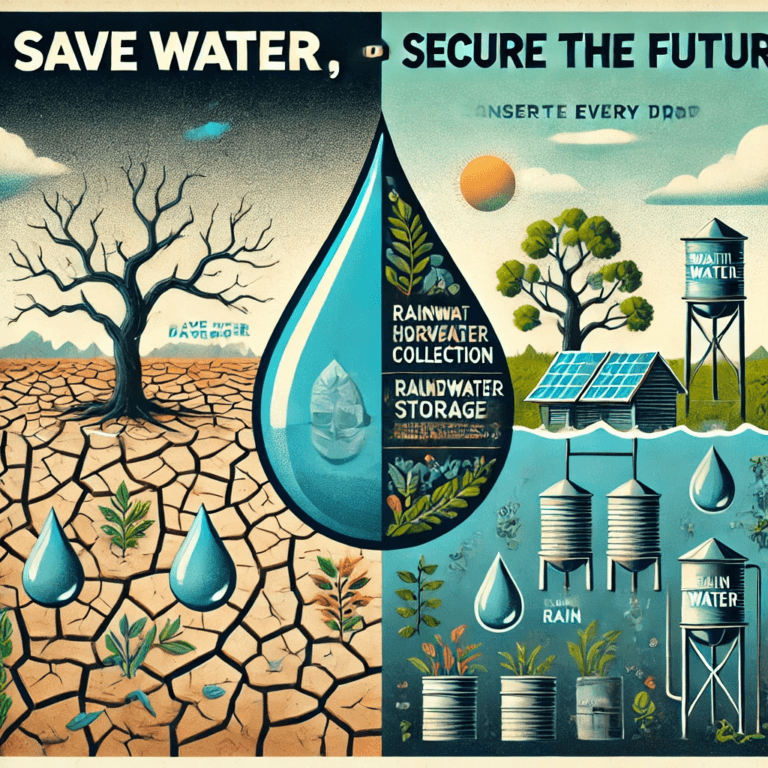
Here’s a structured PowerPoint Documentary (PPT) outline based on the water conservation poster.
Title: Save Water, Secure the Future! 🌍💧
Slide 1: Title Slide
- Background image: The generated poster
- Title: Save Water, Secure the Future!
- Subtitle: A documentary on water conservation & rainwater harvesting
Slide 2: The Water Crisis
- Image: Dry, cracked land & flooding (from the poster)
- Text:
- Water scarcity is a growing concern worldwide.
- Droughts and floods are two extremes, both harming our environment and society.
Slide 3: Why Water Conservation Matters
- Statistics on global water scarcity
- Impact of water shortages on agriculture, drinking water, and daily life
Slide 4: The Need for Rainwater Harvesting
- Image: Water drop with rainwater harvesting systems
- Text:
- Rainwater harvesting helps store excess water for dry seasons.
- Methods include rooftop collection, water storage tanks, and groundwater recharge pits.
Slide 5: How to Save Water in Summer
- Tips:
✅ Fix leaks and turn off taps when not needed
✅ Use buckets instead of hoses for washing
✅ Water plants in the morning or evening to prevent evaporation
Slide 6: How to Store Excess Water During Monsoons
- Methods:
✅ Install rainwater harvesting systems
✅ Build check dams to control floods
✅ Replenish groundwater using recharge pits
Slide 7: Community Efforts & Call to Action
- Encourage people to participate in water conservation projects
- Message: Every drop saved today secures our future tomorrow!
Chapter 1- Dust of Snow (Poem-I)
Summary of “Dust of Snow” (Poem) –(Eng)
“Dust of Snow” is a short yet meaningful poem by Robert Frost, highlighting how small moments can bring about a positive change in one’s mood.
The poem describes a simple scene where the poet, feeling gloomy and lost in sorrow, is sitting under a hemlock tree—a symbol of negativity and sadness. Suddenly, a crow on the tree shakes off some snow, which falls on the poet. This seemingly insignificant event instantly lifts his spirits, making him realize that his day has not been completely wasted.
Through this poem, Frost conveys a deep message: even the smallest acts of nature or life can bring joy and transform our perspective. The crow and the hemlock tree, typically associated with darkness and despair, ironically become symbols of hope and change.
Overall, “Dust of Snow” teaches us that we should not let sadness consume us, as even a tiny moment can brighten our day and change our outlook on life.
Summary of “Dust of Snow” (Poem) –(In Hindi)
“Dust of Snow”कवितारॉबर्ट फ्रॉस्टद्वारा लिखी गई एक छोटी लेकिन गहरी अर्थ वाली कविता है, जो यह दर्शाती है कि कैसे एक छोटी-सी घटना हमारे मनोदशा को सकारात्मक रूप से बदल सकती है।
इस कविता में कवि बताते हैं कि वे उदासी और निराशा से भरे हुए थे औरहेमलॉक वृक्ष (जो आमतौर पर नकारात्मकता का प्रतीक है) के नीचे बैठे थे। तभी, उस पेड़ पर बैठे एककौवेने शाखा को हिलाया, जिससे बर्फ के कुछ कण कवि पर गिर गए। यह छोटी-सी घटना अचानक उनके मन को हल्का और प्रसन्न कर देती है। उन्हें महसूस होता है कि उनका पूरा दिन व्यर्थ नहीं गया है।
इस कविता के माध्यम से फ्रॉस्ट यह संदेश देना चाहते हैं किछोटी-छोटी चीजें भी हमारे जीवन में सकारात्मक बदलाव ला सकती हैं। आमतौर पर अंधकार और अशुभता से जोड़े जाने वाले कौवे और हेमलॉक वृक्ष, इस कविता में आशा और परिवर्तन के प्रतीक बन जाते हैं।
“Dust of Snow”हमें सिखाती है कि हमें निराशा में डूबे नहीं रहना चाहिए क्योंकि एक छोटी-सी घटना भी हमारा नजरिया बदल सकती है और हमारे दिन को खुशनुमा बना सकती है।
Question Answers
Q 1: What is a “dust of snow”? What does the poet say has changed his mood? How has the poet’s mood changed?
Ans 1: A “dust of snow” refers to the tiny snowflakes or small bits of snow that fall off the branches of a tree. In the poem, a crow shakes off this dust of snow from a hemlock tree, which falls on the poet. This small event unexpectedly changes the poet’s mood from sadness to a more positive, refreshed state. He feels a sense of relief and realizes that not all is lost, as part of his regrettable day has been salvaged.
Q 2: How does Frost present nature in this poem?
(i) What are the birds that are usually named in poems? Do you think a crow is often mentioned in poems? What images come to your mind when you think of a crow?
Ans (i): Birds commonly mentioned in poetry include nightingales, peacocks, doves, and swans, which are often associated with beauty and positivity. However, a crow is rarely used in poetry as it is typically linked to negative imagery, such as darkness, bad omens, or death. The crow in this poem, however, plays an unexpected role by bringing about a positive change in the poet’s mood.
(ii) What is a hemlock tree? Why doesn’t the poet write about a more ‘beautiful’ tree such as a maple, oak, or pine?
Ans(ii): A hemlock tree is a poisonous tree often associated with sorrow, death, and negativity. Instead of choosing a conventionally beautiful tree like a maple or an oak, Frost deliberately uses a hemlock tree to show that even things considered unpleasant or gloomy can bring about positive change.
(iii) What do the ‘crow’ and ‘hemlock’ represent—joy or sorrow? What does the dust of snow that the crow shakes off a hemlock tree stand for?
Ans (iii): The crow and the hemlock tree symbolize sorrow, gloom, or negative experiences. However, the dust of snow represents a moment of realization and transformation. It symbolizes how even an ordinary or seemingly negative incident can lead to a positive change, just as the poet’s mood shifts from sadness to hopefulness.
Q 3: Have there been times when you felt depressed or hopeless? Have you experienced a similar moment that changed your mood that day?
Ans 3: Yes, there have been moments when I felt sad or discouraged due to personal struggles or disappointments. However, small things, such as a kind word from a friend, a beautiful sunset, or listening to my favorite song, have lifted my mood and made me feel better. Just like in the poem, an unexpected moment can bring happiness and make us appreciate life’s little surprises.
Chapter 1 Fire and Ice (Poem-II)
Summary of “Fire and Ice” Chapter 1 – Poem, (Eng)
The poem “Fire and Ice” by Robert Frost explores two opposing forces that could lead to the destruction of the world—fire and ice. Fire symbolizes desire, passion, and greed, while ice represents hatred, indifference, and coldness.
The poet suggests that both elements are powerful enough to bring an end to humanity. He initially believes that fire, representing uncontrolled desires, could lead to destruction. However, he also acknowledges that ice, symbolizing hatred and a lack of emotions, is equally capable of causing ruin.
Through this short yet thought-provoking poem, Frost highlights the dangers of extreme emotions and urges humans to control their desires and hatred to prevent self-destruction. The poem carries a deep philosophical meaning, warning that both unchecked passion and cold indifference can be equally harmful.
Summary of “Fire and Ice” Chapter 1 – Poem, (In Hindi)
रॉबर्टफ्रॉस्टकीकविता “Fire and Ice” (आगऔरबर्फ) दोविपरीतशक्तियोंकेबारेमेंबातकरतीहै, जोदुनियाकेविनाशकाकारणबनसकतीहैं—आगऔरबर्फ।यहाँआगइच्छाओं, जुनूनऔरलालचकाप्रतीकहै, जबकिबर्फघृणा, उदासीनताऔरठंडेव्यवहारकाप्रतीकहै।
कविकामाननाहैकियेदोनोंतत्वदुनियाकोखत्मकरनेकीशक्तिरखतेहैं।पहले, वेकहतेहैंकिअत्यधिकइच्छाएँ (आग)विनाशकाकारणबनसकतीहैं, लेकिनफिरवेयहभीमानतेहैंकिघृणाऔरबेरुखी (बर्फ)भीसमानरूपसेविनाशकारीहोसकतीहैं।
इसछोटीलेकिनगहरीकविताकेमाध्यमसे, कविहमेंयहसंदेशदेतेहैंकिअत्यधिकभावनाएँखतरनाकहोसकतीहैं।वेहमेंअपनीइच्छाओंऔरनफरतकोनियंत्रितकरनेकेलिएप्रेरितकरतेहैंताकिआत्म–विनाशसेबचाजासके।यहकविताहमेंसंतुलितजीवनजीनेकीसीखदेतीहैऔरचेतावनीदेतीहैकिअत्यधिकजुनूनऔरठंडाव्यवहार, दोनोंहीनुकसानदेहहोसकतेहैं।
Question answer
Thinking about the poem
Q 1: There are many ideas about how the world will ‘end’. Do you think the world will end some day? Have you ever thought what would happen if the sun got so hot that it ‘burst’, or grew colder and colder?
Ans 1: Yes, scientifically, the world will end one day, though it may take millions or even billions of years. If the sun becomes too hot and explodes (a supernova), life on Earth would be completely destroyed. On the other hand, if the sun gradually loses heat and becomes colder, the Earth would freeze, making survival impossible. Either extreme—excessive heat or extreme cold—would lead to the end of life as we know it.
Q 2: For Frost, what do ‘fire’ and ‘ice’ stand for? Here are some ideas:
Greed avarice cruelty lust
conflict fury intolerance rigidity
insensitivity coldness indifference hatred
Ans 2:
- ‘Fire’ symbolizes desire, greed, lust, conflict, and fury—strong emotions that consume people and lead to destruction.
- ‘Ice’ represents hatred, indifference, coldness, intolerance, and rigidity—emotions that can freeze relationships and humanity itself.
- Frost suggests that both these forces—passionate desires (fire) and cruel indifference (ice)—are capable of bringing destruction to the world.
Q 3: What is the rhyme scheme of the poem? How does it help in bringing out the contrasting ideas in the poem?
Ans 3: The rhyme scheme of Fire and Ice is ABA ABC BCB.
- This scheme helps emphasize the contrasting ideas of fire (passion and destruction) and ice (coldness and hatred).
- The alternating rhymes create a rhythmic balance between the two destructive forces, showing that both have the power to bring an end to the world.
Chapter 1 A Letter to God
Updated Solution 2024-2025
This complete solution is prepared as per the latest syllabus of 2024-25. If you have any further queries, feel free to ask! 😊