
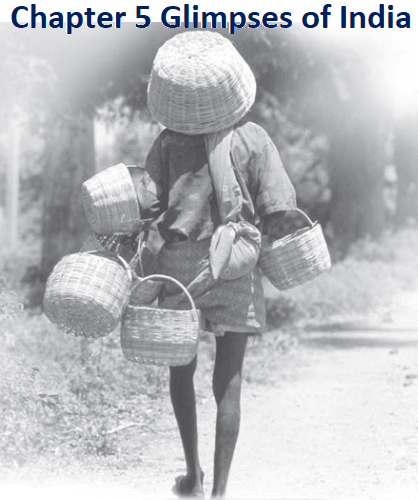
Ultimate NCERT Solutions for Chapter 5 – Glimpses of India
Updated Solution 2024-2025 Updated Solution 2024-2025
NCERT Solutions for Class 10 English, Chapter 5 Glimpses of India
(Question/Answers, summary)
Chapter 5 Glimpses of India
BEFORE YOU READ
Summary of Chapter 5 – Glimpses of India (English)
“Glimpses of India” is a collection of three different stories, each highlighting a unique aspect of Indian culture, traditions, and heritage. These stories take readers on a journey through different regions of India, showcasing its diversity and rich history.
Part I: A Baker from Goa (By Lucio Rodrigues)
This story provides a nostalgic glimpse into the life of Goan bakers, also known as paders, during the Portuguese era. The narrator recalls how these bakers played a significant role in Goan households, supplying fresh bread daily. The sound of their bamboo sticks would announce their arrival, and their profession was considered prestigious. Even though modern advancements have changed many traditions, the Goan love for bread, particularly during special occasions like weddings and festivals, remains unchanged.
Part II: Coorg (By Lokesh Abrol)
This section describes Coorg, a beautiful hill station in Karnataka known for its coffee plantations, lush greenery, and brave Kodava people. The Kodavas, a martial community, have a distinct culture and are known for their hospitality. The region is home to breathtaking landscapes, rich wildlife, and adventure activities like river rafting and trekking. The story highlights Coorg’s connection to history, including the belief that the Kodavas are descendants of Greek or Arabic ancestors.
Part III: Tea from Assam (By Arup Kumar Datta)
This part follows a conversation between Rajvir and Pranjol as they travel to Assam, a region famous for its tea gardens. Rajvir is fascinated by the vast stretches of tea plantations and is eager to learn about the history of tea. He discovers that tea originated in China and was introduced to India by the British. Assam remains one of the largest tea producers in the world. The story beautifully captures the essence of the tea industry and its significance in India’s economy and culture.
Conclusion
“Glimpses of India” offers an insightful look into the traditions, culture, and natural beauty of different parts of India. Whether it is the age-old profession of baking in Goa, the scenic landscapes of Coorg, or the sprawling tea estates of Assam, each story celebrates India’s diversity and heritage.
Summary of Chapter 5 – Glimpses of India (In Hindi)
“ Glimpses of India” तीनअलग–अलगकहानियोंकासंकलनहै, जोभारतकीसमृद्धसंस्कृति, परंपराओंऔरविविधताकोदर्शातीहैं।येकहानियाँभारतकेविभिन्नहिस्सोंकीअनूठीविशेषताओंकोउजागरकरतीहैं।
भाग1: गोवाकाएकबेकर (लेखक: लूसियोरोड्रिग्स)
यहकहानीपुर्तगालीशासनकेसमयगोवाकेबेकरों (पादर) केमहत्वकोदर्शातीहै।लेखकअपनेबचपनकीयादोंकोसाझाकरताहैजबगोवामेंबेकरोंकासमाजमेंविशेषस्थानथा।उनकीपहचानउनकेबाँसकीछड़ीसेहोतीथी, जिसकीआवाज़सेलोगोंकोउनकीउपस्थितिकापताचलताथा।त्योहारों, शादियोंऔरखासअवसरोंपरगोवामेंब्रेडकाविशेषमहत्वथा।भलेहीसमयबदलगयाहो, लेकिनगोवामेंब्रेडकीपरंपराऔरइसकास्वादआजभीबरकरारहै।
भाग2: कूर्ग (लेखक: लोकेशअबरोल)
यहभागकर्नाटककेखूबसूरतपहाड़ीइलाकेकूर्गकावर्णनकरताहै, जोअपनीहरियाली, कॉफीबागानोंऔरसाहसीकोडवसमुदायकेलिएप्रसिद्धहै।कोडवलोगयोद्धास्वभावकेहोतेहैंऔरअपनीअनूठीपरंपराओंऔरअतिथि–सत्कारकेलिएजानेजातेहैं।कूर्गकीमनोरमवादियाँ, वन्यजीवऔररोमांचकगतिविधियाँजैसेरिवरराफ्टिंगऔरट्रैकिंगइसेएकआदर्शपर्यटनस्थलबनातेहैं।इसकहानीमेंयहभीबतायागयाहैकिकोडवलोगोंकाग्रीकयाअरबीवंशसेसंबंधहोनेकीसंभावनाहै।
भाग3: असमकीचाय (लेखक: अरूपकुमारदत्ता)
इसभागमेंदोदोस्तों, राजवीरऔरप्रांजल, कीअसमयात्राकावर्णनकियागयाहै, जोचायकेविशालबागानोंकेलिएप्रसिद्धहै।यात्राकेदौरान, राजवीरचायकेइतिहासऔरउससेजुड़ीरोचकजानकारियाँप्राप्तकरताहै।वहजानताहैकिचायकीउत्पत्तिचीनमेंहुईथीऔरइसेभारतमेंअंग्रेज़ोंनेलोकप्रियबनाया।असमआजदुनियाकेसबसेबड़ेचायउत्पादकोंमेंसेएकहै।यहकहानीनकेवलचायकीमहत्ताकोदर्शातीहै, बल्किअसमकीसुंदरताऔरकृषिमेंइसकीभूमिकाकोभीउजागरकरतीहै।
निष्कर्ष
“ग्लिम्प्सेज़ऑफ़इंडिया“भारतकेविभिन्नराज्योंकीसंस्कृति, परंपराओंऔरप्राकृतिकसुंदरताकीझलकदिखाताहै।गोवाकेपारंपरिकबेकर, कूर्गकीहरी–भरीपहाड़ियाँऔरअसमकेचायबागान–येसभीभारतकीविविधताऔरसमृद्धधरोहरकोदर्शातेहैं।
Activity
Discuss in class
Q 1. What images — of people and of places — come to your mind, when you think of our country?
Ans 1: Images of India
- People: Diverse cultures, traditional attire like sarees and turbans, festivals such as Diwali and Holi, street markets, and spiritual gatherings at temples, mosques, and churches.
- Places: The Himalayas, beaches of Goa, deserts of Rajasthan, tea gardens of Assam, backwaters of Kerala, historic sites like the Taj Mahal and Red Fort, bustling cities like Mumbai and Delhi.
Q 2. What parts of India have you lived in, or visited? Can you name some popular tourist destinations?
Ans 2: Places Lived in or Visited & Tourist Destinations
- If you’ve lived in or visited different parts of India, you can mention them.
- Popular tourist destinations:
- North India: Agra (Taj Mahal), Jaipur (Hawa Mahal), Varanasi (Ganga Ghats), Delhi (India Gate).
- South India: Kerala (Backwaters), Tamil Nadu (Meenakshi Temple), Karnataka (Mysore Palace).
- East India: West Bengal (Sundarbans, Victoria Memorial), Assam (Kaziranga National Park).
- West India: Goa (Beaches), Maharashtra (Ajanta & Ellora Caves).
Q 3. You may know that apart from the British, the Dutch and the French, the Portuguese have also played a part in the history of our country. Can you say which parts of India show French and Portuguese influences?
Ans 3: French and Portuguese Influences
- French Influence: Puducherry (Pondicherry) – French-style buildings, street names in French, cuisine.
- Portuguese Influence: Goa, Daman, and Diu – Old churches, Portuguese architecture, food, and culture.
Q 4. Can you say which parts of India grow (i) tea, (ii) coffee?
Ans 4: Regions Growing Tea and Coffee
- Tea: Assam, West Bengal (Darjeeling), Tamil Nadu (Nilgiris Hills), Kerala.
- Coffee: Karnataka (Coorg, Chikmagalur), Kerala, Tamil Nadu.
I – A Baker from Goa
Oral Comprehension Check
Q 1. What are the elders in Goa nostalgic about?
Ans 1: The elders in Goa often reminisce about the past, particularly the time when Goa was under Portuguese rule. They cherish memories of the delicious bread and the traditional bakeries that were once a vital part of daily life. The Portuguese influence left a lasting mark on Goan culture, especially in the art of baking, which remains a beloved tradition.
Q2. Is bread-making still popular in Goa? How do you know?
Ans 2: Yes, bread-making continues to thrive in Goa. Evidence of its popularity can be seen in the many bakeries that still operate using traditional methods, such as wood-fired ovens. Freshly baked bread is a common sight in Goan households and is often used in local dishes. Additionally, cultural events and workshops dedicated to bread-making help keep this tradition alive.
Q3. What is the baker called?
Ans 3: In Goa, the baker is known as a pader, a term that originates from the Portuguese word padeiro.
Q4. When would the baker come every day? Why did the children run to meet him?
Ans 4: The baker visited twice daily—once in the early morning and again in the evening. Children eagerly awaited his arrival because he often gave them sweet treats like bread bangles or other baked goodies. His presence was always a happy occasion for the young ones.
Oral Comprehension Check
Q 1: Match the following. What is a must
(i) as marriage gifts? – cakes and bolinhas
(ii) for a party or a feast? – sweet bread called bol
(iii) for a daughter’s engagement? – bread
(iv) for Christmas? – sandwiches
Ans 1: Match the following.
- (i) as marriage gifts? – sweet bread called bol
- (ii) for a party or a feast? – bread
- (iii) for a daughter’s engagement? – sandwiches
- (iv) for Christmas? – cakes and bolinhas
Q 2: What did the bakers wear:
(i) in the Portuguese days?
Ans (i): They wore a long, single-piece frock (known as ‘kabai’) reaching down to the knees.
(ii) when the author was young?
Ans (ii): They wore a shirt and trousers that were shorter than full-length but longer than half-pants.
Q 3: Who invites the comment — “he is dressed like a pader”? Why?
Ans 3: Anyone wearing a half-pant that reaches just below the knees invites this comment because it was the traditional dress of bakers (paders) in Goa.
Q 4: Where were the monthly accounts of the baker recorded?
Ans 4: The baker recorded his monthly accounts on a wall in pencil.
Q 5: What does a ‘jackfruit-like appearance’ mean?
Ans 5: It refers to someone who is plump and overweight, resembling the round and bulky shape of a jackfruit.
Thinking About the Text
Q 1. Which of these statements are correct?
(i) The pader was an important person in the village in old times.
(ii) Paders still exist in Goan villages.
(iii) The paders went away with the Portuguese.
(iv) The paders continue to wear a single-piece long frock.
(v) Bread and cakes were an integral part of Goan life in the old days.
(vi) Traditional bread-baking is still a very profitable business.
(vii) Paders and their families starve in the present times.
Ans 1: The correct statements are:
(i) The pader was an important person in the village in old times.
(ii) Paders still exist in Goan villages.
(v) Bread and cakes were an integral part of Goan life in the old days.
(vi) Traditional bread-baking is still a very profitable business.
The incorrect statements are:
(iii) The paders did not go away with the Portuguese; they continued their profession.
(iv) The paders wore a kabai (a single-piece frock), but this tradition has changed over time.
(vii) Paders and their families do not starve; they remain prosperous.
Q 2. Is bread an important part of Goan life? How do you know this?
Ans 2: Yes, bread is an essential part of Goan life. The chapter highlights that bread and cakes were integral to daily meals and festivals. The pader (baker) was a respected figure, and even today, the tradition continues. The author mentions that bread is a staple in Goan households, used in sandwiches, served with tea, and essential for celebrations like Christmas and weddings. The presence of traditional bakers (paders) even in modern times proves that bread remains significant in Goan culture.
Q 3. Tick the right answer. What is the tone of the author when he says the following?
(i) The thud and the jingle of the traditional baker’s bamboo can still be heard in some places. (nostalgic, hopeful, sad)
Ans (i): Nostalgic (The author remembers the past fondly.)
(ii) Maybe the father is not alive but the son still carries on the family profession. (nostalgic, hopeful, sad)
Ans (ii): Hopeful (The author expresses optimism about the continuation of the tradition.)
(iii) I still recall the typical fragrance of those loaves. (nostalgic, hopeful, naughty)
Ans (iii): Nostalgic (The author reminisces about the pleasant memories of baker’s bread.)
(iv) The tiger never brushed his teeth. Hot tea could wash and clean up everything so nicely, after all. (naughty, angry, funny)
Ans (iv): Funny (The statement is humorous and light-hearted.)
(v) Cakes and bolinhas are a must for Christmas as well as other festivals. (sad, hopeful, matter-of-fact)
Ans (v): Matter-of-fact (The author states a simple fact without emotion.)
(vi) The baker and his family never starved. They always looked happy and prosperous. (matter-of-fact, hopeful, sad)
Ans (vi): Matter-of-fact (The author presents this as a straightforward observation.)
WRITING
Q I: In this extract, the author talks about traditional bread-baking during his childhood days. Complete the following table with the help of the clues on the left. Then write a paragraph about the author’s childhood days.
Clues | Author’s childhood days |
the way bread was baked | |
the way the pader sold bread | |
what the pader wore | |
when the pader was paid | |
how the pader looked |
Ans I: Completed Table:
Clues | Author’s Childhood Days |
The way bread was baked | Bread was baked in a traditional way in clay ovens, which gave it a unique taste and aroma. |
The way the pader sold bread | The pader (bread seller) would carry a basket of fresh loaves on his bicycle and deliver them door-to-door. |
What the pader wore | The pader wore a long, loose shirt (kabai) and a black cap. |
When the pader was paid | The pader was paid at the end of the month for the bread supplied throughout the month. |
How the pader looked | The pader looked cheerful, with a sturdy build and a warm smile. |
Paragraph on the Author’s Childhood Days:
The author recalls his childhood days when bread was baked in traditional clay ovens, giving it a distinct flavor and aroma. The pader, or bread seller, played an important role in their daily life. He would cycle through the neighborhood, carrying a basket of freshly baked loaves and delivering them to each house. Dressed in a long kabai (shirt) and a black cap, the pader had a friendly and sturdy appearance. Payments were made at the end of the month, reflecting a system of trust between the baker and the families. The author fondly remembers the paders cheerful smile and the delightful smell of warm bread, which made his childhood days special.
Q II: 1. Compare the piece from the text (on the left below) with the other piece on Goan bakers (on the right). What makes the two texts so different? Are the facts the same? Do both writers give you a picture of the baker?
Our elders are often heard reminiscing nostalgically about those good old Portuguese days, the Portuguese and their famous loaves of bread. Those eaters of loaves might have vanished but the makers are still there. We still have amongst us the mixers, the moulders and those who bake the loaves. Those age-old, time-tested furnaces still exist. The fire in the furnaces had not yet been extinguished. The thud and the jingle of the traditional baker’s bamboo, heralding his arrival in the morning, can still be heard in some places. Maybe the father is not alive but the son still carries on the family profession. | After Goa’s liberation, people used to say nostalgically that the Portuguese bread vanished with the paders. But the paders have managed to survive because they have perfected the art of door-to-door delivery service. The paders pick up the knowledge of bread-making from traditions in the family. The leavened, oven-baked bread is a gift of the Portuguese to India. [Adapted from Nandakumar Kamat’s ‘The Unsung Lives of Goan Paders’] |
Ans 1: Both texts discuss the tradition of Goan bakers (paders) and their connection to the Portuguese era. However, they differ in their style, tone, and focus.
- Tone and Perspective:
- The first text has a nostalgic and descriptive tone, emphasizing the continuation of the baker’s profession through generations. It highlights the sounds (like the baker’s bamboo jingle) and the unchanged furnaces.
- The second text is more factual and historical, focusing on how the paders adapted after Goa’s liberation. It credits the Portuguese for introducing oven-baked bread and mentions the bakers’ door-to-door service.
- Facts Presented:
- Both texts agree that the paders continue their profession despite the end of Portuguese rule.
- The first text romanticizes the bakers’ daily routines, while the second text logically explains their survival through efficient service and inherited skills.
- Depiction of the Baker:
- The first text paints a vivid, sensory-rich picture of the baker—his arrival, the furnaces, and the family tradition.
- The second text provides a more analytical view, discussing the economic and cultural aspects of bread-making in Goa.
Conclusion: While both texts cover similar facts, the first is more emotional and descriptive, whereas the second is informative and practical. Together, they offer a well-rounded understanding of Goan bakers.
Q 2. Now find a travel brochure about a place you have visited. Look at the description in the brochure. Then write your own account, adding details from your own experience, to give the reader a picture of the place, rather than an impersonal, factual description.
Ans 2: Travel Brochure Description:
“Goa is a tropical paradise known for its stunning beaches, vibrant nightlife, and Portuguese heritage. Popular attractions include Calangute Beach, Fort Aguada, and the Basilica of Bom Jesus. Enjoy water sports, seafood, and lively markets.”
My Personal Experience:
Goa is more than just a tourist destination—it’s an experience that stays with you. I remember walking along Calangute Beach early in the morning, feeling the soft golden sand under my feet as the waves gently crashed nearby. The salty breeze mixed with the aroma of fresh coconut water sold by local vendors. Unlike the crowded afternoons, the mornings were peaceful, with only a few fishermen preparing their boats.
One evening, I explored the historic Basilica of Bom Jesus, marveling at its ancient architecture and serene atmosphere. Later, I tried delicious Goan fish curry at a small beachside shack, where the owner shared stories about local traditions. The night markets of Anjuna were a burst of colors, with handmade jewelry, spices, and live music filling the air.
What made Goa special wasn’t just the places, but the warmth of its people and the blend of relaxation and adventure. It wasn’t just a trip—it was a collection of unforgettable moments.
Chapter 5 Glimpses of India (First Flight)
Updated Solution 2024-2025
Group Discussion
Q 1. In groups, collect information on how bakeries bake bread now and how the process has changed over time.
Ans 1: Traditional Method:
In the past, baking bread was a manual and time-consuming process. Bakers used wood-fired ovens and mixed ingredients like flour, water, yeast, and salt by hand. The dough was left to rise naturally before being shaped and baked. The process required skill and experience to maintain the right temperature and timing.
Modern Method:
Today, bakeries use advanced machines for mixing, kneading, and baking. Electric or gas ovens with precise temperature control ensure consistency. Commercial yeast speeds up fermentation, and preservatives are often added to increase shelf life. Automated packaging and distribution have also made bread production faster and more efficient.
Key Changes Over Time:
- Manual labor → Automated machines
- Wood-fired ovens → Electric/gas ovens
- Natural fermentation → Fast-acting yeast
- No preservatives → Added chemicals for longer shelf life
- Local sales → Large-scale distribution
Q 2. There are a number of craft-based professions which are dying out. Pick one of the crafts below. Make a group presentation to the class about the skills required, and the possible reasons for the decline of the craft. Can you think of ways to revive these crafts?
(i) Pottery (v) Carpentry
(ii) Batik work (vi) Bamboo weaving
(iii) Dhurri (rug) weaving (vii) Making jute products
(iv) Embroidery (viii) Handloom
Ans 2: Selected Craft: Handloom Weaving
Skills Required:
- Knowledge of different fabrics (cotton, silk, wool)
- Expertise in operating traditional looms
- Creativity in designing patterns and motifs
- Patience and precision for detailed work
Reasons for Decline:
- Competition from machines: Power looms produce fabric faster and cheaper.
- Lack of market demand: People prefer ready-made, factory-produced clothes.
- Low wages: Weaver’s struggle to earn a sustainable income.
- Declining interest: Younger generations prefer modern jobs over traditional crafts.
Ways to Revive Handloom Weaving:
- Government Support: Provide subsidies, training programs, and financial aid to weavers.
- Promote Eco-Friendly Fashion: Highlight handloom as a sustainable alternative to synthetic fabrics.
- Online Marketing: Use e-commerce platforms to sell handloom products globally.
- Workshops & Exhibitions: Organize craft fairs to attract buyers and tourists.
- Collaboration with Designers: Modernize traditional designs to appeal to younger customers.
By implementing these measures, handloom weaving can regain its importance and provide livelihood opportunities for artisans.
Part II – Coorg
Thinking about the Text
Q 1: Where is Coorg?
Ans 1: Coorg, also known as Kodagu, is the smallest district in Karnataka. It is located between Mysore and Mangalore, making it a picturesque destination nestled in the Western Ghats.
Q 2: What is the story about the Kodavu people’s descent?
Ans 2: The Kodava people of Coorg are known for their independent spirit and unique traditions. According to legend, they are descendants of Greek or Arab settlers. The story suggests that when Alexander the Great’s army moved southward, some soldiers could not return home and chose to settle in Coorg. Over time, they intermarried with the locals, influencing the region’s culture, especially in terms of martial traditions, wedding ceremonies, and religious customs, setting them apart from mainstream Hindu practices.
Q 3: What are some of the things you now know about
(i) the people of Coorg?
Ans (i): The people of Coorg: The Kodava people are known for their bravery, hospitality, and strong cultural heritage. They take pride in sharing tales of valor and are the only community in India allowed to own firearms without a license.
(ii) the main crop of Coorg?
Ans (ii): Main crop of Coorg: Coffee is the primary crop grown in Coorg. The region is famous for its aromatic coffee plantations, where colonial-style bungalows are often nestled under lush green canopies.
(iii) the sports it offers to tourists?
Ans (iii): Adventure sports for tourists: Coorg is a paradise for adventure seekers. Visitors can enjoy river rafting, canoeing, rappelling, rock climbing, mountain biking, and trekking through its scenic landscapes.
(iv) the animals you are likely to see in Coorg?
Ans (iv): Wildlife in Coorg: The forests of Coorg are home to a variety of wildlife, including macaques, Malabar squirrels, langurs, slender lorises, and wild elephants. Additionally, birds, butterflies, and bees add to the natural beauty of the region.
(v) its distance from Bangalore, and how to get there?
Ans (v): Distance from Bangalore and how to get there: Coorg is about 250–260 kilometers from Bangalore. Travelers can take one of two main routes: the popular Mysore route or the alternative route via Neelamangala, Kunigal, and Channarayapatna.
Q 4: Here are six sentences with some words in italics. Find phrases from the text that have the same meaning. (Look in the paragraphs indicated)
(i) During monsoons it rains so heavily that tourists do not visit Coorg. (para 2)
Ans (i): During monsoons, it rains so heavily that tourists do not visit Coorg. → to keep many visitors away
(ii) Some people say that Alexander’s army moved south along the coast and settled there. (para 3)
Ans (ii): Some people say that Alexander’s army moved south along the coast and settled there. → As one story goes
(iii) The Coorg people are always ready to tell stories of their sons’ and fathers’ valour. (para 4)
Ans (iii): The Coorg people are always ready to tell stories of their sons’ and fathers’ bravery. → are more than willing to recount
(iv) Even people who normally lead an easy and slow life get smitten by the high-energy adventure sports of Coorg. (para 6)
Ans (iv): Even those who usually lead a relaxed life are drawn to Coorg’s adventure sports. → The most laidback individuals become converts to
(v) The theory of the Arab origin is supported by the long coat with embroidered waist-belt they wear. (para 3)
Ans (v): The theory of Arab origin is supported by the traditional attire of the Kodava people. → draws support from
(vi) Macaques, Malabar squirrels observe you carefully from the tree canopy. (para 7)
Ans (vi): Macaques and Malabar squirrels carefully observe their surroundings from the trees. → keep a watchful eye
Thinking about Language
Collocations
Certain words ‘go together’. Such ‘word friends’ are called collocations. The collocation of a word is ‘the company its keeps’.
For example, look at the paired sentences and phrases below. Which is a common collocation, and which one is odd? Strike out the odd sentence or phrase.
(a) • ‘How old are you?’ (b) • a pleasant person
- ‘How young are you?’ • a pleasant pillow
Q 1: Here are some nouns from the text.
culture | monks | surprise | experience | weather | tradition |
Work with a partner and discuss which of the nouns can collocate with which of the adjectives given below. The first one has been done for you.
unique | terrible | unforgettable | serious | ancient | wide | sudden |
(i) culture: unique culture, ancient culture
(ii) monks: __________________________________________________________
(iii) surprise: _________________________________________________________
(iv) experience: _______________________________________________________
(v) weather: __________________________________________________________
(vi) tradition: _________________________________________________________
Ans 1: Here are the nouns from the text along with possible adjective collocations:
Noun | Possible Adjective Collocations |
(i) culture | unique culture, ancient culture |
(ii) monks | serious monks, ancient monks |
(iii) surprise | sudden surprise, terrible surprise |
(iv) experience | unforgettable experience, terrible experience |
(v) weather | terrible weather, wide weather (odd) |
(vi) tradition | ancient tradition, unique tradition |
Q 2: Complete the following phrases from the text. For each phrase, can you find at least one other word that would fit into the blank?
(i) tales of _______________________(ii) coastal _____________________________
(iii) a piece of ____________________(iv) evergreen ___________________________
(v) ___________________ plantations (vi) _____________________________ bridge
(vii) wild _______________________
You may add your own examples to this list.
Ans 2: The following phrases can be completed with suitable words from the text, along with alternative words that fit the blanks:
(i) tales of valour / adventure / mystery
(ii) coastal town / village / region
(iii) a piece of heaven / cake / land
(iv) evergreen forest / memories / beauty
(v) Tea / Coffee / Rubber plantations
(vi) Hanging / Stone / Wooden bridge
(vii) wild animals / flowers / imagination
You can also add your own examples, such as:
- (i) tales of wisdom / love
- (iv) evergreen trees / songs
- (vii) wild dreams / adventures
Part-III – Tea from Assam
Thinking about Language
Q I: Look at these words: upkeep, downpour, undergo, dropout, walk-in. They are built up from a verb (keep, pour, go, drop, walk) and an adverb or a particle (up, down, under, out, in).
Use these words appropriately in the sentences below. You may consult a dictionary.
(i) A heavy ____________________ has been forecast due to low pressure in the Bay of Bengal.
(ii) Rakesh will __________________________________ major surgery tomorrow morning.
(iii) My brother is responsible for the ____________________________of our family property.
(iv) The ________________________________ rate for this accountancy course is very high.
(v) She went to the Enterprise Company to attend a __________________________ interview.
Ans 1:
(i) A heavy downpour has been forecast due to low pressure in the Bay of Bengal.
(ii) Rakesh will undergo major surgery tomorrow morning.
(iii) My brother is responsible for the upkeep of our family property.
(iv) The dropout rate for this accountancy course is very high.
(v) She went to the Enterprise Company to attend a walk-in interview.
Q 2. Now fill in the blanks in the sentences given below by combining the verb given in brackets with one of the words from the box as appropriate.
over | by | through | out | up | down |
(i) The Army attempted unsuccessfully to ______________________ the Government. (throw)
(ii) Scientists are on the brink of a major _____________________ in cancer research. (break)
(iii) The State Government plans to build a ________________ for Bhubaneswar to speed up traffic on the main highway. (pass)
(iv) Gautama’s ________________ on life changed when he realised that the world is full of sorrow. (look)
(v) Rakesh seemed unusually _________________________ after the game. (cast)
Ans 2:
- The Army attempted unsuccessfully to overthrow the Government. (throw)
- Scientists are on the brink of a major breakthrough in cancer research. (break)
- The State Government plans to build a bypass for Bhubaneswar to speed up traffic on the main highway. (pass)
- Gautama’s outlook on life changed when he realized that the world is full of sorrow. (look)
- Rakesh seemed unusually downcast after the game. (cast)
Q II: Notice how these -ing and -ed adjectives are used.
(a) Chess is an interesting game. | I am very interested in chess. |
(b) Going trekking in the Himalayas this summer is an exciting idea. | We are very excited about the trek. |
(c) Are all your school books this boring? | He was bored as he had no friends there. |
The -ing adjectives show the qualities that chess, trekking, or these books have: they cause interest, excitement, or boredom in you. The —ed/—en adjectives show your mental state, or your physical state: how you feel in response to ideas, events or things.
- Think of suitable -ing or -ed adjectives to answer the following questions. You may also use words from those given above.
How would you describe
Ans 1:
(i) A good detective serial on television?
– Exciting / Thrilling
(ii) A debate on your favorite topic ‘Homework Should Be Banned’?
– Interesting / Engaging
(iii) How you feel when you stay indoors due to incessant rain?
– Bored / Restless
(iv) How you feel when you open a present?
– Excited / Delighted
(v) How you feel when you watch your favorite program on television?
– Entertained / Engaged
(vi) The look on your mother’s face as you waited in a queue?
– Annoyed / Impatient
(vii) How you feel when tracking a tiger in a tiger reserve forest?
– Thrilled / Nervous
(viii) The story you have recently read or a film you have seen?
– Captivating / Boring (depending on the experience)
Explanation:
- -ing adjectives describe the quality of something (e.g., exciting, boring).
- -ed adjectives describe how someone feels (e.g., excited, bored)
Q 2. Now use the adjectives in the exercise above, as appropriate, to write a paragraph about Coorg.
Ans 2: Paragraph on Coorg:
Coorg is one of the most captivating hill stations in India, known for its breathtaking landscapes and refreshing climate. The rolling green hills and misty forests make it an enchanting destination for nature lovers. Tourists are often excited to explore its coffee plantations, which offer an interesting insight into coffee-making. The thrilling experience of trekking to places like Tadiandamol or Abbey Falls leaves visitors amazed. However, if the weather turns bad, some may feel bored staying indoors. The local culture is equally fascinating, with its unique Kodava traditions and mouthwatering cuisine. Whether you are relaxed by the serene beauty or adventurous enough to try river rafting, Coorg never fails to leave travelers delighted.
Speaking and Writing
Q 1: Read the following passage about tea.
India and tea are so intertwined together that life without the brew is unimaginable. Tea entered our life only in the mid-nineteenth century when the British started plantations in Assam and Darjeeling! In the beginning though, Indians shunned the drink as they thought it was a poison that led to umpteen diseases. Ironically, tea colonised Britain where it became a part of their social diary and also led to the establishment of numerous tea houses.
Today, scientific research across the world has attempted to establish the beneficial qualities of tea — a fact the Japanese and the Chinese knew anyway from ancient times, attributing to it numerous medicinal properties.
[Source: ‘History: Tea Anytime’ by Ranjit Biswas from Literary Review, The Hindu, 1 October 2006]
Collect information about tea, e.g. its evolution as a drink, its beneficial qualities. You can consult an encyclopedia or visit Internet websites. Then form groups of five and play the following roles: Imagine a meeting of a tea planter, a sales agent, a tea lover (consumer), a physician and a tea-shop owner. Each person in the group has to put forward his/her views about tea. You may use the following words and phrases.
- I feel … • It is important to know …
- I disagree with you … • I think that tea …
- I would like you to know … • I agree with …
- It is my feeling … • I suggest …
- May I know why you … • I am afraid …
Ans 1: Group Discussion on Tea: Role Play Activity
Characters:
- Tea Planter
- Sales Agent
- Tea Lover (Consumer)
- Physician
- Tea-Shop Owner
Tea Planter:
“I feel that tea is not just a crop but a way of life for us. It is important to know that tea plantations provide livelihoods to thousands of workers. I would like you to know that growing tea requires skill and patience—from plucking the finest leaves to processing them. I think that tea from Assam and Darjeeling is among the best in the world because of our unique climate and soil.”
Sales Agent:
“I agree with the planter that Indian tea has global demand. It is my feeling that marketing plays a key role in making tea popular. I suggest we promote organic and flavored teas to attract younger consumers. May I know why you (looking at the physician) believe tea has health risks? I am afraid that without proper branding, our tea industry may lose to international competitors.”
Tea Lover (Consumer):
“I think that tea is the perfect start to my day! I disagree with you (sales agent) if you think only marketing matters—the real taste matters more! It is important to know that different teas have unique flavors—Assam is strong, Darjeeling is delicate, and green tea is refreshing. I would like you to know that for many of us, tea is not just a drink but an emotion.”
Physician:
“I feel that tea has numerous health benefits, but moderation is key. It is my feeling that green tea, in particular, is rich in antioxidants. I agree with the consumer that tea can be refreshing, but I am afraid excessive tea with too much sugar or caffeine can cause health issues. May I know why you (tea planter) use pesticides? Organic tea would be much healthier!”
Tea-Shop Owner:
“I think that tea brings people together—my shop is a place where friends chat and ideas flow. I disagree with you (physician) if you discourage tea—my customers love it! It is important to know that a well-brewed cup can lift moods. I suggest we educate people about different brewing styles. I would like you to know that chai is not just a drink, it’s an experience!”
Conclusion:
Each speaker presents their perspective, leading to a lively discussion. The planter emphasizes cultivation, the sales agent focuses on business, the consumer cherishes taste, the physician highlights health, and the shop owner values social connections.
Q 2: You are the sales executive of a famous tea company and you have been asked to draft an advertisement for the product. Draft the advertisement using the information you collected for the role play. You can draw pictures or add photographs and make your advertisement colourful.
Ans 2:
 Sip the Finest – Pure & Aromatic!
Introducing Royal Leaf Tea – A Legacy of Rich Flavor & Wellness!
 100% Pure Assam & Darjeeling Tea Leaves – Handpicked from the finest estates.
 Antioxidant-Rich – Boosts immunity & refreshes your mind.
 Strong, Bold & Aromatic – Perfect start to your day!
 Why Choose Royal Leaf Tea?
 Naturally Grown – No artificial additives. Eco-Friendly Packaging – Freshness sealed for you. Multiple Varieties – Classic Black, Green, Masala & Herbal Infusions.
 Limited Time Offer!
 Buy 2 Packs, Get 1 FREE!
 Available at all leading stores & online at www.royalleaftea.com
 Call 1800-TEA-LOVE for doorstep delivery!
 Visual Suggestions for Advertisement:
- Background: Lush green tea plantations under a misty sunrise.
- Images:
- A steaming cup of golden tea with leaves floating.
- Happy family enjoying tea time together.
- Logo of Royal Leaf Teawith a tea leaf emblem.
- Colors: Earthy greens, warm browns, and golden hues for richness.
Tagline: “Every Sip Tells a Story – Taste the Tradition!”
Chapter 5 Poem – The Trees
Summary of Chapter 5 Poem – “The Trees”(Eng)
The poem “The Trees” by Adrienne Rich highlights the theme of nature’s resilience and the conflict between humans and the natural world. It describes trees that have been confined indoors, possibly as decorative elements, but now they are breaking free. Their branches, roots, and leaves are struggling to escape through cracks in the walls and windows. The poet conveys a sense of urgency as the trees reclaim their natural space in the forest.
The poem also symbolizes freedom and renewal, reflecting the idea that nature cannot be controlled or confined indefinitely. The quiet night, which should be peaceful, is filled with the sounds of trees moving, emphasizing their powerful desire for liberation. The poet subtly criticizes human interference with nature, suggesting that trees belong in the wild, not trapped indoors.
Through vivid imagery and personification, “The Trees” delivers a strong message about environmental awareness and the importance of allowing nature to flourish.
Summary of Chapter 5 Poem – “The Trees”(In Hindi)
एड्रिएन रिच द्वारा रचित कविता “द ट्रीज़” प्रकृति की पुनर्जीवित होने की क्षमता और मनुष्यों द्वारा उस पर किए गए प्रतिबंधों के संघर्ष को दर्शाती है। इस कविता में उन पेड़ों का वर्णन किया गया है जो लंबे समय से घरों या बंद स्थानों में कैद हैं, संभवतः सजावट के रूप में, लेकिन अब वे बाहर निकलने का प्रयास कर रहे हैं। उनकी शाखाएँ, जड़ें और पत्तियाँ दीवारों और खिड़कियों की दरारों से बाहर आने की कोशिश कर रही हैं। कवयित्री इस स्थिति को एक आपातकालीन घटना की तरह प्रस्तुत करती हैं, जहाँ पेड़ अपने प्राकृतिक स्थान—वन—में वापस लौटने के लिए संघर्ष कर रहे हैं।
यह कविता स्वतंत्रता और पुनर्जागरण का प्रतीक भी है, जो यह दर्शाती है कि प्रकृति को हमेशा के लिए कैद नहीं किया जा सकता। रात, जो सामान्यतः शांत होनी चाहिए, पेड़ों के हिलने-डुलने की आवाज़ों से भर जाती है, जो उनकी स्वतंत्रता की तीव्र इच्छा को दर्शाता है। कवयित्री अप्रत्यक्ष रूप से मनुष्यों द्वारा प्रकृति के दोहन की आलोचना करती हैं और यह संदेश देती हैं कि पेड़ों का असली स्थान जंगलों में है, न कि बंद कमरों में।
इस कविता में सजीव चित्रण और व्यक्तिकरण (personification) का उपयोग किया गया है, जो पर्यावरण संरक्षण और प्रकृति को स्वतंत्र रूप से विकसित होने देने के महत्व पर एक गहरा संदेश देती है।
Thinking About The Poem
Q 1: (i) Find, in the first stanza, three things that cannot happen in a treeless forest.
Ans 1:(i) Three things that cannot happen in a treeless forest (from the first stanza):
- “No bird could sit” – Without trees, birds have no branches to perch on.
- “No insect could hide” – Insects lose their natural shelter in leaves and bark.
- “No shadow could form” – Shadows are created when sunlight is blocked by trees; without them, the ground remains bare and unshaded.
(ii) What picture do these words create in your mind: “… sun bury its feet in shadow…”? What could the poet mean by the sun’s ‘feet’?
Ans (ii): Imagery and meaning of “the sun bury its feet in shadow…”
- Mental Picture: The phrase paints an image of the sun’s rays (like “feet”) stepping into the shade under trees, as if the sun is dipping its light into darkness.
- Poetic Meaning:
- Personification:The sun is given human-like “feet,” suggesting its rays gently touching the forest floor.
- Contrast:The “shadow” highlights the interplay of light and darkness in a dense forest, emphasizing how trees create cool, shaded spaces even in bright sunlight.
- Metaphor:The sun’s “feet” could symbolize the lowest, fading rays at dusk or the way sunlight filters through leaves.
Q 2: (i) Where are the trees in the poem? What do their roots, their leaves, and their twigs do?
Ans (i): In the poem, the trees are initially inside the poet’s house, confined in a human-made space. Their roots work all night to free themselves from the cracks in the veranda floor. The leaves strain toward the glass windows, trying to break free, while the twigs become stiff with exertion as they push against the constraints of the house
(ii) What does the poet compare their branches to?
Ans (ii): The poet compares the long-cramped branches of the trees to newly discharged patients from a hospital. Like patients who are weak and dazed after a long illness, the branches struggle to move toward freedom, shuffling under the roof as if stepping hesitantly toward the clinic doors
Q 3: (i) How does the poet describe the moon: (a) at the beginning of the third stanza, and (b) at its end? What causes this change?
Ans (i): (a) At the beginning of the third stanza:
The poet describes the moon as “a broken mirror” whose pieces shine brightly on the tall trees in the forest.
(b) At the end of the third stanza:
By the end, the moon is described as “a full moon” shining in the open sky, as the trees have moved out into the forest.
What causes this change:- The change occurs because the trees, which were initially inside the house, have now moved outside into the forest. Earlier, the moonlight was fragmented as it reflected off the trees inside, but once the trees leave, the moon appears whole in the open sky.
(ii) What happens to the house when the trees move out of it?
Ans (ii): When the trees move out, the house becomes empty and silent. The poet mentions that the smell of leaves and lichens, which once filled the rooms, fades away. The glass panes no longer tremble due to the movement of branches, and the wind returns to normal.
(iii) Why do you think the poet does not mention “the departure of the forest from the house” in her letters? (Could it be that we are often silent about important happenings that are so unexpected that they embarrass us? Think about this again when you answer the next set of questions.)
Ans (iii): The poet likely avoids mentioning the departure of the forest in her letters because such an event is too strange and unexpected to express in words. Sometimes, people remain silent about significant, shocking events that are hard to explain or may even embarrass them. The poet’s silence suggests that some experiences are too surreal or personal to share openly.
Q 4: Now that you have read the poem in detail, we can begin to ask what the poem might mean. Here are two suggestions. Can you think of others?
(i) Does the poem present a conflict between man and nature? Compare it with A Tiger in the Zoo. Is the poet suggesting that plants and trees, used for ‘interior decoration’ in cities while forests are cut down, are ‘imprisoned’, and need to ‘break out’?
Ans 4: After reading the poem in detail, we can explore its deeper meanings. Here are two possible interpretations, along with additional perspectives:
(i): Conflict Between Man and Nature: The poem may highlight the tension between humans and nature, where trees are uprooted from forests and confined in cities for decoration. This resembles how the tiger in A Tiger in the Zoo is trapped in a cage, stripped of its natural freedom. The poet might be suggesting that trees, like the tiger, are imprisoned and long to break free. The line “The forest which was empty all these nights will be full of trees by morning” could symbolize nature’s rebellion against human control.
(ii) On the other hand, Adrienne Rich has been known to use trees as a metaphor for human beings; this is a recurrent image in her poetry. What new meanings emerge from the poem if you take its trees to be symbolic of this particular meaning?
Ans (ii): Trees as a Metaphor for Human Beings: Adrienne Rich often uses trees to represent people. If we see the trees in the poem as symbols of humans, new meanings emerge. The “forest” could signify society, while the trees “moving out” may represent individuals breaking free from oppressive structures. The poem might then reflect themes of liberation, resistance, and the struggle for freedom against societal constraints.
Other Possible Interpretations:
- Environmental Awareness: The poem could be a critique of deforestation, urging readers to recognize the consequences of destroying natural habitats.
- Feminist Perspective: Since Rich was a feminist poet, the trees might symbolize women breaking free from patriarchal control, reclaiming their space in the world.
- Rebirth and Change: The movement of trees could represent transformation—nature (or humanity) renewing itself despite human interference.
Q 5: You may read the poem ‘On Killing a Tree’ by Gieve Patel (Beehive – Textbook in English for Class IX, NCERT). Compare and contrast it with the poem you have just read.
Ans 5: Comparison and Contrast Between “On Killing a Tree” and “The Trees”
- Theme
- “On Killing a Tree” (Gieve Patel): Focuses on the brutality of destroying nature, depicting the resilience of a tree and the deliberate, violent effort required to kill it. The poem critiques deforestation and human cruelty towards nature.
- “The Trees” (Adrienne Rich): Explores the idea of trees rebelling against captivity, symbolizing a struggle for freedom. The poem suggests that nature cannot be confined and will eventually reclaim its space.
- Tone and Mood
- “On Killing a Tree”: The tone is grim and critical, emphasizing the violence of uprooting a tree. The mood is somber, evoking empathy for the tree’s suffering.
- “The Trees”: The tone is more hopeful and rebellious, portraying trees as determined to break free. The mood shifts from confinement to liberation.
- Symbolism
- “On Killing a Tree”: The tree symbolizes nature’s endurance, while its killing represents human destruction of the environment.
- “The Trees”: The trees symbolize oppressed beings (possibly women or marginalized groups) breaking free from societal constraints.
- Structure and Style
- “On Killing a Tree”: Written in free verse with irregular stanzas, using vivid imagery (e.g., “bleeding bark,” “leprous hide”) to depict violence.
- “The Trees”: Also free verse but with a more rhythmic flow, using metaphors like “long-cramped boughs” to suggest confinement.
- Human-Nature Relationship
- “On Killing a Tree”: Shows humans as aggressors, highlighting the irreversible damage they cause.
- “The Trees”: Suggests a dynamic where nature resists human control, ultimately overpowering it.
Conclusion
While both poems address human interference with nature, Patel’s work is a lament on destruction, whereas Rich’s is a celebration of nature’s defiance. “On Killing a Tree” warns against environmental harm, while “The Trees” inspires hope for liberation.
Homophones
Q: Can you find the words below that are spelt similarly, and sometimes even pronounced similarly, but have very different meanings? Check their pronunciation and meaning in a dictionary.
- The dump was so full that it had to refuse more refuse.
- When shot at, the dove dove into the bushes.
- The insurance was invalid for the invalid.
Ans: Here are the homophones (or near-homophones) from the given sentences, along with their different meanings and pronunciations where applicable:
1. Refuse (v.) vs. Refuse (n.)
Refuse (verb) – Pronounced “ri-FYOOZ” (like “re-fuse”) – Means to reject or say no.
Example: “The dump was so full that it had to refuse more trash.”
Refuse (noun) – Pronounced “REF-yoos” – Means garbage or waste.
Example: “The workers cleared the refuse from the landfill.”
2. Dove (n.) vs. Dove (v.)
Dove (noun) – Pronounced “DUHV” – A bird symbolizing peace.
Example: “A white dove flew over the trees.”
Dove (verb) – Pronounced “DOHV” – Past tense of “dive” (to plunge down).
Example: “When shot at, the bird dove into the bushes.”
3. Invalid (adj.) vs. Invalid (n.)
Invalid (adjective) – Pronounced “in-VAL-id” – Means not valid or expired.
Example: “The expired coupon was invalid.”
Invalid (noun) – Pronounced “IN-vuh-lid” – A sick or disabled person.
Example: “The invalid needed constant care.”
Key Takeaway:
These words are homographs (same spelling, different meanings) and sometimes homophones (same pronunciation, different meanings). Their meanings change based on context, and in some cases (like “dove”), pronunciation also shifts slightly.
Chapter 5 Glimpses of India (First Flight)
Updated Solution 2024-2025
This complete solution is prepared as per the latest syllabus of 2024-25. If you have any further queries, feel free to ask! 