
Chapter 1- Real Numbers (Mathematics) for Class 10
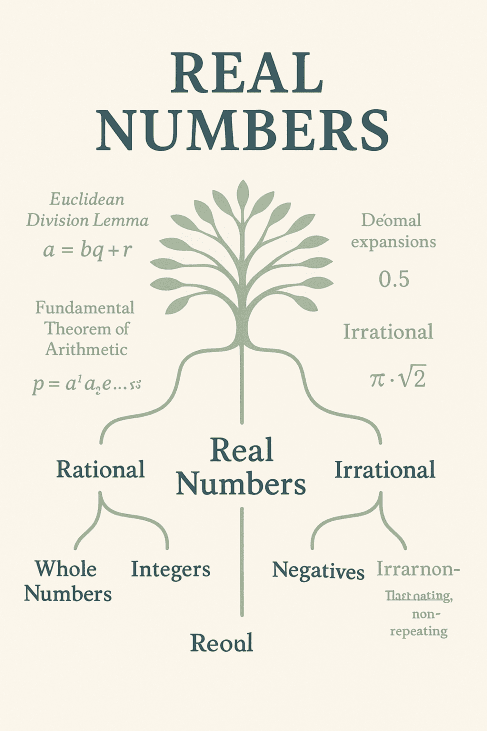
Ultimate NCERT Solutions for Class 10 –Chapter 1- Real Numbers
Updated Solution 2025-2026 Updated Solution 2025-2026
NCERT Solutions for Class 10 (Mathematics) Chapter 1- Real Numbers
(Exercises, Question/Answers & Solutions)
Chapter 1: Real Numbers
EXERCISE 1.1
1. Express each number as a product of its prime factors:
(i) 140 (ii) 156 (iii) 3825 (iv) 5005 (v) 7429
Solution 1:
(i) 140:
Step 1: Check smallest prime factor.
140 ÷ 2 = 70
70 ÷ 2 = 35
Step 2: 35 is not divisible by 2, try 3 (no), try 5 → 35 ÷ 5 = 7
Step 3: 7 is a prime number.
So:
140 = 2 × 70
= 2 × 2 × 35
= 2 × 2 × 5 × 7
140 = 2² × 5 × 7
(ii) 156
Step 1:
156 ÷ 2 = 78
78 ÷ 2 = 39
Step 2: 39 ÷ 3 = 13
Step 3: 13 is prime.
So:
156 = 2 × 78
= 2 × 2 × 39
= 2 × 2 × 3 × 13
156 = 2² × 3 × 13
(iii) 3825
Step 1: Check divisibility:
Last digit is 5, so divisible by 5:
3825 ÷ 5 = 765
Step 2: 765 ends with 5 → divisible by 5:
765 ÷ 5 = 153
Step 3: 153 → sum of digits = 1 + 5 + 3 = 9 → divisible by 3:
153 ÷ 3 = 51
Step 4: 51 ÷ 3 = 17
Step 5: 17 is prime.
So:
3825 = 5 × 765
= 5 × 5 × 153
= 5 × 5 × 3 × 51
= 5 × 5 × 3 × 3 × 17
3825 = 3² × 5² × 17
(iv) 5005
Step 1: Check divisibility by 5 (ends with 5):
5005 ÷ 5 = 1001
Step 2: 1001 — check divisibility by 7 (since 7 × 143 = 1001, yes):
1001 ÷ 7 = 143
Step 3: 143 = 11 × 13
So:
5005 = 5 × 1001
= 5 × 7 × 143
= 5 × 7 × 11 × 13
5005 = 5 × 7 × 11 × 13
(v) 7429
Step 1: Check small primes: not divisible by 2, 3, 5.
Try 7: 7 × 1061 = 7427 (remainder 2) → no.
Try 11: 11 × 675 = 7425 (remainder 4) → no.
But we can try 17 (since sometimes in NCERT, 7429 = 17 × 19 × 23 possibly):
Let’s test 17:
17 × 437 = 7429 exactly (since 17 × 400 = 6800, 17 × 37 = 629, total 7429).
So, 7429 ÷ 17 = 437.
Step 2: 437 ÷ 19 = 23 (since 19 × 23 = 437).
Step 3: 23 is prime.
Thus:
7429 = 17 × 437
= 17 × 19 × 23
∴ 7429 = 17 × 19 × 23
2. Find the LCM and HCF of the following pairs of integers and verify that LCM × HCF = product of the two numbers.
(i) 26 and 91 (ii) 510 and 92 (iii) 336 and 54
Solution 2:
(i) 26 and 91
Step 1: Prime factorization
26 = 2 × 13 91 = 7 × 13
Step 2: HCF = common factor(s) = 13
Step 3: LCM = product of highest powers of all prime factors:
LCM = 2 × 7 × 13 = 182
Step 4: Verification
HCF × LCM = 13 × 182 = 2366
26 × 91 = 2366
Equal.
HCF = 13, LCM = 182
(ii) 510 and 92
Step 1: Prime factorization
510 = 2 × 3 × 5 × 17
92 = 2² × 23
Step 2: HCF = common factor(s) = 2 (only prime 2 in common, lowest power 2¹)
Step 3: LCM =
2² × 3 × 5 × 17 × 23
= 4 × 3 × 5 × 17 × 23
= 4 × 3 × 5 = 60 (then 60 × 17 = 1020, 1020 × 23 = 23460)
LCM = 23460
Step 4: Verification
HCF × LCM = 2 × 23460 = 46920
510 × 92 = 46920
Equal.
HCF=2, LCM=23460
(iii) 336 and 54
Step 1: Prime factorization
336 = 2⁴ × 3 × 7
54 = 2 × 3³
Step 2: HCF = common primes 2 and 3, lowest power:
2¹ × 3¹ = 6
Step 3: LCM = highest powers:
2⁴ × 3³ × 7 = 16 × 27 × 7
16 × 27 = 432, 432 × 7 = 3024
LCM = 3024
Step 4: Verification
HCF × LCM = 6 × 3024 = 18144
336 × 54 = 18144
Equal.
(HCF = 6, LCM = 3024)
3. Find the LCM and HCF of the following integers by applying the prime factorisation method.
(i) 12, 15 and 21 (ii) 17, 23 and 29 (iii) 8, 9 and 25
Solution 3:
(i) 12, 15 and 21
Step 1: Prime factorisation
12 = 2² × 3
15 = 3 × 5
21 = 3 × 7
Step 2: HCF
Common prime = 3 (lowest power 3¹)
HCF = 3
Step 3: LCM
Take highest powers: 2², 3¹, 5¹, 7¹
LCM = 2² × 3 × 5 × 7
= 4 × 3 × 5 × 7
4 × 3 = 12, 12 × 5 = 60, 60 × 7 = 420
LCM = 420
(HCF = 3, LCM = 420)
(ii) 17, 23 and 29
Step 1: Prime factorisation
17 = 17
23 = 23
29 = 29
Step 2: HCF
No common prime ⇒
HCF = 1
Step 3: LCM
All are distinct primes:
LCM = 17 × 23 × 29
First: 17 × 23 = 391
Then 391 × 29 = 11339
LCM = 11339
(HCF = 1, LCM = 11339)
(iii) 8, 9 and 25
Step 1: Prime factorisation
8 = 2³
9 = 3²
25 = 5²
Step 2: HCF
No common primes ⇒
HCF = 1
Step 3: LCM
Highest powers: 2³, 3², 5²
LCM = 2³ × 3² × 5²
= 8 × 9 × 25
8 × 9 = 72, 72 × 25 = 1800
LCM = 1800
(HCF = 1, LCM = 1800)
4. Given that HCF (306, 657) = 9, find LCM (306, 657).
Solution 4: Given that HCF (306, 657) = 9, find LCM (306, 657)
We use the formula:
HCF(a, b) × LCM(a, b) = a × b
Given:
a = 306, b = 657, HCF = 9
9 × LCM = 306 × 657
First, compute 306 × 657:
306 × 657 = 306 × (600+57) = 306 × 600 + 306 × 57
306 × 600 = 183,600
306 × 57 = 306 × (50+7) = 15300 + 2142 = 17442
Sum:
183600 + 17442 = 201,042
So:
9 × LCM = 201,042
LCM = 201042 / 9 = 22338
5. Check whether 6n can end with the digit 0 for any natural number n.
Solution 5:
Check whether 6ⁿ can end with the digit 0 for any natural number n
A number ends with digit 0 if it is divisible by both 2 and 5 (i.e., divisible by 10).
6ⁿ = (2 × 3)ⁿ = 2ⁿ × 3ⁿ
Prime factorization of 6ⁿ contains only primes 2 and 3, no factor of 5.
Therefore 6ⁿ is never divisible by 5, so it can never end with digit 0.
(“No”)
6. Explain why 7 × 11 × 13 + 13 and 7 × 6 × 5 × 4 × 3 × 2 × 1 + 5 are composite numbers.
Solution 6: (i) 7 × 11 × 13 + 13
Take 13 common:
13 × (7×11 + 1) = 13 × (77 + 1) = 13 × 78
Since it is a product of two integers greater than 1 (13 and 78), it has factors other than 1 and itself
⇒ Composite.
(ii) 7 × 6 × 5 × 4 × 3 × 2 × 1 + 5
That’s 7! + 5.
Take 5 common:
5 × (7!/5 + 1) = 5 × ( 7 × 6 × 4 × 3 × 2 × 1 + 1)
7!/5 = 1008
So:
5 × (1008 + 1) = 5 × 1009
Since 1009 > 1 and 5 > 1, product of two integers > 1 ⇒ Composite.
= (“Both are composite”)
7. There is a circular path around a sports field. Sonia takes 18 minutes to drive one round of the field, while Ravi takes 12 minutes for the same. Suppose they both start at the
Solution 7: Circular path problem
Sonia → 18 minutes per round
Ravi → 12 minutes per round
Start together at the same point and time.
They meet again at starting point at LCM of their times.
LCM (18, 12)
18 = 2 × 3²
12 = 2² × 3
LCM: 2² × 3² = 4 × 9 = 36 minutes.
Interpretation: They will meet again at starting point after 36 minutes.
=(36 minutes)
If you meant to write the whole problem and it was cut off, the answer to the usual “when will they meet at start” is 36 minutes.
EXERCISE 1.2
1. Prove that √5 is irrational.
Sol:
Step 1: Assume the opposite
Assume that √5 is rational.
Then we can write it in the form: √5 = a / b
where a and b are coprime integers (i.e., HCF(a, b) = 1) and b ≠ 0.
Step 2: Square both sides
5 = a² / b²
a² = 5b²
This means a² is divisible by 5.
Step 3: Apply Euclid’s Lemma
If a prime p divides a², then p divides a.
Since 5 is prime and 5 ∣ a², we conclude 5 ∣ a.
Let a = 5k for some integer k.
Step 4: Substitute back
(5k)² = 5b²
25k² = 5b²
5k² = b²
This means b² is divisible by 5, so again 5 | b (since 5 is prime).
Step 5: Contradiction
We found 5 ∣ a and 5 ∣ b, so a and b have a common factor 5.
But initially we assumed a and b are coprime.
This is a contradiction.
Hence, our assumption that √5 is rational is false.
=√5 is irrational.
2. We want to prove that 3+2√5 is irrational.
Solution 2:
Step 1: Assume the opposite
Assume that 3+2√5 is rational.
Let:
3 + 2√5 = r
where rr is a rational number.
Step 2: Rearrange the equation
2√5 = r − 3
√5 = r−3 / 2
Step 3: Analyze the result
Since r is rational, r−3 is rational, and dividing by 2 keeps it rational.
So the equation √5 = r − 3 / 2 means √5 is rational (because the right-hand side is rational).
Step 4: Contradiction
We know √5 is irrational (proved earlier).
This is a contradiction.
Therefore, our assumption that 3+ 2√5 is rational must be false.
Hence, 3+ 2√5 is irrational.
3. Prove that the following are irrationals:
(i) 1/√2
Solution (i): Step 1: Assume the opposite
Assume 1/√2 is rational.
So, we can write:
1/√2 = a/b
where a and b are integers, coprime (i.e., HCF ( a , b ) = 1 ), and b ≠ 0.
Step 2: Rearrange:
1/√2 = a/b
√2 = b/a
Step 3: Analyze
Since a and b are integers, b / a is a rational number.
Thus, √2 would be rational.
Step 4: Contradiction
We know √2 is irrational (standard proof via contradiction).
This contradicts the assumption.
Therefore, 1 / √2 cannot be rational.
(1/ √2 is rational)
(ii). 7√5
Solution (ii). Step 1: Assume the opposite
Assume 7√5 is rational.
That means:
7√5 = a / b
where a and b are coprime integers, b ≠ 0.
Step 2: Rearrange
√5 = a / 7b
Step 3: Analyze
Since a and b are integers, a / ( 7b ) is rational.
So √5 is rational.
Step 4: Contradiction
We know √5 is irrational (proved earlier).
This is a contradiction.
Conclusion
Thus, 7√5 must be irrational.
= 7√5 is irrational
(iii) 6 + √2
Solution (iii): Step 1: Assume the opposite
Assume 6 + √2 is rational.
Then we can write:
6 + √2 = r
where r is a rational number.
Step 2: Rearrange
√2 = r – 6
Step 3: Analyze
Since r and 6 are rational, r – 6 is rational.
So √2 would be rational.
Step 4: Contradiction
We know √2 is irrational (standard proof).
This contradicts the assumption.
Conclusion:
Therefore, 6+√2 is irrational.